
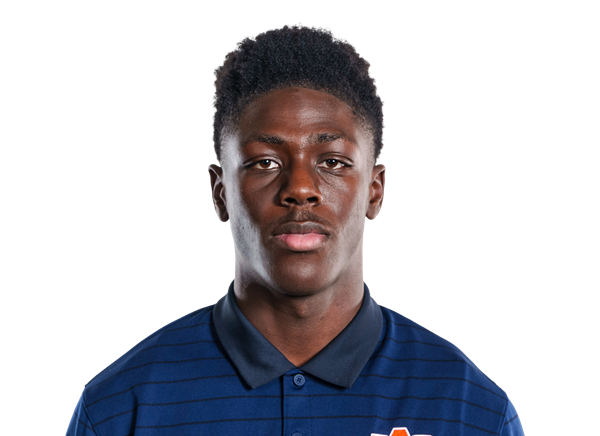
Wayne Henry
 Auburn
Freshman
Auburn
Freshman
Bio
Recruiting
Scouting Report
Wayne Henry is a 3-star Safety from Baltimore, MD (St. Frances Academy) in the 2026 class. Ranked No. 1523 nationally, No. 137 at S, No. 37 in MD. Composite rating: 0.8611. Committed to Auburn University since August 4, 2024.
Physical Profile
Listed at 5-10, 175 lbs. Taller than 4% and heavier than 13% of 2026 Safety prospects in the SEC Scouts database (200 with a listed size).
Play Style
A downhill, instinctive defensive back who plays faster than his size. He is at his best in zone, with his eyes on the quarterback, breaking on throws in front of him and rallying to the ball carrier. The IMG pick-six shows the pattern: he jumps a route, has the ball skills to finish the catch, and has the vision to score. Against the run he fills alleys aggressively, and he takes on contact more willingly than his size suggests. Wrapping up rather than launching at ball carriers keeps his missed-tackle rate low. Schematically he is a nickel, star or overhang player more than a single-high safety.
Strengths
- Tackling: Standish described him as 'a sure-tackler who can close space and wrap up top-tier athletes.' Wrapping up in the open field makes him playable on special teams right away, and that is how a sub-200-pound defensive back earns trust early.
- Processing and instincts: he reads plays quickly and triggers downhill without wasted steps. On film he gets to the ball because he anticipates, not because he outruns people, and that projects well to the nickel, where reads happen in fractions of a second.
- Ball production against elite competition: Auburn's bio credits him with 60 tackles, 2 INTs, 5 PBUs and 1 FF for a St. Frances team ranked No. 1 nationally. His signature play was a 79-yard fourth-quarter pick-six that sealed a 30-3 win over IMG Academy, one of the most talent-dense high school rosters in the country.
- Polished background: he was a Polynesian Bowl selection and was coached at St. Frances under Messay Hailemariam, where he practiced daily against Division I talent. He has already been through the kind of coaching and competition that usually separates a polished three-star from a raw one.
Areas to Improve
- Play strength and mass: at 175 he will get engulfed by SEC slot receivers who block well, and by pulling linemen when he fills against the run. He needs a full year in the strength program to set the edge as a nickel without giving up leverage.
- Proving his top-end speed: no verified track or testing times exist, so his recovery speed in deep coverage is an open question. If he lacks long speed, his role narrows to nickel and underneath zone rather than a true deep safety.
- Man coverage against SEC slots: his evaluation is built on zone instincts and tackling. Matching quick, sudden slot receivers man-to-man for a full game is the skill that decides whether he becomes a starter or stays a rotational and special-teams player.
College Projection
Year 1 (2026): special teams contributor (coverage units) plus reserve reps at nickel or safety, with redshirt eligibility protected through the 4-game rule if the depth chart allows. Year 2: physically ready to compete for sub-package nickel snaps once he gets into the 180s. Years 3-4: a realistic ceiling as a starting nickel or rotational safety, and a realistic floor as a dependable special-teams captain and sub-package defensive back. Coming from St. Frances, Kelly's direct recruitment and the established Baltimore-to-Auburn pipeline (Blake Woodby, Bryce Deas, Darion Smith) should ease his transition.
Best Fit
A defense that uses a true nickel or star position and plays a lot of quarters or split-field zone, where pre-snap disguise and reading the quarterback matter more than size or man-to-man coverage on the outside. Auburn under Charles Kelly fits well. Programs that need a 6-1, 200-pound box safety or press-man nickel corners would undersell his tools.
Current Team
Auburn University