
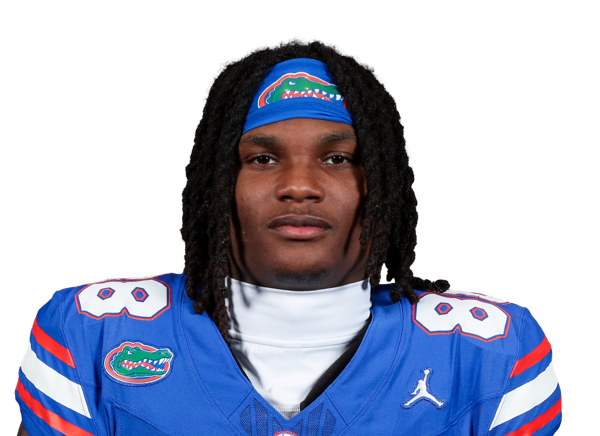
Marquez Daniel
 Florida
Freshman
Florida
Freshman
Bio
Recruiting
Scouting Report
Marquez Daniel is a 4-star Wide Receiver from Tuskegee, AL (Booker T. Washington) in the 2026 class. Ranked No. 402 nationally, No. 53 at WR, No. 18 in AL. Composite rating: 0.8967. Committed to University of Florida since June 13, 2025.
Physical Profile
Listed at 6-5, 219 lbs. Taller than 96% and heavier than 98% of 2026 Wide Receiver prospects in the SEC Scouts database (329 with a listed size).
Play Style
A boundary, catch-point receiver. He plays like a rebounder: he tracks the ball late, uses his body to shield defenders, and wins with timing and hands above the rim, not with pure speed. He is most dangerous on back-shoulder throws, fades, seam balls against smaller defenders, and red-zone isolations. His 19.3 yards per catch shows he can build to speed and finish plays after the catch. His experience at safety and quarterback shows up in his sense of leverage and spacing, but his routes are still loose by SEC standards.
Strengths
- Contested-catch ability: 247's Andrew Ivins called him a 'jump ball winner with a hoops background that is a mismatch for most defenders with his size, balance and hands.' He can box out and high-point over smaller corners, which makes him a natural red-zone target.
- Big-play production for his size: a career line of 82 catches for 1,579 yards (19.3 yards per catch), including 38-757-12 TD as a junior. He creates yards down the field and after the catch, not only on 50/50 balls.
- Versatility and football IQ: he played WR, free safety and even QB as a senior, and added 11 tackles, 2 PBUs, 2 forced fumbles and a kickoff return touchdown. That shows he understands coverage from the other side and is a real athlete, not just a tall pass-catcher.
- Physical development: he went from about 195 to a listed 219 by his first fall, which is critical for surviving press coverage against SEC corners.
Areas to Improve
- Route detail and separation: his high school production came mostly from size mismatches. Outside WRs coach Marcus Davis said in preseason, 'He's got some ways to go.' Sinking his hips at the top of routes, releasing against press, and running a full route tree beyond go, fade and comeback are the main development needs.
- Play strength at the catch point and as a blocker against college DBs, plus staying healthy. He needs to carry the new weight without losing the body control that makes him effective, and avoid the soft-tissue problems that limited him in camp.
College Projection
A redshirt year in 2026 is the realistic path. Florida's WR room is crowded (Vernell Brown III, Dallas Wilson, Eric Singleton Jr., Micah Mays Jr., Bailey Stockton, Jaylen Lloyd and others). He had no catches in the 2-0 start against FAU and Campbell, and he ranked behind fellow freshmen Justin Williams and Duke Clark in early usage. He could get spot red-zone snaps, but the four-game redshirt limit fits his development timeline. He projects as a rotational X receiver as a redshirt freshman in 2027 and a starting boundary receiver in 2028 if his route running catches up to his frame.
NFL Outlook
A Day 3 draft profile with upside if things break right. Height, length and ball skills like his always get NFL evaluation, and big-slot and X receivers with basketball backgrounds are a proven archetype. Whether he goes higher depends on two things: a verified 40 time (he will likely need to run 4.5 or faster at around 220), and consistent separation against SEC press coverage. If he becomes a reliable 40- to 50-catch red-zone starter by 2028, he enters the mid-round conversation. If he stays a situational jump-ball target, he is a late-round or priority free agent developmental prospect.
Best Fit
A pro-style or RPO-heavy offense that isolates a big X on the boundary against single coverage and throws the ball up for him: back-shoulder throws, fades, and red-zone isolation routes. Florida under Jon Sumrall and first-year OC Buster Faulkner fits well if they are patient with his development. His skills are wasted in a quick-game, horizontal system that asks receivers to separate with short-area quickness.
Current Team
University of Florida