
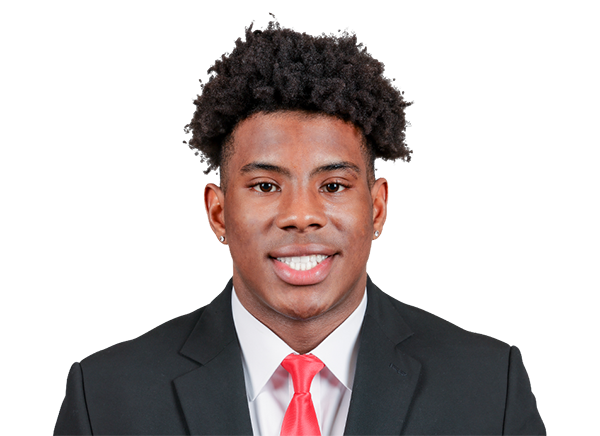
Justin Williams
 Georgia
Junior
Georgia
Junior
Bio
Recruiting
Scouting Report
Justin Williams is a 4-star Athlete from Conroe, TX (Buchholz) in the 2026 class. Ranked No. 166 nationally, No. 23 at ATH, No. 17 in FL. Composite rating: 0.9331. Committed to University of Florida since June 7, 2025.
Physical Profile
Listed at 6-2, 225 lbs. Taller than 69% and heavier than 91% of 2026 Athlete prospects in the SEC Scouts database (150 with a listed size).
Play Style
He is a movable, touch-first offensive weapon. On film he shows up in the backfield as a downhill runner with good tempo and lateral burst, and out wide or in the slot on quick game, bubbles, jet sweeps and shallow crossers. He is at his best with the ball in his hands in space. He sets up defenders with quick feet, gets north quickly, and runs through tacklers instead of around them. As a receiver he catches cleanly away from his frame and secures the ball quickly through contact. He tracks deep balls competently but is not a pure vertical stretcher. His approach looks more like a running back's than a receiver's, and Florida's staff has compared his intended usage to Eugene Wilson III and Vernell Brown III: motioned around the formation to create mismatches.
Strengths
- Historic dual-threat production. In 2024 he had 108 carries for 1,023 yards and 16 TDs plus 85 catches for 1,473 yards and 13 TDs. He added 67-1,117-12 receiving and 91-547-9 rushing as a senior, for about 3,800 all-purpose yards and 47 TDs over the two seasons before his senior year, and he set a school record with 7 TDs in one game.
- Run-after-catch ability as a running back in a receiver's role. He breaks arm tackles, keeps his feet through contact, and turns short throws into chunk gains, which fits screens, jet motion and option routes from the slot.
- Natural hands in traffic. Ivins specifically noted receiving skills in crowded windows, and 16.7 yards per catch as a senior shows he is more than a gadget touch player.
- Competitiveness and toughness. Scouts consistently say he 'maximizes opportunities.' He was the centerpiece of back-to-back Buchholz state semifinal runs, which should earn him early special-teams and situational snaps.
Areas to Improve
- Route detail at the position. Much of his production came from manufactured touches and backfield work, so he needs to sharpen the stems, breaks and leverage reads of a slot receiver against SEC nickel corners and nickel-trained safeties.
- Long speed needs to be proven. Without verified sprint times it is unclear whether he can threaten the seam vertically, and without that defenses can sit on his underneath and horizontal routes.
- Pass protection and blocking. If Florida uses him in the backfield as his 247 projection suggests, he needs to show he can pick up blitzes. As a slot, he has to be a willing crack and stalk blocker in UF's perimeter run game.
College Projection
Florida recruited him as a slot receiver, and he enrolled for 2026 wearing #83. Expect a year-one role on special teams (kick return is a natural fit) and in packaged slot and gadget touches while he learns the route tree. A realistic timeline is rotational slot by year two and a featured hybrid weapon by years 2-3. That means 40-60 touches a season split between the slot, jet and screen game and occasional backfield work. Ivins' ceiling projection is a three-down running back with receiving value. If Florida's receiver room gets crowded, a move to running back would suit his build and is a legitimate outcome.
NFL Outlook
247Sports projects a Day 3 pick (rounds 4-7) and compares him to LeQuint Allen (Jaguars), a sturdy receiving back. His NFL path most likely runs through running-back versatility plus special teams: a third-down or change-of-pace back who can split out, with return value. Moving into Day 2 would require verified long speed and clear gains as a route runner from the slot or in pass protection.
Best Fit
A spread or RPO offense that manufactures touches through motion, jet action, screens and option routes, and is willing to use a hybrid RB/WR 'offensive weapon.' Florida fits: its staff plans to motion him around and use his do-it-all skill set, and staying local keeps a well-supported, hometown prospect in a stable development environment. Pro-style systems that would lock him into a traditional outside-receiver role would waste his best traits.
Player Comparison
Jones entered LSU at a similar size (5'11", 185 lbs) and profile as a versatile linebacker who excelled in coverage and processing complex SEC offenses. Like this prospect, Jones was a highly-rated recruit from the Southeast who projected as an instinctive, athletic linebacker capable of playing multiple roles in modern defensive schemes, eventually becoming an elite NFL coverage linebacker despite his smaller stature.
Season Stats - 2025
Defensive
General
Returning
Career History
Georgia
#19 LB - Junior
 Florida
#83 WR - Freshman
Georgia
#19 LB - Sophomore
Florida
#83 WR - Freshman
Georgia
#19 LB - Sophomore
Current Team
University of Georgia