
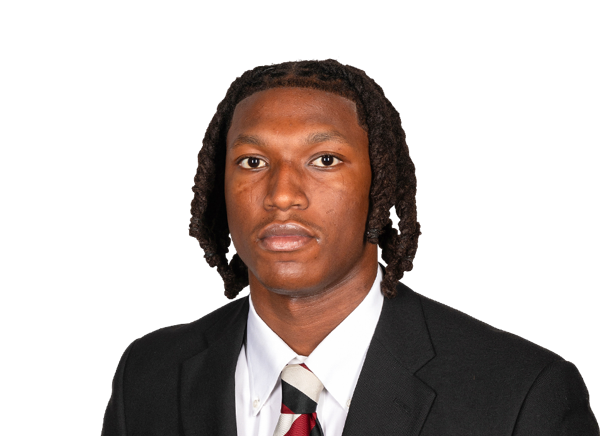
J'Zavien Currence
 South Carolina
Freshman
South Carolina
Freshman
Bio
Recruiting
Scouting Report
J'Zavien Currence is a 4-star Safety from Rock Hill, SC (South Pointe) in the 2026 class. Ranked No. 68 nationally. Composite rating: 0.9704. Committed to University of South Carolina.
Physical Profile
Listed at 6-4, 215 lbs. Taller than 97% and heavier than 99% of 2026 Safety prospects in the SEC Scouts database (200 with a listed size).
Play Style
On defense he plays physical and downhill. He is most comfortable at quarter-to-half depth, where he can read the backfield and attack. He takes efficient angles, closes quickly and tackles to punish rather than just wrap up. In zone he drifts into throwing lanes as a robber and baits quarterbacks into throws he can break on. In man coverage he relies on length to crowd bigger slot receivers and tight ends at the catch point. His quarterback film shows the open-field side of his game: he is patient as a ball carrier, cuts sharply for his size and has the long speed to finish runs, and those traits should also carry over to returning interceptions and special teams.
Strengths
- Rare size and length for a defensive back (6-4, 215): he can match up with big slot receivers and tight ends in man coverage and contest throws without needing perfect position
- Fast, controlled downhill trigger: per Ivins, he 'charges downhill in a hurry from the shelf,' takes efficient angles and arrives looking to make a hit, which makes him a real force in the run fit from depth
- Ball skills and instincts in zone: evaluators call him a 'sneaky robber' who reads routes, jumps them and creates turnovers, which fits a defense that wants to disguise rotations
- Rare versatility: he projects to safety, the nickel/star role, boundary corner or eventually a hybrid linebacker, giving a defensive coordinator several ways to use one player
- Proven competitor and leader: he moved to quarterback as a senior and led South Pointe to a 14-1 record and the 2025 Class 4A state title (2,764 passing yards, 24 TD passes, 1,497 rushing yards, 18 rushing TDs), and he was a Big 22 finalist
Areas to Improve
- Defensive repetitions lost to quarterback: playing quarterback as a senior cost him a year of development in coverage technique, especially press footwork, pedal-to-drive transitions and reading receivers' hands, so his feel for coverage is still behind his tools
- Change of direction at his height: a taller defensive back with a high center of gravity can get grabby or late when he flips his hips against sudden slot receivers, so staying low and efficient out of breaks is the key technical test if he plays corner or nickel
- Keeping his speed as he adds weight: he is already up about 20 pounds, and adding more without losing range will decide whether he stays in the secondary or drifts toward linebacker
- Discipline on his aggression: his instinct to attack downhill needs eye discipline against play-action and double moves at the SEC level, where a wrong step in the deep half gives up explosive plays
College Projection
He is already on the field track at South Carolina. Defensive backs coach Torrian Gray said 'I expect him to play a lot this year,' special teams coordinator Matthew Smiley has him in special teams plans, and he is competing for a starting safety spot as a true freshman in 2026. The realistic path is a rotational safety/nickel role and core special teams duty in year one, then a full-time starter as a big hybrid safety or star in year two. His fit is the Emmanwori-type role in Clayton White's defense, moving around the formation. If his frame keeps filling out past 225, a hybrid safety/linebacker role becomes a real option by year three.
NFL Outlook
He has Day 2 draft potential with first-round upside if the tools become production. NFL teams are increasingly valuing 6-3+, 215-225 pound safeties who can cover big slot receivers and tight ends and still play in the box, and Nick Emmanwori took this exact path from South Carolina into a high draft selection. The deciding factor will be his coverage technique. If he proves he can handle man coverage against slot receivers and tight ends, rather than being only a physical box player, his size, length and ball skills make him a high-end prospect after three seasons. If his coverage stalls, he projects as a Day 3 box safety or special-teams linebacker.
Best Fit
His ideal fit is a multiple-front, pattern-matching defense that uses a big nickel or rotates its safeties heavily, where he can play the robber, cover tight ends in man and add to the run fit from different alignments. South Carolina's system under Clayton White, which developed Emmanwori in exactly this 'chess piece' role, is close to ideal. He is less suited to a single-high, pure press-man corner role, where his height would be tested every snap against small, quick receivers.
Player Comparison
Both are highly-ranked prospects from South Carolina high school programs with similar physical builds (6'3", 205 lbs) who committed early to their home-state Gamecocks. Gilmore was also a top-100 national recruit with elite athleticism and the versatility to impact games in multiple ways, developing into a shutdown cornerback with the technical fundamentals and football IQ that South Carolina's program emphasizes.
Current Team
University of South Carolina