
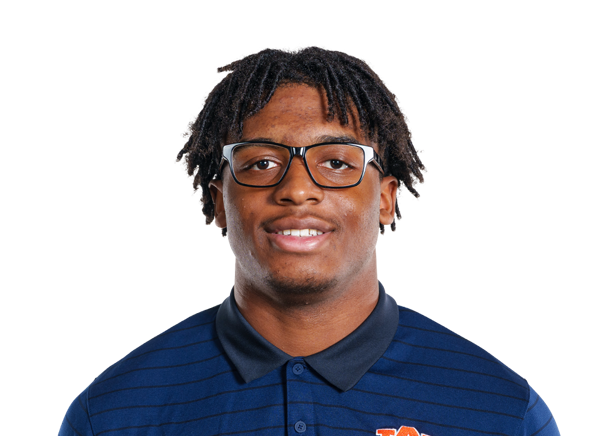

#87

DJ Broughton

TE Auburn Auburn Freshman

Bio

Height 6'5"
Weight 220 lbs
Hometown Semmes, AL
High School Mary Montgomery
Rating ⭐⭐⭐

Recruiting

⭐⭐⭐ Class of 2026
#1211 National
#47 TE
#27 State
0.8678 Rating

Scouting Report

B+
87 / 100 Ceiling 87 • Floor 75
project

Damarcus 'DJ' Broughton Jr. is a 6-foot-5 developmental tight end from Mary G. Montgomery (Semmes, AL) who became Alex Golesh's first Auburn commitment on Dec. 1, 2025, following the coach from USF within 24 hours of decommitting. He is a frame-and-traits projection rather than a finished product — a multi-sport athlete (basketball, baseball) reported to be relatively new to football, whose recruitment was driven by measurables and a summer 7-on-7 camp performance on the Plains rather than by an extensive offer sheet. His 46-catch, 751-yard, 11-touchdown career line is low-volume but high-efficiency (16.3 yards per catch, a touchdown on nearly a quarter of his receptions), which is the statistical signature of a big-bodied vertical and red-zone target, not an every-down offensive hub.

Physical Profile

The 6-5 frame is the entire evaluation's foundation and it is legitimately rare — length that plays above the rim on 50-50 balls and creates throwing windows a quarterback can miss high and still complete. He signed at roughly 220 pounds and is already listed at 240 on Auburn's roster, a ~20-pound gain since enrollment that tells you two things: he had substantial room on the frame, and the strength staff prioritized filling it immediately. That build is currently 'tall receiver who will become a tight end' rather than 'tight end.' The basketball background shows in the profile scouts describe — body control, high-point ability, hip fluidity for the height — but there is no camp testing, verified 40, or combine data publicly available to anchor a speed or explosiveness grade, and the composite rating of .8678 sits in the band where services are grading projection, not production. At 240 he is still 10-20 pounds short of the mass needed to hold up as an attached in-line Y against SEC edge defenders.

Play Style

He plays like a converted basketball wing operating out of a flex alignment: he wins vertically down the seam and in the red zone by out-sizing and out-reaching the defender at the catch point rather than by creating separation with technique. The efficiency numbers point to a target who was schemed into space and asked to go get the ball — play-action seams, back-shoulder fades, and boundary red-zone isolations — instead of being a high-volume underneath chain-mover. Public evaluations consistently use the word 'raw,' and his USF commitment came off a frame-and-flashes projection during an official visit weekend rather than off a deep body of film. Expect the tape to show real flashes of catch-point dominance interspersed with the imprecision of a player still learning the position: rounded route breaks, inconsistent release timing, and blocking effort that outpaces blocking technique.

Strengths

  • Elite catch radius and contested-catch profile for the position — 11 touchdowns on 46 career receptions (24 percent) with a 16.3-yard career average is a strike-zone-and-seam producer, not a checkdown outlet, and the 6-5 frame with a basketball player's high-point instincts is the reason why
  • Genuine multi-sport athleticism — basketball and baseball backgrounds correlate with the body control, rotational athleticism, and hand-eye tracking that translate to adjusting to off-target throws down the seam; his ASWA honorable mention All-State nod and Mississippi-Alabama All-Star selection confirm the athletic tools were visible even with limited football reps
  • Extremely low mileage with a steep improvement curve already on tape — his production nearly doubled from a 14-catch, 254-yard underclass baseline to 32-497-7 as a senior, and a player reported to be this new to organized football improving that fast suggests the learning slope is still climbing rather than flattening
  • Scheme and relationship continuity — he chose the coach twice. Golesh recruited him at USF, offered again at Auburn, and Broughton reopened and re-closed his recruitment in a single day to follow him. Buy-in this specific usually means a staff that has a concrete, pre-built developmental plan for the player

Areas to Improve

  • Blocking is the gating item for playing time, and there is no evidence he can do it yet at an SEC level. At 220-240 pounds with limited football experience, he has neither the mass, the hand technique, nor the rep count to be trusted as an attached Y on early downs. He needs to reach 250-255 pounds without losing the vertical juice, and he needs a full year of point-of-attack and combo-block fundamentals before he is a three-down candidate
  • Route craft and detail — a low-volume high school target on a run-leaning offense typically wins on size and straight-line release rather than on stems, tempo changes, and leverage manipulation. Against SEC linebackers and safeties who can match his speed, size alone stops separating. Route tree expansion, release package versus press from a wing alignment, and understanding zone-coverage sit-down points are all effectively from scratch
  • Position identity and football IQ volume — 247Sports still classifies him as a wide receiver, which is the industry telling you it does not know what he is yet. He must absorb tight end run-fits, protection IDs, and motion adjustments that his peers have been learning for four years. Mental processing speed, not physical ability, is the most likely reason he redshirts

College Projection

Redshirt year one is the overwhelmingly likely outcome, and it is the correct outcome. He early-enrolled in January 2026 and went through winter conditioning and spring practice, which is the single biggest advantage in his file — he banked an extra developmental cycle before his true freshman fall. Realistic timeline: 2026 is a scout-team and body-composition year with special teams as the ceiling; 2027 is a rotational move-tight-end role, roughly 15-25 snaps a game, deployed as a detached red-zone and play-action seam threat where his blocking limitations can be schemed around; 2028-2029 is the window for a starting job if the frame carries 255 pounds and the blocking catches up. He is not a plug-and-play SEC contributor, and his floor is real — a lot of tall, raw, late-to-football tight ends never sort out the blocking and end up as career TE3s or portal departures. But the combination of Golesh's personal investment, an early enrollment head start, and the least-refined profile in his position group means the upside case is genuinely wide.

Best Fit

Auburn under Golesh is close to the ideal landing spot, and that is not a coincidence — the fit is the reason the recruitment happened. Golesh's tempo spread deploys tight ends detached, in the slot, and as flex mismatch pieces rather than as attached three-point Y's, which lets Broughton's catch radius be the featured trait while his blocking develops on a delayed timeline. Golesh also has a tight-end coaching background and a track record of getting production from the position, so the developmental infrastructure is there. Any pro-style, 12-personnel, in-line-Y-heavy scheme would be a poor fit at this stage — it would expose his blocking before his receiving ability could pay for it. What he needs specifically: a two-year runway, an offense that will flex him into the slot and the red zone, and a strength program willing to add 20-25 pounds while protecting his movement skills.