
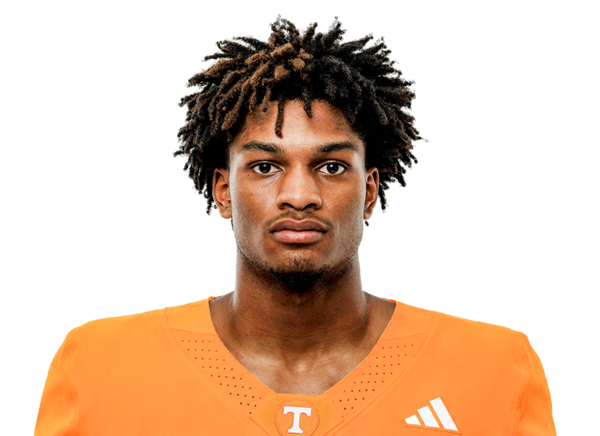
Zay Anderson
 Tennessee
Freshman
Tennessee
Freshman
Bio
Recruiting
Scouting Report
Zay Anderson is a 4-star Athlete from Greeneville, TN (Greeneville) in the 2026 class. Ranked No. 189 nationally, No. 13 at ATH, No. 2 in TN. Composite rating: 0.9252. Committed to University of Tennessee since June 27, 2025.
Physical Profile
Listed at 6-0, 175 lbs. Taller than 33% and heavier than 28% of 2026 Athlete prospects in the SEC Scouts database (150 with a listed size).
Play Style
On film he plays like a receiver on defense. He is comfortable turning and running, stays on the receiver's hip in trail position, and uses 200m speed to close separation late. When the ball is in the air he attacks it the way a receiver does instead of just breaking it up. His jumping ability makes him dangerous on 50/50 balls and in-breaking throws. Against the run he is more willing than forceful, and his tackling is more reaching and grabbing than wrapping up. He is best in off-man or bail technique, where his speed and eyes matter more than his weight. His return skills and open-field ability as a receiver also make him a natural special-teams candidate early on.
Strengths
- Verified long speed (21.59 in the 200m, 50.68 in the 400m) lets him recover on vertical routes and play trail technique without giving up the deep ball
- Ball skills of a receiver: as a junior he had 28 catches for 713 yards (25.4 per catch) and 11 TDs with 4 INTs, and as a senior he had about 1,100+ receiving yards and 18 TDs. He tracks the deep ball and finishes at the high point, where most high school corners only knock it away
- Jumping ability of a 23-4.75 long jumper and state champion shows up as closing burst and extra reach on contested balls
- Proven competitor across sports: Region 1-4A Athlete of the Year (2024), four individual state titles, track All-American, and a starting point guard on a state-tournament team
- 247Sports' Ivins (October 2025) describes him as a trail-technique ball hawk, which fits the man-heavy boundary coverage Tennessee plays
Areas to Improve
- Strength and weight: at 170-176 he has to add weight to hold up in press, get off stalk blocks and survive SEC run support. In his own words on signing day: 'good with coverage, need work on my tackling'
- Limited defensive snaps: most of his high school production came on offense, so his technique at corner (press footwork, pattern recognition, zone eyes and spacing) is less developed than his rankings suggest
- Tackling technique and willingness to take on contact in the open field and on perimeter runs
- Physicality at the catch point against bigger receivers. Speed will not make up for losing leverage early in the route at the SEC level
College Projection
He signed early and is on Tennessee's 2026 roster as a true freshman CB wearing No. 34. According to 247's freshman report, he had not played a snap through Week 4 (Kennesaw State). He sits behind Miami transfer Jaidas Richard, Tre Poteat and Timothy Merritt, so a redshirt using the four-game allowance is the most likely 2026 outcome. A realistic timeline: special teams and depth work in 2027 once he reaches about 180-185, competing for a starting outside corner job in 2028, and starting in years 3-4 if the strength gains come. He is a reasonable fallback at nickel or safety, but his length and speed fit best at boundary corner.
NFL Outlook
A mid-to-late Day 3 prospect with a higher ceiling than most players at that range. Track speed at his height is what NFL scouts look for in outside corners, and his ball skills translate. Whether he gets drafted depends on reaching about 185-190 with tackling scouts can trust, and on turning his athletic traits into consistent SEC production. Until he does, he is more of a traits-based developmental prospect than a projected draft pick.
Best Fit
A man-coverage program that is patient with development, has a strong strength-and-conditioning staff and runs a boundary-corner role built around trail technique and deep-ball recovery. Tennessee fits well: its defense plays a lot of man coverage, it can redshirt him while he adds weight, and he stays in state. He would be undervalued in a heavy Cover 2 or cloud scheme that asks corners to jam and fill against the run.
Player Comparison
Donte Jackson shares a remarkably similar physical and athletic profile to Anderson, standing at 5-foot-11 and 175 pounds with elite, verifiable track speed that was a cornerstone of his game at LSU. Like Anderson, Jackson was a multi-faceted player with experience on offense and as a dangerous return man, showcasing similar ball skills and big-play ability whenever he touched the football. Both players are described as fluid, fast athletes who excel in space and use their speed to mirror receivers and recover quickly, fitting the mold of a classic finesse/speed corner.
Current Team
University of Tennessee