
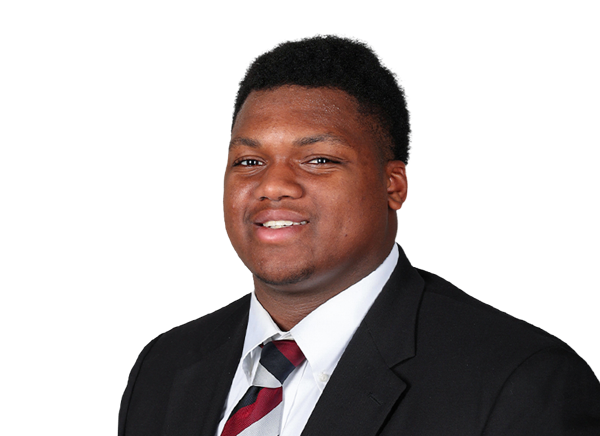
Noah Clark
 South Carolina
Freshman
South Carolina
Freshman
Bio
Recruiting
Scouting Report
Noah Clark is a 4-star Defensive Line from Durham, NC (C.E. Jordan) in the 2026 class. Ranked No. 305 nationally. Composite rating: 0.9061. Committed to University of South Carolina.
Physical Profile
Listed at 6-5, 345 lbs. Taller than 87% and heavier than 99% of 2026 Defensive Line prospects in the SEC Scouts database (227 with a listed size).
Play Style
Clark is a downhill, gap-shooting nose. He gets off on the snap count, drives his hips through a single gap and uses his mass to push the guard or center into the backfield. When he doesn't win right away, he turns his shoulders and slips off the block to get into the ball-carrier's lane instead of stalling. That is why he made so many tackles for loss for an interior player. He plays as a pusher more than a technician, which works against high school players but will need refining. His experience on the offensive line gives him a feel for blocking angles and leverage.
Strengths
- First-step quickness for his size: he wins at the snap by firing off the ball and getting into the backfield, not by leaning on blockers. That makes him a disruptive player, not just a gap-filler.
- Anchor and mass against the run: at 345 pounds he can take on double teams and keep linebackers clean. That is the main job of a nose in South Carolina's even front.
- Production in the backfield: the sources disagree on his exact numbers, but they agree he was consistently disruptive. South Carolina lists 75 tackles, 18.5 TFL, 4 sacks and 2 forced fumbles as a senior. 247Sports' senior line shows 13 TFL and 33 QB hits in nine games.
- Recognition and readiness: all-state, three-time all-conference and a Shrine Bowl invite. He also won the Newcomer of the Spring award only months after enrolling early.
Areas to Improve
- Pass-rush variety: Ivins calls him 'more of a linear penetrator.' He needs a counter move (a swim or rip off his push, or a club-and-cross) so SEC guards can't just ride his charge past the play.
- Stamina and body composition: he needs to handle a bigger snap count without his pad level rising late in drives. Trimming bad weight while keeping his anchor will decide whether he is a 20-snap rotation player or a 40-snap starter.
- Block recognition and escaping blocks: he already angles himself off blockers well once engaged. He now needs to read down blocks, reach blocks and traps faster against the quicker, more coordinated interior lines he will face in the SEC.
College Projection
Enrolling early and winning the spring award put him ahead of schedule. Expect him to play right away as a rotational nose or 3-tech on early downs and in short-yardage packages in 2026, likely 10 to 20 snaps a game in the interior rotation. His snaps should grow from there. If his conditioning improves he projects as a starter at nose by his redshirt freshman or sophomore season (2027), with a ceiling as a multi-year SEC starter who anchors the run defense and adds 3 to 5 sacks a year from the interior.
NFL Outlook
247Sports projects him as a Day 3 pick (rounds 4-7). That is a fair starting point for a big, powerful nose who is still refining his pass rush. His size and burst give him upside beyond that. If he develops a reliable counter move and proves he can play more snaps, he could move into Day 2 (rounds 2-3), because NFL teams pay a premium for 330-plus-pound interior linemen who can collapse the pocket as well as stop the run. If he stays mainly a run-stuffer, he would likely be a mid-to-late-round rotational nose.
Best Fit
An SEC or Power 4 even front (4-3 or 4-2-5) that plays a 1-technique nose and rewards getting upfield rather than read-and-react two-gapping. South Carolina fits that well. He can also play 0-technique in a three-down front, but his best trait is his get-off, and a strict two-gap system would waste some of it. The ideal staff has a strong strength-and-nutrition program to manage his weight and a position coach who can teach counter moves off his push.
Player Comparison
Both are massive offensive linemen at 6'4" 345+ lbs who were undervalued in high school recruiting despite strong physical tools. Fluker was a 3-star recruit who developed into an All-American at Alabama and NFL starter, showing how late-developing big men can maximize their physical gifts with proper development.
Current Team
University of South Carolina