
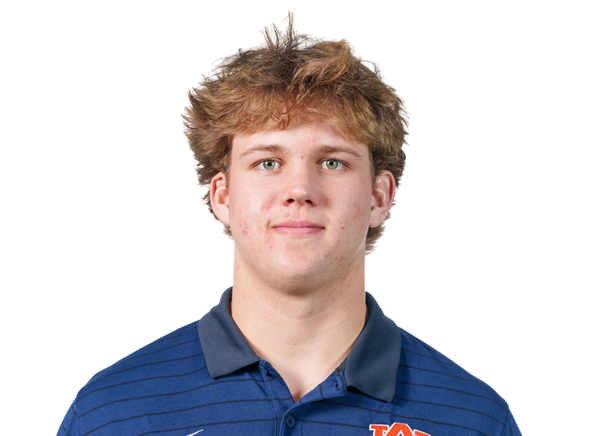

Travis Wakefield
Auburn
Freshman
Bio
Recruiting
Scouting Report
Wakefield is a specialist-only recruit who filled a specific, immediate roster need — Auburn's six-year incumbent Reed Hughes exhausted his eligibility after 2025 and signed with Saskatchewan of the CFL, leaving the snapping job open. He is a genuine split-consensus evaluation: a 3-star and the No. 3 long snapper nationally by 247Sports (0.8067 composite, No. 76 in Tennessee), but a 5-star and No. 7 nationally in Kohl's specialist-specific ratings, which are the more predictive of the two for this position. Reported measurables — a 4.67 forty at 6-2/205 and a 0.68-second average snap time — describe an athletic, technically-trained snapper rather than a body-only prospect, and he has trained under 13-year NFL veteran and 2013 Pro Bowl long snapper Matt Overton.
Physical Profile
Listed 6-2, 205 at commitment and 6-2, 215 on Auburn's current roster — roughly ten pounds of freshman mass added, which matters more at this position than it sounds. The modern long snapper is a two-job player: deliver the ball and then hold up as an interior blocker against a designed rush, and the sub-215 snappers who can't anchor get exposed by SEC front bodies on field-goal protection. The 4.67 forty is the outlier trait. For context, that is a linebacker-grade time from a specialist, and it is the trait that converts him from a snap-and-stand player into a real coverage asset — a snapper who can release and be among the first two men downfield on punt changes the math on gunner double-teams. Frame at 6-2 is well-proportioned for the position: tall enough for long arms through the snap motion, not so tall that his hips sit high and force him to over-bend to get his hands under the ball. He projects to carry 225-235 by his junior year without losing the change-of-direction quality that makes the coverage piece real.
Play Style
The available profile describes a rhythm-and-repetition snapper rather than a raw-arm prospect — the pairing of a strong snap time with high scored-snap accuracy is the signature of trained, repeatable mechanics rather than arm strength papering over inconsistent hand placement. The tight end and outside linebacker snaps are the tell on how he plays after the ball leaves his hands: he is a snapper with a football player's second phase, comfortable releasing, running, and finishing a tackle instead of drifting downfield as an eleventh body. Note the honest limit here — no game-film breakdown, senior-season snap chart, or graded evaluation from 247Sports, Rivals, or ESPN is publicly available on him, and Lipscomb Academy's 3-8 2024 season means his tape comes with limited high-leverage postseason volume. This section is inference from measurables, camp charting, and role, not from verified film study.
Strengths
- Snap velocity and consistency: a reported 0.68-second average on the long snap sits inside the range SEC coordinators want (roughly 0.65-0.70 to the punter's hands at 15 yards), and it is the number that lets a punt operation stay under 2.0 seconds ball-to-foot without the punter rushing his drop.
- Accuracy under camp charting: reportedly hit on 10 of 12 scored snaps in Kohl's competition scoring. The value there is not the raw count but the repeatability — target-scored snaps are graded on laces and location, and a snapper who can put the ball on the hold spot in a competition setting is one who protects a holder from having to reposition before the plant foot lands.
- Two-way athleticism and coverage upside: a 4.67 forty plus real snaps at tight end and outside linebacker for Lipscomb Academy means he has played in space, tackled in space, and taken live contact — not a background you find in most snapper-only recruits. That is the separator between a snapper who executes and a snapper who is a fifth cover man.
- Positional coaching pedigree and program-tested résumé: training under Matt Overton (13 NFL seasons, 2013 Pro Bowl) means his mechanics have been built by someone who snapped at the level Wakefield is aiming at, and he arrives with All-American and All-State selections, a 2022 TSSAA state title, and the Mr. Lipscomb Academy award — a durability and reliability signal across four varsity seasons.
Areas to Improve
- Protection strength against SEC interior rushers: the field-goal snap leaves him blind and stationary at the moment of contact, and the transition from snap to anchor is where freshman snappers lose ground. At 215 he can be walked back by a 300-pound A-gap push; the immediate offseason priority is lower-body and grip strength so the anchor arrives at the same instant the ball does, not a beat late.
- Speed-to-accuracy stability under live rush: camp snap times are recorded without a rush and without weather. The number that matters is whether 0.68 holds at the same location when there is contact 0.4 seconds after release, in a hostile road stadium, off a wet ball. This is not a flaw — it is the untested variable in every specialist evaluation, and it is the entire content of his first fall camp.
- Situational snap variance: the punt snap and the PAT/field-goal snap are different mechanics (15 yards versus 7-8, laces-out requirement on the hold), and freshmen frequently arrive strong at one and merely adequate at the other. Public reporting does not distinguish his charting between the two, which is a real gap in the evaluation.
College Projection
Realistic path to starting as a true freshman in 2026, which is the entire reason he was recruited. Auburn signed him into an open job: Hughes was the full-time starter in 2024 and 2025 and is gone to the CFL, so the competition is against walk-ons and whatever the staff developed behind Hughes rather than against an entrenched scholarship veteran. Expect the standard specialist arc — win or split the job in fall camp, handle PAT/field-goal snaps first if the staff wants to stage him, then take the full operation. Long snappers who arrive technically trained rarely need a redshirt, and burning one on a player at a position with no depth would be self-defeating. Four-year starter is the reasonable expectation, with the ceiling being an SEC all-conference specialist nod by his junior or senior year if the snap times hold under live rush.
Best Fit
Auburn is a clean fit and this is not a case where the commitment needs second-guessing. He needs exactly what he found: a program with an open snapping job the year he arrives, an SEC strength program to add the 15-20 pounds of anchor mass, and a special teams staff willing to use a fast snapper as a coverage player rather than treating the position as a single-purpose role. The scheme detail that maximizes him is a punt unit that releases the snapper — spread-punt or shield-punt looks where he is not locked into a full protection assignment and can get downfield on his forty speed. Programs that keep the snapper in as a permanent protector waste the trait that separates him from the field.