
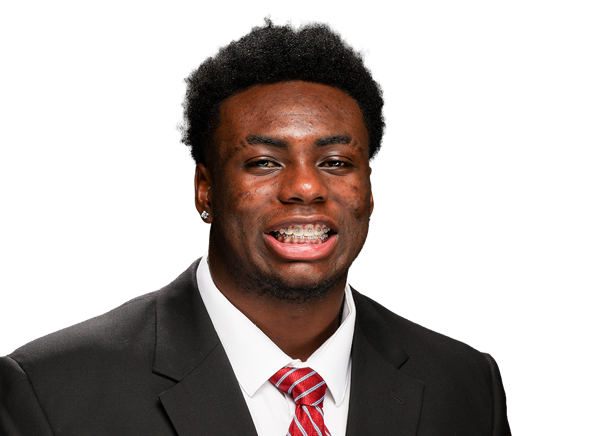
Traeshawn Brown
 Alabama
Freshman
Alabama
Freshman
Bio
Recruiting
Scouting Report
Traeshawn Brown is a 3-star Running Back from Huntsville, TX (Huntsville) in the 2026 class. Ranked No. 731 nationally, No. 53 at RB, No. 99 in TX. Composite rating: 0.8800. Committed to University of Alabama since December 3, 2025.
Physical Profile
Listed at 5-10, 206 lbs. Taller than 30% and heavier than 83% of 2026 Running Back prospects in the SEC Scouts database (138 with a listed size).
Play Style
Brown is a one-cut, downhill zone runner. He presses the line of scrimmage, reads the blocks in front of him and plants hard into the seam. DeBoer's description of the ECU run ('hit that seam and was gone') fits the pattern: patient through the mesh point, then sudden once the lane opens. He runs behind his pads with a low center of gravity, keeps his feet through traffic and rarely takes big losses. He is trusted to pick up blitzes, and the coaches say he has made progress on adjusting at the line of scrimmage, which is mental maturity unusual for a mid-year enrollee. He is not a home-run, perimeter-stretch back. His value comes from consistent efficiency, ball security and reliability as a blocker.
Strengths
- Vision and patience: OC Ryan Grubb called his 'empty cut vision' really, really good and said he can 'see and feel that next guy.' He sets up blocks and cuts off second-level defenders instead of bouncing everything outside.
- Productive and durable in high school: 401 carries for 2,960 yards and 35 TDs over 27 games, finishing with 165 carries, 1,362 yards, 17 TDs and 8.3 YPC as a senior. His best game was 210 rushing yards on 16 carries (13.1 YPC) with 3 TDs against Nederland.
- Pass protection ahead of his size: Grubb called him 'a much better pass protector than people would think.' That is the main reason a true freshman gets on the field in an SEC offense on passing downs.
- Low pad level and contact balance: he plays with leverage, so first contact rarely puts him down, and his weight gain to about 206 lbs makes him a better between-the-tackles option.
- Already proven against Power 4 defenses: 7.0+ YPC and a TD against Florida State (Alabama Freshman of the Week), with no drop-off in his efficiency against better opponents.
Areas to Improve
- Receiving: only 2 catches for 4 yards through four games. He has drawn camp praise as a pass catcher, but he needs to prove he can run routes and win from the backfield and empty sets to become a true three-down back.
- Breakaway speed: there are no verified timed numbers, and an aiming point for development is turning long runs into touchdowns consistently against SEC pursuit angles. Speed work and getting the most out of his new weight are the offseason priorities.
- Big-play volume: his 5.2 YPC is boosted by a few explosive games (15 yards on 7 carries in the opener). His next step is consistent down-to-down production, in short yardage and late in games, when defenses gear up to stop the run.
College Projection
He has already gone past the usual timeline for a late-signing 3-star. He is the No. 2 back alongside five-star classmate EJ Crowell in a rotation-heavy Alabama backfield, and he took advantage of Crowell's camp injury to earn a set role. He should project as a 10–15 touch per game committee back for 2026 and a likely 1B or co-starter from 2027 on. If his receiving develops, he can be a three-down option by his sophomore or junior year. The competition will come from incoming blue-chip backs every cycle at Alabama, but his pass protection and trustworthiness give him a stable place in the rotation.
Best Fit
An inside/outside zone or duo-based offense, like Alabama's Grubb system, that rewards vision, patience and pass protection over raw speed. His best use is as part of a two-back committee next to a bigger-play back (Crowell), where he handles early downs, short yardage and passing-down protection. A pro-style or spread offense that runs from empty and shotgun and needs a back who can stay in to block would get the most from his skill set.
Current Team
University of Alabama