
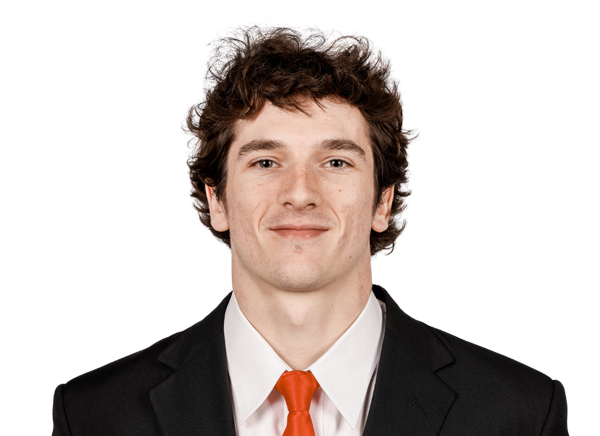
Dallas Dickerson
 Georgia
Freshman
Georgia
Freshman
Bio
Recruiting
Scouting Report
Dallas Dickerson is a 4-star Wide Receiver from Athens, GA (North Oconee) in the 2026 class. Ranked No. 469 nationally, No. 70 at WR, No. 48 in GA. Composite rating: 0.8911. Committed to University of Georgia since January 9, 2026.
Physical Profile
Listed at 6-0, 185 lbs. Taller than 26% and heavier than 55% of 2026 Wide Receiver prospects in the SEC Scouts database (329 with a listed size).
Play Style
He plays as a vertical, field-stretching outside receiver. He wins with acceleration off the line and speed that keeps building on go routes, posts, and deep overs. His senior production (213 yards on 5 catches) came almost entirely on chunk plays, and he is dangerous after the catch in space because angles that are fine against normal speed stop working against his. North Oconee used him to win one-on-one outside and force deep safety help, and that attention opened room underneath for everyone else. The things still to prove are consistency at the catch point in traffic and his work in the short-to-intermediate route tree.
Strengths
- Top-end speed verified on the track (10.36 100m), not just a hand-timed 40. He tilts safeties, and his 73-yard touchdown on his first snap back from injury against Marist shows that speed turns into big plays against good competition.
- Explosive plays per catch: as an injury-limited senior he had 5 catches for 213 yards and 3 TDs, about 42.6 yards per reception. Nearly every touch threatened a score.
- Big-game and winning-program experience. He started on North Oconee's 15-0 4A state title team in 2024 and helped a 12-1 team in 2025. North Oconee has sent several players to Georgia, including WR Landon Roldan, OLB Khamari Brooks, and DB Khalil Barnes.
- Recruited by several Power Four programs: offers from Georgia, Florida, Ole Miss, Kentucky (signed), Georgia Tech, Indiana, West Virginia, Kansas State, and Wisconsin, plus official visits to Oklahoma, Indiana, Kentucky, Georgia Tech, and Kansas State. Coaching staffs in several conferences saw a Power Four player.
Areas to Improve
- Play strength and weight. At 180-185 lbs he has to add mass to beat press at the line, stay balanced through contact at the catch point, and hold up as a perimeter blocker, which Georgia expects from every receiver.
- Route-running range and total snaps. Injuries cut his senior season to 5 games, so there is little film of him running a full route tree against structured coverage. He needs to show he can set up defenders on the intermediate in-breakers, comebacks, and option routes Georgia uses to move the chains, not just win vertically.
- Staying healthy. Missing most of his senior year leaves questions about durability that his first year of strength and conditioning should help answer.
College Projection
In 2026 he is a developmental reserve. Fall camp projections put him about sixth on the Z depth chart, with snaps likely coming in lopsided games and possibly on special-teams coverage units, where his speed helps right away. Georgia can take a redshirt under the four-game rule. A realistic timeline: weight room and scout team in 2026, rotational deep threat in 2027, and a push for a starting job as a redshirt sophomore or junior (2028-29) if he adds strength and sharpens his route tree. Georgia signed only three true receivers in the 2026 class, which helps his path to the field.
NFL Outlook
It's too early to call him a draft prospect. His speed will get NFL scouts to look: a 10.3-range sprinter at 6-1 fits the profile NFL teams test for at the combine. A draftable outcome, most likely Day 3, depends on reaching roughly 195 lbs and becoming a multi-year starter in Georgia's receiver rotation. If that doesn't happen, his most likely pro path is as a speed or special-teams depth player. For now, college production is the deciding factor, not his traits.
Best Fit
His ideal fit is a pro-style, play-action offense that uses vertical shots off the run game and has an established strength program to add weight to a lean frame. That describes Georgia almost exactly. He would also fit spread offenses that isolate a speed X receiver one-on-one on the backside, like the Kentucky, Indiana, and Kansas State offenses that recruited him. Programs that need an outside receiver who can play as a freshman right away are a worse fit than one like Georgia that can give him time to develop.
Current Team
University of Georgia