
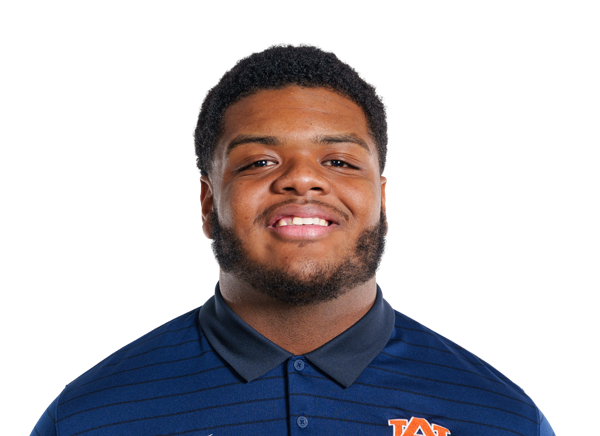
Tavian Branch
 Auburn
Freshman
Auburn
Freshman
Bio
Recruiting
Scouting Report
Tavian Branch is a 3-star Defensive Line from Taylor, PA (Riverside) in the 2026 class. Ranked No. 554 nationally, No. 43 at DL, No. 10 in PA. Composite rating: 0.8867. Committed to Auburn University since December 2, 2025.
Physical Profile
Listed at 6-4, 320 lbs. Taller than 67% and heavier than 91% of 2026 Defensive Line prospects in the SEC Scouts database (227 with a listed size).
Play Style
Branch is an attacking, upfield interior lineman. He uses his first step and active hands to get into gaps and blow up plays behind the line, which is reflected in his tackle-for-loss numbers (27 TFL among 61 total tackles). His defining trait on film is effort: he keeps working after first contact and chases ball carriers across the field, so a lot of his production comes from pursuit as well as winning at the snap. He is most at home shaded on a guard as a 3-tech, where he can rush one gap. He has also lined up wider as a 5-tech, which projects to a 4i or end in a 3-4 look.
Strengths
- Backfield disruption: 27 tackles for loss and 11.5 sacks as a senior is elite output for an interior lineman, and shows he wins quickly instead of just holding blocks
- Pass-rush tools for a 300-pounder: evaluators note active hands and enough athleticism to win as a rusher, which is rare at his size and his most valuable trait for the SEC
- Motor and pursuit: his effort chasing plays down the line and from behind stands out on film, which raises his floor and helps him get on the field early on special teams and in rotation
- Versatility and readiness: he has played 3-tech and 5-tech, and was a two-time All-State captain, so he arrives with leadership and a frame built to play early
Areas to Improve
- Competition level: his production came against Pennsylvania small-school competition, so his hand usage, pad level and anchor have to hold up against SEC guards who are as big and strong as he is. Double-team takeaway will be his first big test
- Run-defense technique and pad level: players who win on quickness and hustle in high school often play high. He needs to learn to stack and shed, hold his gap in the run game and play with leverage on early downs before he becomes an every-down player
- Refining his rush plan: his active hands need to turn into a counter-based approach (a go-to move plus a counter) and better rush-lane discipline instead of relying mostly on effort and athleticism
College Projection
A redshirt or limited 2026 is the realistic path. He could see special teams or rotation snaps in mop-up time and use the four-game redshirt allowance, but SEC interior line play usually needs a year of strength and technique work. He should become a rotational interior lineman in 2027, with a realistic ceiling as a multi-year starter at 3-tech by 2028 if his pass-rush production carries over. His relationship with Auburn defensive line coach Vontrell King-Williams, who was his primary recruiter and stayed on staff, gives him developmental continuity. A ranking around #544 undersells a player with this production, and his offer list backs that up: roughly 20 Power 4 schools, including Alabama, Notre Dame, Florida, Oklahoma, Penn State and Wisconsin.
Best Fit
An attacking, one-gap 4-3 or multiple front that lets him play 3-tech and rush upfield instead of two-gapping and reading. Auburn's SEC scheme and his position coach's continuity are a good match. He also has the frame to play a 4i in an odd front on early downs. The schemes that would get the least out of him are heavy two-gap, absorb-blockers 3-4 systems, where his quickness and motor would be wasted.
Current Team
Auburn University