
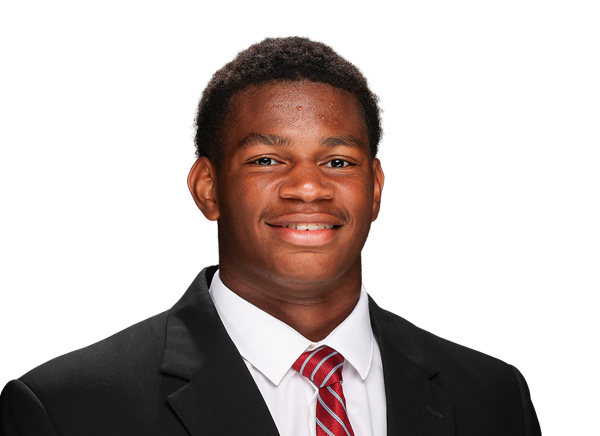
Malique' Franklin
 Alabama
Freshman
Alabama
Freshman
Bio
Recruiting
Scouting Report
Malique' Franklin is a 4-star Edge Rusher from Daphne, AL (Daphne) in the 2026 class. Ranked No. 379 nationally, No. 32 at EDGE, No. 11 in AL. Composite rating: 0.8978. Committed to University of Alabama since December 1, 2025.
Physical Profile
Listed at 6-6, 275 lbs. Taller than 93% and heavier than 99% of 2026 Edge Rusher prospects in the SEC Scouts database (169 with a listed size).
Play Style
Based on his production and his usage as a Bandit/field end: an aggressive, upfield edge who wins with first-step burst and length, keeps playing through the whistle and pursues from the back side. He gets pressure often (19 hurries on top of 11 sacks), which suggests he collapses the pocket regularly and doesn't depend on a few coverage sacks. His game is energy and athletic traits more than refined technique, which fits a player in his first year at the position. His effort on special teams (3 blocked kicks) makes him useful right away in that phase.
Strengths
- Big production in his first year on defense: 23 TFL and 11 sacks in 12 games shows he finds the backfield naturally without much technical coaching
- Length and height (6-6) give him a wide tackle radius and let him get into passing lanes; his 3 blocked kicks show the same reach and timing
- Varied background: time at OL and TE gives him a feel for blocking angles and hand fighting from the other side of the ball, which is uncommon for a first-year edge
- Straight-line burst and pursuit effort from a track background; 98 total tackles for an edge player shows he chases plays sideline to sideline rather than only rushing
Areas to Improve
- Technical rush plan: with one season at DE, his hand usage, counter moves and ability to bend tightly around the corner are still at an early stage. Right now he wins mostly on athleticism, which won't be enough against SEC offensive tackles
- Strength at the point of attack: he needs to add weight and build lower-body power to set a firm edge against the run and avoid getting washed out by down blocks and double teams
- Consistency with pad level and play recognition (reading reads, options and screens) will come only with reps, and he has had fewer of them than most signees
College Projection
A redshirt candidate in 2026. He enrolled in the summer and missed spring practice, and he needs to add weight in the strength program. His most realistic early path is special teams (field-goal block and coverage units) where his length and motor help. He projects as a rotational pass-rush specialist by 2027 and could compete for a starting Bandit/Jack role in 2028-29 if the physical development and technical coaching take hold. Because he is so new to the position, how quickly he develops will matter more than his recruiting rating.
NFL Outlook
The services disagree on his rating: On3's 91 is in the 4-star range, while 247 and the Composite have him as a 3-star. His NFL case rests on his tools, not polish. EDGE players at 6-6 with length, burst and a frame that can reach 265-275 are exactly the type NFL teams draft on traits, and his production after one year at the position suggests his ceiling is still well above where he is now. A reasonable projection is a Day 3 prospect with a Day 2 ceiling if he becomes a consistent SEC starter who produces pressure by his third or fourth year. His draft stock depends almost entirely on adding weight and building a pass-rush plan beyond simple speed.
Best Fit
A multiple or 3-4 front with a stand-up Bandit/Jack edge role, where he can rush from a wide alignment and use his length in space instead of lining up inside as a 4i or 3-technique. The best program for him is one with an elite strength-and-conditioning staff and patient development of the defensive front, so he can redshirt and add weight without being rushed onto the field. Alabama fits that description, and signing him also kept him close to home.
Current Team
University of Alabama