
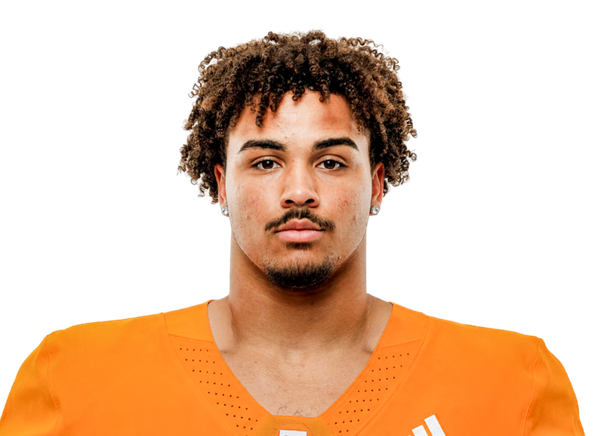
Kedric Golston II
 Tennessee
Freshman
Tennessee
Freshman
Bio
Recruiting
Scouting Report
Kedric Golston II is a 4-star Edge Rusher from Leesburg, VA (Stone Bridge) in the 2026 class. Ranked No. 469 nationally, No. 59 at EDGE, No. 6 in VA. Composite rating: 0.8911. Committed to University of Tennessee since June 26, 2025.
Physical Profile
Listed at 6-3, 243 lbs. Taller than 21% and heavier than 70% of 2026 Edge Rusher prospects in the SEC Scouts database (169 with a listed size).
Play Style
A high-motor, pursuit-driven edge who plays like the linebacker he was recruited as. His production shows up all over the field (120 tackles) rather than only in the backfield. He works to get the ball out (6 forced fumbles) and finishes plays for scores (3 defensive TDs), which suggests good awareness around the ball. At Tennessee he is being used at LEO, a stand-up rush end who also has to set the edge and occasionally drop into coverage. That fits his background better than a hand-down defensive end role would. Note that no verified public film breakdown was found, so this description comes from his production, position history and how Tennessee is using him.
Strengths
- Production across the whole stat sheet: as a senior in 2025 he had 120 tackles, 13 sacks, 6 forced fumbles, 4 fumble recoveries and 3 defensive touchdowns. For an edge player, that tackle total means he makes plays in pursuit, not just as a pass rusher.
- Ball disruption: 6 forced fumbles plus 3 scores point to a deliberate habit of attacking the ball at the quarterback and ball carrier, which carries over to the college level.
- Linebacker background: his off-ball experience gives him the drop-and-rush versatility Tennessee asks of its LEO, which is uncommon for a first-year edge player.
- Readiness and coaching: his father, Kedric Golston Sr. (Georgia, 11 NFL seasons with Washington), has been his high school head coach since 2024. His father was coached at Georgia by Rodney Garner, now Tennessee's DL coach, so the technique vocabulary lines up. Early enrollment and a spring on campus let him contribute in Week 1, mainly on special teams, and he played 14 defensive snaps with 1 tackle against Kennesaw State on 9/19/2026.
- Honors: first-team All-State and All-Met, region Defensive Player of the Year, and Virginia High School Player of the Year from the DC Touchdown Club.
Areas to Improve
- Play strength at the point of attack: at about 243 pounds he'll give up 60+ pounds to SEC offensive tackles. He needs stronger hands, better leverage when setting the edge, and more mass (target about 250) before he can stay on the field on run downs.
- A developed pass-rush plan: his high school sacks came largely from athleticism and pursuit against Virginia competition. He needs a reliable go-to move and a counter, plus better hand fighting, to win one-on-one against Power 4 tackles.
- Getting fully comfortable in a three-point stance: he is still moving from linebacker to full-time edge, so his get-off, pad level and snap anticipation with his hand in the dirt still need repetitions.
College Projection
2026 (true freshman): he's on the two-deep at LEO behind Christian Gass (sources differ on the exact order). His snaps so far have come mostly on special teams, with limited defensive work (14 snaps vs. Kennesaw State). Expect a rotational and special-teams role, and he can likely keep his redshirt by staying at 4 games or fewer if the staff chooses. 2027: a realistic step into a pass-rush rotation role once he's at about 250 pounds. 2028–29: a potential multi-year starter at LEO if his pass-rush toolkit develops. Early enrollment and his family's ties to Rodney Garner's coaching point to a faster-than-usual timeline for a high 3-star.
NFL Outlook
Day 3 or priority free-agent range for now, with room to move up. The NFL case would rest on his hybrid LEO/outside linebacker versatility and his knack for forcing turnovers, which suits a 3-4 outside linebacker. He'd need to reach about 250 pounds while keeping his speed and turn his high school production into SEC sacks by 2028. With his pedigree and how early he's on the depth chart, he's a name to track, but projecting further isn't possible yet without college rush production or verified testing.
Best Fit
Tennessee's current scheme is close to ideal: a multiple front with a dedicated LEO/stand-up edge that uses his linebacker background, coached by Rodney Garner, whose teaching his family already knows. More generally, he fits best in a 3-4 or hybrid front that asks its outside linebackers/LEOs to rush, set the edge and sometimes drop. He fits less well in a 4-3 scheme that wants 265-pound hand-down ends to two-gap.
Current Team
University of Tennessee