
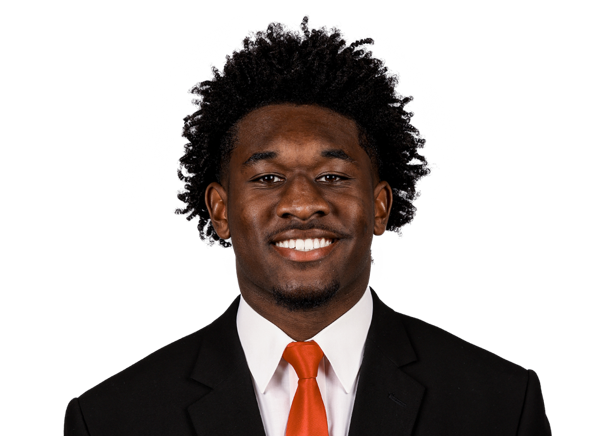
Blake Stewart
 Georgia
Freshman
Georgia
Freshman
Bio
Recruiting
Scouting Report
Blake Stewart is a 4-star Safety from Atlanta, GA (Woodward Academy) in the 2026 class. Ranked No. 311 nationally, No. 19 at S, No. 31 in GA. Composite rating: 0.9051. Committed to University of Georgia since December 2, 2025.
Physical Profile
Listed at 6-0, 190 lbs. Taller than 27% and heavier than 62% of 2026 Safety prospects in the SEC Scouts database (200 with a listed size).
Play Style
He plays like a smart, instinctive center fielder who also likes to come downhill. On film he reads run/pass quickly, takes efficient pursuit angles and arrives under control rather than overrunning plays. He tracks the ball well in the air and plays it like a receiver, which fits his production on offense, and he creates turnovers instead of just breaking passes up. He looks most comfortable in zone, where he can keep his eyes on the quarterback and break on throws. With the ball in his hands on returns he's a natural runner with vision and burst through lanes.
Strengths
- Processing speed against the run: 247's Andrew Ivins singled out how fast he diagnoses plays and triggers downhill. He made 80 tackles as a junior and 47 tackles with 4 TFL in 10 games as a senior, from the back end.
- Ball skills on both sides of the ball: 3 INTs (one pick-six), 1 forced fumble and 1 fumble recovery as a senior, plus 8 PBUs and 2 INTs as a junior. As a receiver he caught 45 passes for 549 yards and 8 TDs as a senior (38-467-3 as a junior), so his hands and tracking translate.
- Proven return specialist: he averaged 39 yards per kickoff return with a 93-yard TD as a senior, after returning both a kickoff and a punt for TDs as a junior. That gives him a realistic early special-teams role at Georgia.
- Versatility and football IQ: he can play free safety, strong safety, nickel or on special teams. His high school staff calls him 'a four-down safety in college' who 'doesn't come off the field.'
Areas to Improve
- Man coverage: 247's evaluation says he needs to get more comfortable in man-to-man. Against SEC slot receivers he has to tighten his footwork, keep his hips patient and stay in phase on vertical routes, especially since he lacks elite recovery speed.
- Play strength and size: he needs to get from about 175 to 195–200 lb to hold up as a box defender and to take on pulling linemen and tight ends without losing tackling reliability.
- Top speed: he projects to the high-10s in the 100m. Cleaner technique and track-specific work would widen his margin for error in deep-half and Cover 1 looks.
College Projection
Georgia's 2026 safety room was deep (Tyriq Green, Zech Fort, Jordan Smith and others), so expect special teams plus a redshirt or developmental year in Year 1, with kickoff/punt return and coverage units as his quickest path to the field. After a year or two in the strength program he fits as a rotational nickel/star or backup safety in Years 2–3. 247 projects him as a potential multi-year Power 4 starter, which points to a starting chance around Year 3–4 if the man-coverage work and weight gain come together.
NFL Outlook
Day 3 / priority free-agent range for now. NFL teams will like his instincts, ball production, return value and versatility, but he needs to prove he can match up in man coverage and add about 20 lb without losing movement. If he becomes a multi-year starter at Georgia and keeps a return role, a mid-round grade as a safety/nickel who contributes on special teams is realistic.
Best Fit
A pattern-matching, split-safety defense that rewards reading the quarterback and communication, like Georgia's quarters and Cover 6 package, where he can play deep-half or robber with his eyes in the backfield. A deep safety rotation that lets him develop physically while contributing right away on special teams makes the most of his profile. Heavy man-coverage schemes that isolate him on slot receivers would expose his current limits.
Current Team
University of Georgia