
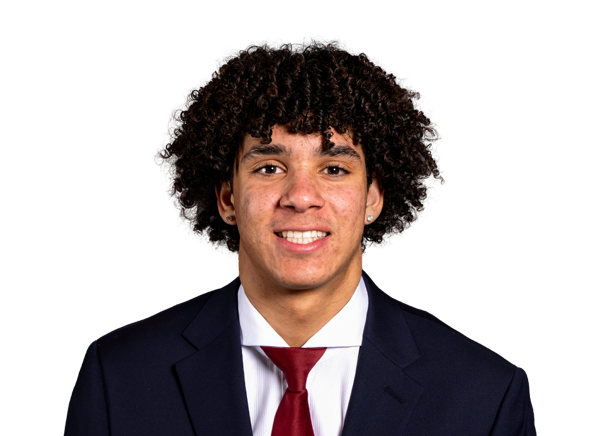

#12

Derrick Johnson

DB Oklahoma Oklahoma Freshman

Bio

Height 6'0"
Weight 170 lbs
Hometown Murrieta, CA
High School Murrieta Valley
Rating ⭐⭐⭐⭐

Recruiting

⭐⭐⭐⭐ Class of 2026
#341 National
#39 CB
#26 State
0.9021 Rating
⭐⭐⭐ Class of 2025
#1157 National
0.8639 Rating

Scouting Report

A
90 / 100 Ceiling 90 • Floor 82
year 1 contributor NFL Rd 5

Derrick Johnson II is a long, fluid perimeter cornerback from Murrieta Valley (CA) who was one of the 2026 cycle's most significant risers — an 88-rated three-star sitting around No. 604 nationally when he pledged to Oklahoma in June 2025, he closed as a 92-rated Composite prospect at No. 206 overall, No. 24 among cornerbacks and No. 20 in California. He is a legitimate two-sport athlete (11.12 100m / 22.40 200m / 51.82 400m) with NFL bloodlines, as the son of Derrick Johnson Sr., a Washington defensive back taken in the sixth round of the 2005 draft by San Francisco. The profile is high-ceiling and unfinished: the movement traits, ball production and coverage IQ are already Power Four caliber, while the frame is at least two developmental offseasons from being SEC-ready.

Physical Profile

Listed between 6-0 and 6-2 depending on source and weighed in the 170-185 range, with Oklahoma carrying him near 6-0, 170 this spring. That is the exact build type SEC staffs target on the boundary — high-cut, long-limbed, with the arm length to contest 50-50 balls against the taller X receivers he'll see in the league — but he is currently 15-25 pounds under a functional college playing weight and it is the single most limiting factor on his 2026 usage. The track numbers matter and are worth reading carefully: the 11.12 100m is very good rather than elite for the position, but the 51.82 400m is the more telling mark for a corner, indicating speed endurance and the ability to carry vertical routes deep into a rep without decelerating in the last 10 yards. Hip fluidity and change of direction are his best athletic traits — 247Sports' Andrew Ivins credited him with covering significant ground through his footwork and explosive break mechanics, which is what allows him to play off-coverage without conceding the underneath.

Play Style

He plays as a smooth, patient off-corner who wins with anticipation and closing burst rather than contact. Out of his pedal he stays low and square, reads the quarterback's shoulders, and triggers downhill with the explosive break Ivins described — that combination is what produced his interception and pass-breakup volume, because he arrives at the catch point rather than trailing to it. In man coverage his preferred technique is trail, staying on the receiver's upfield hip and playing through the hands late, which suits his length and his receiver-trained ball skills. In run support he is a wrap-up tackler more than a striker at his current weight, but he sets a firm edge and consistently plays with correct outside leverage, and the tackle-for-loss production shows he diagnoses screens and perimeter runs quickly. The two-way background is visible in his route recognition — he understands stem manipulation because he ran the routes himself.

Strengths

  • Coverage versatility across the alignment map — Ivins' evaluation specifically noted he is proficient in both zone and man, and is particularly effective in trail technique, which is a learned, rep-intensive skill that most high school corners simply do not have. Trail-man is the coverage that shows up most in his November evaluation and it means he can be deployed in a match-quarters or Cover 1 system on day one without a total technique rebuild.
  • Genuine ball production over a three-year sample, not a one-year spike — 3 INTs and 8 PBUs as a sophomore, a 91-yard pick-six among his junior-year takeaways, and 2 INTs plus 3 PBUs in only six senior games. Ball skills also transfer from his offensive work (39 catches for 585 yards and 5 TDs as a sophomore, 17 for 301 and 5 as a junior); he plays the ball at the catch point like a receiver rather than playing the man's hands.
  • Willing, productive run support for a light corner — 47 tackles with 7 tackles for loss and 2 sacks as a junior, and 3 TFLs in a six-game senior season. Seven TFLs from a boundary corner is an outlier number and reflects both edge-setting discipline and a willingness to take on blocks, which Ivins flagged explicitly. That trait is what gets a freshman corner onto special teams and, from there, onto the field.
  • Elite coaching lineage and developmental context — his father played the same position at Washington and in the NFL. This consistently shows up in film as pre-snap awareness, leverage discipline and clean footwork out of the pedal, and it lowers the coaching burden in a way that separates him from similarly rated athletes.

Areas to Improve

  • Play weight and functional strength are the gating issue. At roughly 170 pounds on a 6-foot-plus frame he will get displaced at the line of scrimmage against SEC receivers in press and will struggle to disengage from stalk blocks by 200-pound outside receivers. Ivins was direct that he may need an adjustment period adding weight. A realistic target is 185-190 by the 2027 season without sacrificing the long speed that makes him valuable.
  • Press-man technique against physical route-runners. He is most comfortable and most productive with vision on the quarterback — trail and zone — and the film volume in true press with a two-hand jam is thin. He will need to develop a reliable kick-slide, patient hands and a plan for the release phase, because SEC offenses will attack a light corner with slants and quick game to test whether he can reroute.
  • Limited senior-season sample. Only six games of senior tape (25 tackles, 19 solo) means his final evaluation rests heavily on junior film, camp performance and projection. Coverage evaluators had less late-cycle evidence than usual, which is one reason his ranking moved so sharply — and it means less certainty in either direction than a typical No. 206 prospect.

College Projection

This is no longer a projection in the abstract: Johnson signed in December 2025, enrolled at Oklahoma and completed spring practice in 2026 under new cornerbacks coach LaMar Morgan, whose detail-oriented technique work he has publicly credited. The Sooners return Courtland Guillory and Eli Bowen as the expected starting corners in 2026, so the realistic freshman-year path is special teams plus situational and dime-package snaps, with the rotation opening in 2027. The two-year arc is the honest one — a redshirt or minimal-snap 2026 spent almost entirely in the weight room, a rotational nickel/boundary role in 2027, and a starting job in 2028. Because he is fluid enough to play inside, an accelerated path exists at nickel if his weight lags but his coverage instincts translate quickly.

NFL Outlook

Legitimate draftable ceiling. Ivins projected him as a Day 3 selection (rounds 4-7), which is an appropriate baseline for a 92-rated Composite corner — and it is a floor-and-ceiling projection that hinges almost entirely on frame development. If he adds 15-20 pounds while retaining the 400-meter speed endurance and develops a functional press game, the length-plus-fluidity-plus-ball-skills combination is a Day 2 profile, because NFL teams pay a premium for 6-foot corners who can play trail technique and finish at the catch point. If the weight never comes and he settles at 175, he projects as a slot/dime cover corner and core special-teamer — still an NFL body, but a late-round or priority free-agent outcome. The bloodline is a real tiebreaker here: second-generation defensive backs consistently outperform their measurables during pro evaluation because the technical floor is higher.

Best Fit

A match-quarters or Cover 3 zone-heavy scheme that lets him keep his eyes in the backfield and play the ball — Oklahoma's structure fits well, and Morgan's technique-first coaching is the right environment for a prospect whose instincts already outrun his strength. He is a poor schematic fit for a defense that lives in bump-and-run press-man from snap one, at least until the weight arrives; the ideal staff plays him off in year one, builds him physically, and layers press in as a change-up in year two. A program with a demonstrated cornerback development track record and enough returning depth to let him sit — which describes his current situation exactly — maximizes the outcome. The bet Oklahoma made in June 2025, before the industry caught up to him, was that the traits were worth two years of patience, and his post-commitment ranking climb from No. 604 to No. 206 suggests they were right.