
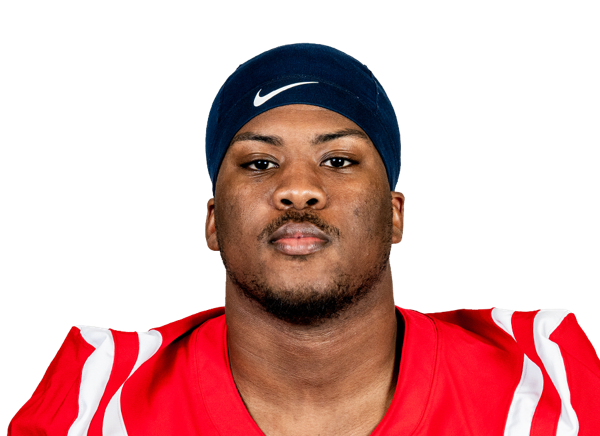
Emanuel Faulkner
 Ole Miss
Freshman
Ole Miss
Freshman
Bio
Recruiting
Scouting Report
Emanuel Faulkner is a 4-star Offensive Tackle from New Albany, MS (New Albany Bulldogs) in the 2026 class. Ranked No. 253 nationally, No. 34 at OT, No. 14 in MS. Composite rating: 89.3667. Committed to University of Mississippi since September 4, 2025.
Physical Profile
Listed at 6-6, 305 lbs. Taller than 42% and heavier than 71% of 2026 Offensive Tackle prospects in the SEC Scouts database (182 with a listed size).
Play Style
On high school film he is an athletic, movement-oriented tackle. In pass protection he relies on quick feet and the range to cut off edge rushers. In the run game he is at his best on the move, reaching, climbing and working in space, more than as a people-mover drive blocker, although his size lets him overwhelm most 4A competition. Because he also played defense, his motor and physicality are good, but his technique, especially hand usage and leverage, still depends more on athletic ability than on repeatable fundamentals. His fall-camp reports suggest he is already fixing this: he is playing faster, is more comfortable in one-on-ones, and has improved as a double-team partner.
Strengths
- Pass-protection feet: 247's evaluation singles out his flexibility and foot quickness in pass sets. That is the hardest trait to teach and the main reason he projects at tackle instead of being pushed inside.
- Proven multi-sport athleticism: a state discus title (139-5), basketball and track all back up his movement skills. Linemen with this background usually handle space and change of direction well, which helps against speed rushers and on the move in the run game.
- Positional flexibility: 247 projects him at tackle or guard, and he was a two-way lineman in high school, so a staff has more than one way to get him on the field.
- Fast developer: Ole Miss head coach Pete Golding said in 2026 fall camp that Faulkner had 'probably taken the biggest steps of anybody in that class.' Golding cited improvement in pass-rush one-on-ones and double teams and said he's 'playing faster.' Early enrollment and spring ball gave him a head start on that growth.
- Winning background: he started for a New Albany program that went 34-12 over his four years and made the 2025 Mississippi/Alabama All-Star Game roster.
Areas to Improve
- Pad level and leverage: at 6-6 he tends to play tall, and a high center of gravity can let shorter, powerful SEC interior players and bull rushers get under his pads. He needs to stay low through contact.
- Technical refinement: evaluators call him 'raw technically,' which is typical for a small-school two-way lineman. He needs cleaner hand placement and timing, a consistent set-point, and polish on combination blocks and pass-rush games.
- Play strength against SEC power: he needs to build anchor and drive strength in the college weight room before he can hold up against grown defensive linemen.
College Projection
In 2026 he is a developmental reserve for Ole Miss. He will likely redshirt, using the four-game allowance for spot or special-teams snaps, while he builds strength and refines his technique. If the fall-camp progress continues, he could compete for a two-deep tackle job, or a guard spot if the staff needs him inside, as a redshirt freshman in 2027. A realistic starting window is his second or third year on campus, with a chance to become a multi-year starting tackle. His floor is a versatile swing lineman who can back up both tackle and guard.
NFL Outlook
He has Day 2–3 upside if he develops as projected. The traits NFL evaluators look for in tackles are already there: 6-6 length, feet that hold up in pass protection, proven multi-sport athleticism and the ability to play multiple positions. 247's evaluation says he has 'traits that lead beyond the college game.' Whether he gets drafted depends on fixing his leverage and adding play strength. If he turns into a multi-year SEC starter at tackle, he fits the profile of a mid-round tackle prospect, and his guard versatility gives him another path to a roster spot.
Best Fit
An up-tempo, spread, pass-heavy system with zone-run concepts, which is what Ole Miss runs. That scheme gets the most out of his pass-set feet and his ability to move and climb to the second level, and it asks less of him as a phone-booth mauler early in his career. He also benefits from a staff that will redshirt him and put him through a serious strength program instead of forcing him into early snaps.
Player Comparison
Jackson Lloyd shares a remarkably similar profile as a highly-rated, multi-sport athlete with an elite 6'7" frame who was considered a projection-based prospect. Like Faulkner, Lloyd's dominance in high school was attributed to his raw size and athleticism, often manhandling opponents without refined technique. Both prospects possess significant upside due to their foundational physical traits and athletic backgrounds, with the understanding that they would require technical development at the collegiate level.
Current Team
University of Mississippi