
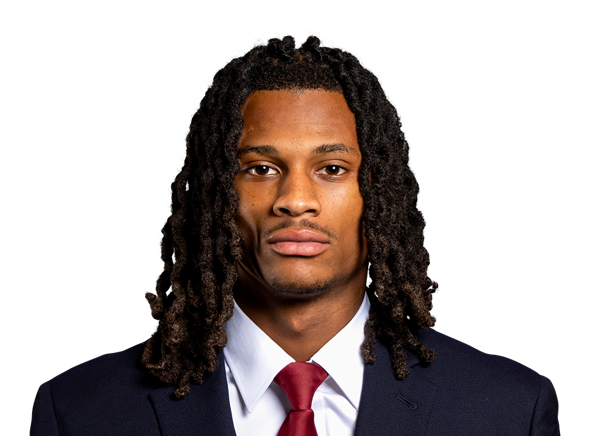
Daniel Odom
 Oklahoma
Freshman
Oklahoma
Freshman
Bio
Recruiting
Scouting Report
Daniel Odom is a 4-star Wide Receiver from Los Angeles, CA (St. John Bosco) in the 2026 class. Ranked No. 438 nationally, No. 105 at WR, No. 56 in CA. Composite rating: 0.8933. Committed to University of Oklahoma since January 27, 2025.
Physical Profile
Listed at 6-2, 195 lbs. Taller than 58% and heavier than 79% of 2026 Wide Receiver prospects in the SEC Scouts database (329 with a listed size).
Play Style
Odom is a boundary receiver who plays physically. He attacks press with his hands and a strong release and uses his body to box defenders out at the catch point. His production is mainly outside the numbers: fades, back-shoulder throws, comebacks and intermediate in-breaking routes where his size lets him post up. He catches the ball away from his body and holds on through contact, which makes him a dependable target on third down and in the red zone. He is more of a possession and chain-moving receiver with some ability downfield than a pure vertical threat. His 15 yards per catch as a junior came from winning on the ball more than from running away from coverage.
Strengths
- Physical play against press. 247's Greg Biggins wrote in April 2024 that he has 'the physical tools to be a dominant outside receiver' and pointed to strong releases off the line, which is the most important trait for a boundary receiver at his size.
- Strong, reliable hands. Scouts cite his ability to catch the ball away from his body and hold onto it through contact, and he uses his 6-2 frame to shield defenders on back-shoulder throws and in contested situations.
- Proven against top competition. He produced for St. John Bosco, one of the country's elite programs, in the Trinity League, where he faced Power 4 defensive backs every week. 247 credits him with 45 catches for 682 yards and 5 TDs as a junior, about 15 yards per catch, which shows he can win downfield as well as underneath.
- Stable commitment and maturity. He shut down his recruitment and held firm through a late flip push by Colorado before signing in December 2025 and enrolling early. SI's spring coverage describes him as a 'student of the game' who used his injury rehab to learn the playbook.
Areas to Improve
- Getting healthy and making up for lost reps. The arm and wrist surgery and the limited spring cost him the development jump most early enrollees get. He was not on 247's official Week 1 2026 depth chart, so he has to prove he is fully healthy in practice before he can earn a role.
- Separation against off coverage. He wins with physicality more than twitch. Against SEC corners who play off and read the route, he needs sharper stems, better tempo at the top of routes and cleaner breaks on digs and comebacks so every catch isn't contested.
- Adding mass and play strength. Getting from 195 to 200+ lbs without losing burst would help him hold up as a blocker in the run game, which OU's staff will require from outside receivers, and help him win when defenders grab him at the catch point.
College Projection
He is a true freshman at Oklahoma in 2026, playing for WR coach Emmett Jones in a crowded 2026 WR signing class that also includes Jayden Petit and Jahsiear Rogers. Because he wasn't on the Week 1 two-deep and had a limited spring, the most realistic path for 2026 is special teams and occasional snaps, with the four-game redshirt rule in play. One secondary source lists him third on the Z depth chart behind Trell Harris and Manny Choice, but the official chart did not list him. If he has a healthy 2027 offseason, he projects as a rotational outside receiver as a redshirt freshman or sophomore in 2027. He has a realistic chance to start at X or Z by 2028, when his size and hands match what OU needs from a boundary receiver.
NFL Outlook
Day 3 profile with a Day 2 ceiling. NFL teams look for 6-2, physical outside receivers with good hands, but his draft value depends on two things college tape will have to show: that he can separate from NFL-caliber press-man corners, and his verified speed at the combine, since no reliable timed speed exists yet. If he turns into a productive two-year starter who wins contested catches in the SEC, a mid-round grade is realistic. If he stays a possession receiver without separation, he fits more as a priority free agent or late-round pick valued for special teams.
Best Fit
A pro-style or spread offense with a lot of RPOs that isolates a big receiver on the boundary and throws back-shoulder, fade and comeback routes against single coverage, while relying on slot and speed receivers to stretch the field vertically. Oklahoma's system and a crowded young receiver room fit this well: he can develop over one or two years behind veterans instead of being forced into a big role while still recovering from surgery. His skills also carry over to red-zone packages, where his size and hands are a matchup advantage right away.
Current Team
University of Oklahoma