
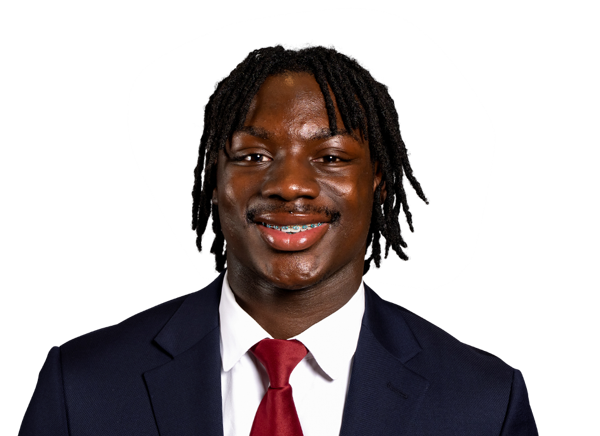
Jahsiear Rogers
 Oklahoma
Freshman
Oklahoma
Freshman
Bio
Recruiting
Scouting Report
Jahsiear Rogers is a 4-star Wide Receiver from Wilmington, DE (Appoquinimink) in the 2026 class. Ranked No. 328 nationally, No. 37 at WR, No. 1 in DE. Composite rating: 0.9034. Committed to University of Oklahoma since October 26, 2025.
Physical Profile
Listed at 5-11, 182 lbs. Taller than 17% and heavier than 54% of 2026 Wide Receiver prospects in the SEC Scouts database (329 with a listed size).
Play Style
He is a vertical and yards-after-catch playmaker who wins mostly with explosiveness. On film he threatens defenses deep off the line, takes quick screens and short throws and gets upfield immediately without dancing, and is most dangerous in open space, where his acceleration beats pursuit angles. He tracks the deep ball well and catches with his hands instead of his body, so he finishes contested and over-the-shoulder throws better than most receivers his size. Schematically he is a motion, jet and bubble-screen weapon who can also take the top off a defense from the slot.
Strengths
- Game-breaking speed with the ball in his hands. His reported 4.3 speed shows up on film, where he turns short catches into long touchdowns. As a junior in 2024 he averaged 23.7 yards per catch (37 catches, 877 yards, 10 TD) and made 3A first-team all-state. Brent Venables: 'With the ball in his hands, he can score at any point in time.'
- Fast acceleration and quick transitions. 247's evaluation points to his 'acceleration and juice' in catch-and-run situations and on touches out of the backfield, which makes him hard to bring down in open space.
- He plays the ball better than his size suggests. 247 notes soft hands and the ability to win at the catch point, which gives him a higher floor than most undersized speed receivers.
- Proven big-play production. Through five games of his 2025 senior season he had 19 catches for 440 yards (23.2 per catch) and 6 TD, keeping up his explosive-play rate as the focus of opposing defenses.
- Can move between the slot and outside, so offensive coordinators can use him in motion, on jet sweeps, on screens and on vertical routes.
Areas to Improve
- Big jump in competition level. Delaware high school football is a thin talent pool, and 247 notes that he needs to adjust to SEC-caliber defensive backs. His press-release technique and physicality at the line are still untested against length.
- Strength and frame. At about 175-180 pounds he needs to add weight for contested catches, working through contact over the middle, and perimeter blocking in Oklahoma's run game.
- Route detail and variety. Much of his production has come from vertical routes and catch-and-run concepts. Sharper breaks, tempo and leverage reading on option routes will decide whether he becomes a full-time slot receiver or stays a gadget player.
- He will need to earn a role on special teams early. Using his speed in the return game is his clearest path to the field while his receiving refinement catches up.
College Projection
He enrolled early in January 2026, which gave him spring practice and time to build rapport with QB John Mateer. The most likely path is special teams and packaged slot snaps as a freshman in 2026, with a real chance at a rotational slot role by his second year once he adds 10-15 pounds and tightens his route running. If his routes develop, his top-end speed and hands make him a starting slot or 'Z' receiver candidate by year 2-3. If they don't, he still has solid value as a specialist and return man.
NFL Outlook
It's a long-term projection that depends on his development. His 4.3 speed and ball skills will get NFL scouts' attention, but slot receivers under 5-11 and 185 pounds have to be elite at separation or in the return game to be drafted. If he produces as a multi-year starter in the SEC and adds return value, he projects as a Day 3 pick in the mid-to-late rounds as a slot and returner. If his route running reaches an elite level, a Day 2 ceiling is possible. As a straight-line speed player only, he projects as a priority free agent.
Best Fit
An up-tempo spread offense that creates space and uses motion, RPO screens and vertical shots from the slot. Oklahoma's system, which gets its playmakers the ball in space, fits well. He will do best with a coordinator who schemes touches for him early (jet sweeps, bubbles, choice routes) and a strength staff that can add mass without costing him speed.
Player Comparison
Kaden Saunders shares a nearly identical physical profile (5'10", 175 lbs) and 4-star recruiting pedigree with the prospect. His playing style is described as explosive and versatile, with strengths as a vertical threat, in the screen game, and as a return specialist, which directly mirrors the prospect's on-field attributes. Saunders was a highly-touted recruit known for his game-changing speed and ability to make plays in space, making him an excellent comparison.
Current Team
University of Oklahoma