
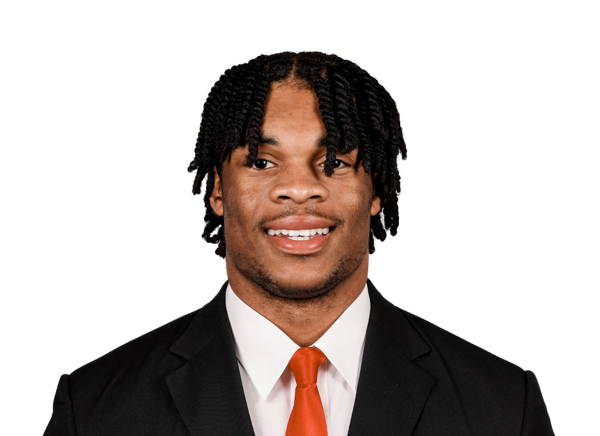
Nick Abrams
 Georgia
Freshman
Georgia
Freshman
Bio
Recruiting
Scouting Report
Nick Abrams is a 4-star Linebacker from Baltimore, MD (McDonogh School) in the 2026 class. Ranked No. 379 nationally, No. 33 at LB, No. 7 in MD. Composite rating: 0.8978. Committed to University of Georgia since July 15, 2025.
Physical Profile
Listed at 6-2, 225 lbs. Taller than 44% and heavier than 82% of 2026 Linebacker prospects in the SEC Scouts database (207 with a listed size).
Play Style
Abrams is a downhill, instinctive off-ball linebacker who plays faster than his size suggests. On film he reads run keys quickly, takes efficient angles to the ball and arrives with force, which fits his 'thumper' label, and he has the range to make plays sideline to sideline. McDonogh used him in many roles: blitzing from depth, spying, rushing from the edge on passing downs and dropping into zone, where he reads the quarterback well enough to break on throws. His senior season of 84 tackles, 13 TFL, 9 sacks, 2 interceptions and a fumble recovery earned All-MIAA honors on an 8-3 team that finished as MIAA A runner-up. That stat line reflects a linebacker who can hurt an offense in several ways rather than a pure tackle accumulator.
Strengths
- Run diagnosis and pursuit angles: 247Sports credits him with reading and reacting to the run 'at a high level' and flowing downhill with ideal pursuit angles. That shows up in his tackle totals, which rose from 36 as a sophomore to 77 as a junior and 84 as a senior.
- Getting into the backfield from an off-ball alignment: he had 9 tackles for loss and 4 sacks as a junior, then 13 TFL and 9 sacks as a senior at McDonogh (MIAA A). He is effective as a green-dog blitzer, a spy and a rusher from the edge, and Glenn Schumann pitched him on a Jalon Walker-style rush role.
- Coverage ability: 247Sports says he is comfortable in zone and redirects quickly. He had 1 interception as a junior and 2 as a senior, and Georgia sees a Chris Cole-type role covering backs and tight ends, so he is not just a run-down thumper.
- Open-field tackling and length: he makes difficult tackles in space, and his wingspan gives him a wide tackle radius and an early advantage against blockers.
- Experience and makeup relative to age: he produced this well as one of the youngest players in the class, carries a 3.8 GPA, enrolled early, and held his commitment through a hard midseason push from Michigan. Those are good signs for picking up Georgia's defense, which asks a lot mentally.
Areas to Improve
- Play strength and weight: at 220 pounds he needs to add muscle mass to take on SEC guards in the box every down without getting washed out of his gap. Georgia's strength program is the main factor in when he can play.
- Linebacker experience: he has only about three seasons at the position, so his key-and-diagnose skills against college play-action, RPO conflicts and misdirection are still raw. His pass-rush plan also depends more on athleticism than on a developed set of moves.
- Man coverage: his zone instincts are good, but he is unproven in man coverage against quick backs and flexed tight ends. He needs work on hip fluidity and staying in phase in man to fill the coverage role Georgia described.
College Projection
A redshirt or special-teams-heavy 2026 is the likely path in Georgia's deep linebacker room, which added fellow early enrollees Elijah Littlejohn and Terrence Penick. His length and speed make him a natural contributor on kick and punt coverage right away. With 10-15 pounds of added weight he projects as a rotational MIKE/WILL in 2027 and could compete for a starting job in 2028. The versatility Schumann described, rushing on passing downs and covering backs and tight ends, could get him on the field earlier as a sub-package or third-down specialist before he is an every-down starter.
NFL Outlook
He is a mid-to-late-round prospect with a higher ceiling if he develops. The NFL values his traits: very long arms, sub-4.6 speed at linebacker size, three-down versatility and blitz production. Georgia's recent linebackers show the pipeline, with Roquan Smith and Nakobe Dean as off-ball examples and Jalon Walker as a hybrid, and Smith personally recruited Abrams. If he reaches 230-plus pounds, starts for two years and proves himself in man coverage, a Day 2 grade is realistic. His youth works in his favor because he could still be improving when he becomes draft-eligible.
Best Fit
Abrams fits best in a multiple, pressure-heavy 3-4 or hybrid front that uses linebackers as blitzers, spies and zone droppers, which describes Kirby Smart and Glenn Schumann's system at Georgia. He does best as a WILL or a hybrid rush/coverage piece. That role lets him play in space and use his length and pursuit speed while he adds the weight needed to handle downhill duties at MIKE. Programs that would force him into a pure two-gap, take-on-guards role early would not make the most of his skill set.
Player Comparison
Both Ausberry and Owusu-Koramoah share nearly identical physical profiles, entering college at around 6'2" and in the 215-220 pound range. Their playing styles are remarkably similar; both are described as highly athletic, sideline-to-sideline linebackers with exceptional speed, instincts, and the ability to make impactful plays all over the field. While Owusu-Koramoah was a three-star 'athlete' in his recruiting class, his collegiate development at Notre Dame into a Butkus Award winner mirrors the high ceiling projected for a top-ranked linebacker like Ausberry.
Current Team
University of Georgia