
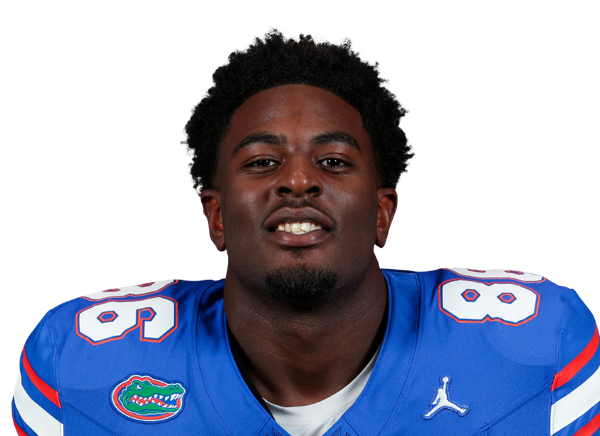
Heze Kent
 Florida
Freshman
Florida
Freshman
Bio
Recruiting
Scouting Report
Heze Kent is a 4-star Athlete from Brunswick, GA (Brunswick) in the 2026 class. Ranked No. 402 nationally, No. 32 at ATH, No. 36 in GA. Composite rating: 0.8967. Committed to University of Florida since July 11, 2025.
Physical Profile
Listed at 6-6, 288 lbs. Taller than 97% and heavier than 99% of 2026 Athlete prospects in the SEC Scouts database (150 with a listed size).
Play Style
On film he looks like an oversized receiver more than a traditional in-line tight end. Brunswick lined him up detached and in the slot and threw him seam and vertical routes, where he used his frame to box out defenders and catch over the top. He is smooth after the catch for his size and hard to bring down. In the red zone and short yardage he was an overpowering ball carrier. As a blocker he is currently more a big body who gets in the way than a refined technician, but when he gets his hands on defenders he moves them. His footwork and redirection look like a basketball forward's rather than a lineman's.
Strengths
- Productive and explosive as a pass catcher despite his size: as a junior in 2024 he caught 41 passes for 983 yards and 8 TDs (24.0 yards per catch), so he was creating big plays, not just catching short throws.
- Hands and catch radius: Florida head coach Jon Sumrall said Kent 'may have the best ball skills on our team.' His basketball rebounding shows up in how he wins contested catches and high-points throws in the red zone.
- Blocking upside because of his mass: at 300-plus pounds he can play in-line as an extra tackle, seal the edge and move defensive ends. 247 highlighted 'significant developmental blocking upside when asked to stay attached.'
- Versatile with the ball: he also ran 32 times for 211 yards and 8 TDs, a short-yardage and goal-line option that creates packaging and personnel mismatches.
Areas to Improve
- Keeping his weight and conditioning at a tight end playing weight. His position depends on staying near his post-cut target, and snap counts in SEC heat will test his stamina.
- Burst off the line and route detail. At his size, getting separation from SEC linebackers and safeties depends on crisp breaks and use of leverage, not speed. His high school production came largely against smaller defenders.
- Blocking technique when attached: hand placement, pad level and staying on the move in zone schemes. His size will win early reps, but consistent sustain and reach-block footwork need coaching.
- Learning the position. As an ATH/TE hybrid, he needs to master pass-protection chips, motion and alignment responsibilities, and the details of blocking assignments in an SEC offense.
College Projection
He is already on the field as a true freshman in 2026 as a heavy/Y tight end: jumbo packages, goal line, short yardage, and play-action shots where his size creates mismatches. Realistically he projects as a rotational TE2 in 2026-27 whose role grows as his blocking improves, with a chance to start by 2027-28 if he holds his weight. If the tight end experiment stalls, the offensive tackle and defensive tackle fallback most programs projected is still there, and that fallback is part of his value.
NFL Outlook
As a tight end, he fits the rare mold of a 6-6, 280-plus blocking/receiving hybrid, the kind of player NFL teams value in 12- and 13-personnel offenses. Reaching a draftable grade depends on proving he can separate against SEC coverage and block consistently while attached. As an offensive tackle, his length, feet and basketball athleticism give him a legitimate path to Day 2-3 if he moves back to the line. Either way, his physical traits give him a real NFL route; the variance is in which position.
Best Fit
A pro-style or multiple-tight-end offense that uses 12/13 personnel, heavy play-action and a gap/duo run game, where a 280-300-pound tight end is both an extra blocker and a big red-zone target. Florida under Sumrall fits, as long as the staff keeps his conditioning and position development on track.
Player Comparison
Taylor shares the same 6'6" 320 lb frame and was also a highly-rated Florida commit from Georgia. Both prospects have the size and SEC pedigree that projects to major college contributor, with Taylor developing into a consistent NFL starter at offensive tackle after being drafted in the second round.
Current Team
University of Florida