
#11

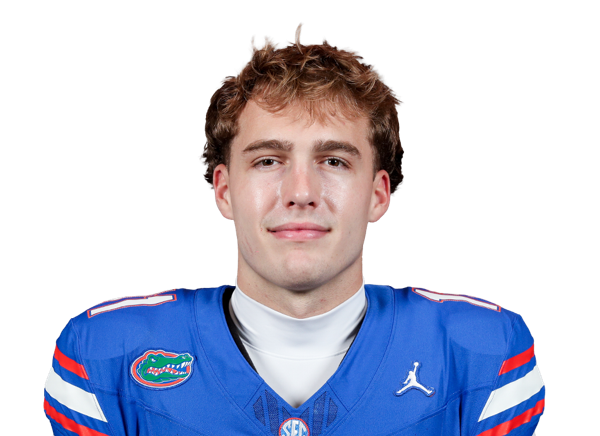
Will Griffin

QB Florida Florida Freshman

Bio

Height 6'3"
Weight 230 lbs
Hometown Tampa, FL
High School Tampa Jesuit
Rating ⭐⭐⭐⭐

Recruiting

⭐⭐⭐⭐ Class of 2026
#226 National
#23 QB
#39 State
0.9184 Rating

Scouting Report

A
92 / 100 Ceiling 92 • Floor 84
year 1 contributor NFL Rd 5

Griffin is a thickly-built, high-volume pocket passer out of Tampa Jesuit who was the first commit in Florida's 2026 class (June 2024) and never wavered, signing as a consensus four-star ranked roughly No. 104–151 nationally and No. 8–14 among quarterbacks. He left high school as the No. 2 passer in Florida state history with 143 career touchdown passes and the Tampa Bay area's all-time leader with 12,299 career passing yards, capped by a 2025 senior season of 160-of-246 for 2,534 yards, 37 touchdowns and just 2 interceptions and the Gatorade Florida Player of the Year award. ESPN's Craig Haubert and Tom Luginbill labeled him the most college-ready quarterback in the entire 2026 signing class — an evaluation built on processing, timing and production rather than raw physical ceiling.

Physical Profile

Listed between 6-foot-2.5 and 6-foot-3 and 225–230 pounds, Griffin already carries a college-ready frame — evaluators have described him as 'built almost like a linebacker,' which is unusual for a true freshman quarterback and means he needs no redshirt-year mass acquisition. He owns some of the largest hands measured in recent recruiting cycles, which shows up in wet-weather Florida ball security, on play-action carry-outs, and in his ability to reset and re-grip without a full second hand on the ball. Height is adequate rather than ideal — he plays at a functional 6-2/6-3, so throwing lanes matter and he must be disciplined about launch point and interior pocket movement rather than relying on a Josh Allen-style over-the-top release. Athletically he is a functional-mobility quarterback, not a designed-run threat; the closest current comp offered by evaluators is Fernando Mendoza — enough movement to escape a collapsing pocket, slide to open grass and pick up a third-and-3, but he will not be a zone-read or QB-power centerpiece.

Play Style

Griffin is a timing-and-rhythm pocket operator who plays the position from the neck up. On film he takes the snap, works his footwork in concert with the route concept, and gets the ball out on time with a short, whippy stroke — he is at his most dangerous on hitches, glance routes, digs, and intermediate in-breakers where he can step into the throw and rip it on a line. He is confident in the pocket, comfortable holding a safety with his eyes, and does not panic at first contact-window pressure; the 37-to-2 touchdown-to-interception senior ratio reflects a quarterback who knows when a play is dead and is willing to take the check-down. He is a functional athlete who moves to throw rather than moves to run — he will climb, slide, escape and pick up first downs with his legs when the defense vacates, but scrambling is a fallback, not a feature. The unorthodox catcher-style release is the tell on film: it looks unconventional in slow motion, but it is why the ball is out fast and why he can complete throws that never quite reach a textbook overhand plane.

Strengths

  • Elite production and decision-making at high volume: 37 touchdowns to 2 interceptions as a senior on 246 attempts (65.0% completions) is a nearly 19-to-1 TD/INT ratio, and it came on top of a 3,404-yard, 34-touchdown junior campaign — this is a four-year, 12,299-yard starter whose ball security got better as his usage and defensive competition got tougher.
  • Compact, repeatable, quick-twitch release. Evaluators at the Elite 11 Finals described a throwing motion that mimics a catcher's — unorthodox in look but extremely fast and efficient, producing consistent ball placement rep after rep. That short stroke is why he wins on timing and rhythm concepts and why the ball gets out before free rushers can affect him.
  • Drives the ball to every level with real velocity when he can step into it. He rips darts on tight lines into intermediate windows, works the 12–18 yard hole shots and comeback/dig routes that most high school quarterbacks cannot access, and showed measurable growth as a deep-ball thrower during his senior year.
  • College-ready mental and physical package: already at 230 pounds with pocket poise, plus documented leadership as the class's anchor commit who actively recruited Florida's 2026 haul for two full years. Elite 11 Finalist and Under Armour All-American as a junior — he has performed against national competition, not just Tampa Bay 3A/4A defenses.

Areas to Improve

  • Deep-ball accuracy and max-horsepower throws. His placement tightens up the shorter the throw and dips the further downfield he looks; at the Elite 11 he specifically struggled on the biggest-horsepower throws — the 50-plus-yard boundary go and the far-hash deep out that require full torque. The arm is explosive in a phone booth but the outer-limits throws are inconsistent, which is a lower-body sequencing and hip-rotation issue as much as an arm issue.
  • Base and platform under duress. Because he is at his best stepping into throws, his velocity and accuracy fall off meaningfully when he cannot get his feet set — off-platform, moving-left, and truncated-base throws are the clearest developmental gap. Refining the unorthodox release so it holds up when the pocket is muddy, rather than only when it is clean, is the priority.
  • Height-related throwing lanes at the SEC level. Against 6-foot-5 interior defensive linemen with mature pass-rush plans, a 6-2/6-3 quarterback who does not have an elevated release point must master subtle pocket climb and lane-finding. Batted balls and forced platform changes are the realistic risk if this is not coached up early.
  • Full-field progression speed against disguised SEC coverage. His high school production came with a considerable schematic and talent advantage; the jump from reading a two-high shell in Florida high school football to post-snap rotation from an SEC coordinator is the standard freshman wall, and it is the one thing his 'most college-ready' label cannot pre-solve.

College Projection

Griffin enrolled early at Florida and has already been through spring camp, where he sat behind Aaron Philo and Tramell Jones Jr. in the quarterback competition while flashing what observers called an extremely explosive arm in early spring periods. The realistic path is QB3 as a true freshman with mop-up and situational reps, a full year in an SEC strength program and playbook, and then a legitimate run at the job in year two — the ESPN 'most college-ready' tag makes him a genuine emergency-injury option rather than a redshirt-only body, which is meaningful insurance value in his first season. His floor is a multi-year SEC starter and his ceiling is a three-year starter who becomes a program cornerstone, largely because the mental side, frame and durability are already in place; the timeline hinges almost entirely on whether the deep-ball and off-platform accuracy come along by his second offseason. He does not need a redshirt for physical development, which separates him from most freshman quarterbacks — he needs reps and a defensive-complexity education.

NFL Outlook

Legitimate Day 2 to Day 3 draft potential with a Group-of-Five-to-priority-free-agent floor if the deep-ball accuracy never rounds out. The NFL projection is heavily development-dependent: the processing, ball security, hand size, frame and quick release are all traits scouts will underwrite, but a 6-2/6-3 quarterback with a functional-athlete profile who is inconsistent on max-effort throws has almost no margin for error on the mental side — he must be a decisive, high-completion, on-schedule operator to grade out. His most likely NFL identity is a timing-based system quarterback in a West Coast/play-action offense who wins on anticipation and pre-snap work rather than arm-talent highlights. Realistic tracking comp for his draft arc: Bo Nix or Fernando Mendoza — a heavy-production, high-experience college starter whose stock is built over three-plus years of starts rather than out of recruiting hype. If he starts two-plus seasons in the SEC at his current trajectory, a Day 2 selection is a fair expectation.

Best Fit

A timing-and-rhythm passing scheme with a strong play-action and RPO backbone — West Coast concepts, quick-game and intermediate in-breakers, tempo, and a heavy dose of half-field reads that let him get the ball out on his own timing rather than surviving in the pocket for four seconds. He needs an offensive line that can create clean interior throwing lanes and a coordinator who builds the deep shot game off play-action and boot rather than asking for isolated, max-torque 55-yard sideline throws. Florida is a defensible fit if the offensive staff commits to a rhythm-based system; the wrong fit would be an Air Raid-style vertical offense that lives on outer-limits arm talent, or a heavy zone-read/QB-run scheme that wastes his best traits and exposes his only average athleticism. Ideal setup: a stable program with a veteran quarterback in front of him for one season and a coordinator who has developed multiple mid-sized, high-processing quarterbacks into multi-year starters.

Player Comparison

Will Grier West Virginia • Dallas Cowboys 88% match

Both Griffin and Will Grier share a similar physical build and were highly-touted 4-star pro-style quarterback recruits known for their exceptional arm talent. Like Grier, Griffin is a confident pocket passer with the ability to extend plays with his legs and isn't afraid to be a physical runner. Their extensive high school careers and leadership qualities also draw a strong parallel.