
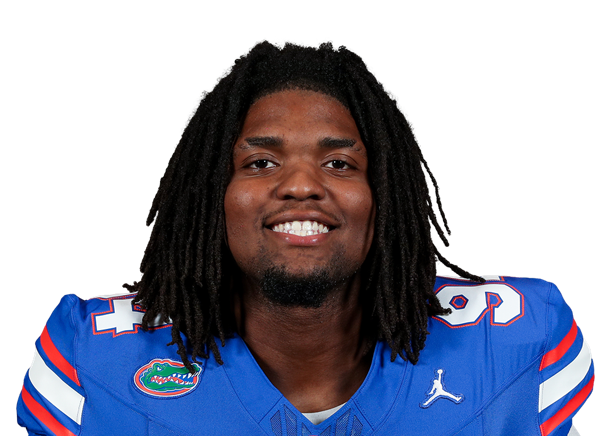
Kendall Guervil
 Florida
Freshman
Florida
Freshman
Bio
Recruiting
Scouting Report
Kendall Guervil is a 4-star Defensive Line from Fort Myers, FL (Fort Myers) in the 2026 class. Ranked No. 301 nationally, No. 22 at DL, No. 23 in FL. Composite rating: 0.9067. Committed to University of Florida since July 1, 2025.
Physical Profile
Listed at 6-5, 309 lbs. Taller than 87% and heavier than 85% of 2026 Defensive Line prospects in the SEC Scouts database (227 with a listed size).
Play Style
A physical, downhill interior lineman who plays through blockers rather than around them. On film he shoots his hands, wins the leverage battle, and uses a bull rush to drive guards into the backfield. He also chases hard from the backside, which explains his high tackle totals for an interior player. His tackles for loss come from beating his blocker in his gap and holding the point of attack more than from quick penetration. He is at his best as a run-first 3-technique or shade who plays both gaps if needed and pushes the pocket on passing downs.
Strengths
- Power at the point of attack: Ivins says he 'can forklift obstacles' with his bull rush. That weight-room power moves guards back, lets him hold his gap against double teams and collapses the pocket from the inside.
- Consistent production for an interior lineman: about 165-172 career tackles, 24-26 tackles for loss, 7.5 sacks, 4 forced fumbles and 3 fumble recoveries. His junior year alone was 88 tackles, 12 TFL and 2 forced fumbles, which shows he makes plays, not just eats blocks.
- Effort and pursuit: Ivins notes 'the downhill charge to close gaps in backside pursuit.' His motor keeps him in plays that go away from him, which matters for a 315-pounder who might otherwise be limited to a two-down role.
- A college-ready body: at his size he will not need a long weight-gain period, so once he is healthy he can compete for interior rotation snaps.
Areas to Improve
- Getting back to full health after the ACL and meniscus tear. He has missed a full season of games and needs to regain his first-step burst, bend and trust in the knee. The injury also cost him senior-year film showing growth in technique.
- Pass-rush moves and hand use. His rush depends mostly on the bull rush, so he needs to add a real counter (a swipe or club-rip, or a push-pull) and a plan to finish rushes, or he will be a run-stopper who only pushes the pocket.
- Get-off and pad level. His 'adequate' first step needs to be quicker at the snap, and he needs to keep his pads low all game, which is harder for a tall tackle, so he doesn't get washed out by down blocks and double teams at SEC level.
College Projection
Because of the injury, 2026 is most likely a redshirt and rehab year, with scout-team and possibly four-game-rule snaps late in the season if he is cleared. Once healthy, his body and power should earn him rotation snaps inside in 2027 as a run-down 3-technique or nose. He could become a starter by his third year (2028) if his burst comes back and he adds pass-rush moves. His likely ceiling is a multi-year SEC starter at defensive tackle whose value comes from beating double teams and pushing the pocket rather than big sack numbers.
NFL Outlook
He has a realistic Day 3 draft profile with room to move up. NFL teams like 315-pound interior linemen with real power and effort, so he is a legitimate draft prospect if he stays healthy and produces in the SEC. Moving into the Day 2 range would take a full return of his first-step quickness after the ACL repair, a proven pass-rush plan (about 4-5+ sacks and steady pressure numbers from the interior), and good testing numbers at his size. His most likely NFL role is a rotational run-stuffing tackle with some pass-rush value.
Best Fit
A multiple or 4-3 front that uses him as a penetrating 3-technique on early downs and moves him to the shade nose or 4i in odd fronts, with an attacking style that lets his bull rush and downhill charge play. A program with a strong strength staff, patient rehab and a deep enough defensive line rotation to let him redshirt without pressure is ideal. Florida fits well: he is a legacy-level in-state signee with close ties to the defensive line staff, and the Gators need interior depth, so he has a path to snaps once he is healthy.
Player Comparison
Both prospects share similar physical dimensions at 6'4" 315+ lbs with elite early recruiting momentum from major programs. Kinlaw was also a highly-rated Florida recruit who generated significant interest despite limited early film, suggesting exceptional measurables and athletic projection that evaluators believed would translate to dominant college production.
Current Team
University of Florida