
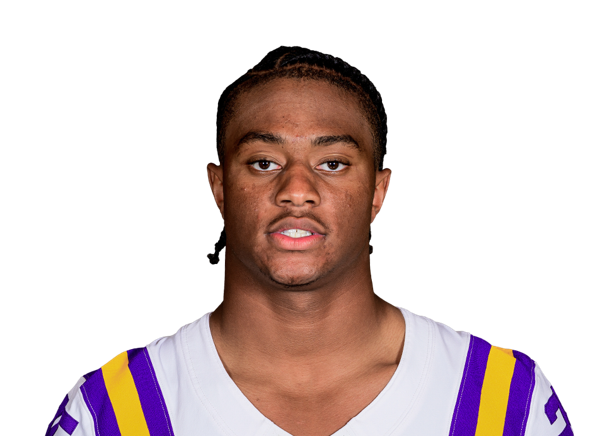
Aiden Hall
 LSU
Freshman
LSU
Freshman
Bio
Recruiting
Scouting Report
Aiden Hall is a 4-star Safety from New Orleans, LA (Edna Karr) in the 2026 class. Ranked No. 217 nationally, No. 37 at S, No. 16 in LA. Composite rating: 0.9204. Committed to Louisiana State University since August 2, 2024.
Physical Profile
Listed at 6-2, 193 lbs. Taller than 75% and heavier than 77% of 2026 Safety prospects in the SEC Scouts database (200 with a listed size).
Play Style
Hall is a zone-aware, aggressive downhill safety who plays best when he can read the quarterback and drive on the ball. On tape he sits on out and hitch concepts from a boundary alignment, breaks late, and plays the catch point instead of the receiver. His TFL and sack numbers show that Edna Karr used him as an overhang and pressure player, so he is comfortable against the run and in blitz packages. He is more of a collision player than a form tackler, often fitting as the second player in rather than making the first stop. On special teams he is a disruptive rusher on punt block and tracks the ball well.
Strengths
- Ball production in coverage: as a junior he had 11 pass breakups and 4 interceptions. Ivins notes he made takeaways by undercutting out-breaking routes, which shows he reads route stems and trusts his eyes in zone.
- Can match size in the slot: at 6-2/200+ he has the length and build to cover large slot receivers and tight ends man-to-man. 247 says he is 'quick enough to hang as a man defender,' which makes him useful against 11 and 12 personnel.
- Impact near the line of scrimmage: 12 TFL and 4 sacks in 2024 show real value as a pressure and fill player in the box, not just a deep-half safety.
- Special teams value right away: 4 blocked punts plus 2 fumble recoveries as a junior show timing, get-off and nose for the ball. That usually earns a freshman snaps on the punt-block and coverage units before he starts on defense.
- Winning pedigree against top competition: he started on a loaded Edna Karr defense (alongside future LSU DL Richard Anderson) that won consecutive state titles and 28 straight games. He has played meaningful snaps against strong Louisiana competition.
Areas to Improve
- Finishing as a tackler: 247 calls him more of a 'tackle-assister than tackle-maker' in run support. He only had 38 total tackles in a dominant junior season, so he needs to square up, wrap and finish alone in space rather than rely on pursuit help.
- Range as a single-high safety: his production and eval point to underneath and boundary work. He has not shown the post-safety range or deep-ball tracking needed to play middle-of-field against SEC vertical passing games.
- Adding weight without losing movement: he has gained about 30 lbs since committing. He has to keep the fluidity that makes him a man-cover option while building the play strength to take on pulling guards and stalk-blocking receivers.
College Projection
2026 (true freshman): special teams contributor and depth at boundary or strong safety, with a redshirt still possible under the four-game rule. 2027: rotation player in sub-packages (big nickel and dime) where he can cover slot tight ends. 2028-29: a realistic multi-year starter at the boundary or strong safety spot, which matches Ivins' 'potential multi-year starter at the P4 level' projection. His timeline mostly depends on how quickly his run-support finishing catches up to his coverage instincts.
NFL Outlook
Day 3 to early Day 2 upside if he becomes a consistent tackler and puts starter-level ball production on SEC film. NFL teams value safeties who are 6-2/200+ and can match tight ends in man coverage and play special teams right away. His four blocked punts are a trait scouts note. To climb into the Day 2 range, he would need verified top-end speed and proof he can cover a deep half. Without that, he projects as a box or big-nickel safety and core special-teamer at the next level.
Best Fit
A multi-safety, pattern-match or quarters scheme that keeps him in the boundary or as a big nickel. LSU's defense, which asks safeties to rotate down, match tight ends and play the run, fits his skills. It keeps him in reads-and-drives situations and limits single-high deep responsibility. Programs that commit real resources to special teams would get the most out of him in his first two years.
Player Comparison
Both prospects share similar physical dimensions (Mathieu was 5'9" 186 lbs vs Hall's 6'1" 195 lbs), both developed through elite Louisiana high school programs before committing to LSU, and both earned their recruiting status through exceptional football IQ and versatility rather than pure athleticism. The combination of strong fundamentals from a premier developmental program, early SEC commitment, and ability to impact games through instincts rather than measurables creates a compelling parallel.
Current Team
Louisiana State University