
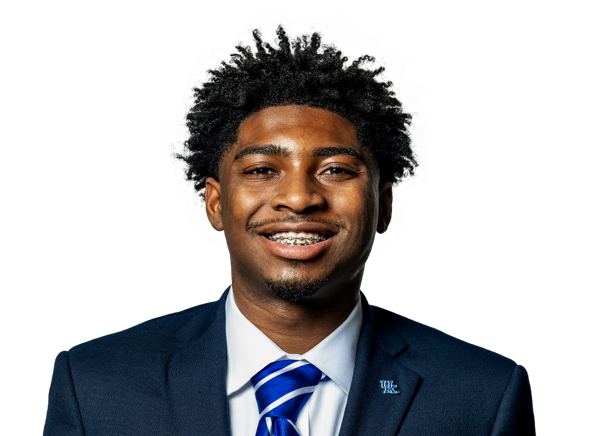
Kenny Darby
 Kentucky
Freshman
Kentucky
Freshman
Bio
Recruiting
Scouting Report
Kenny Darby is a 4-star Wide Receiver from Bossier City, LA (Airline) in the 2026 class. Ranked No. 218 nationally, No. 30 at WR, No. 6 in LA. Composite rating: 0.9204. Committed to University of Kentucky since December 4, 2025.
Physical Profile
Listed at 6-1, 180 lbs. Taller than 43% and heavier than 41% of 2026 Wide Receiver prospects in the SEC Scouts database (329 with a listed size).
Play Style
Darby is the focal point of Airline's offense, and his coach says defenses 'overplay' him every week. He wins early with his release and route tempo, reads soft spots against zone coverage, and turns quick throws into chunk plays after the catch. Late in his senior year Airline moved him into the backfield because it was 'the easiest way to get him the ball,' which shows how easily he adapts to different ways of getting touches. His best work is at intermediate depth and after the catch; he wins vertically by stacking and tracking rather than with raw speed.
Strengths
- Route running: Airline head coach Justin Scogin said his route running is 'up there with the best I've ever coached' and compared him to former LSU and NFL receiver Terrace Marshall. That is notable praise from a program that has produced SEC receivers.
- Proven high-volume production: 100-1,764-24 as a junior and 83-1,124-8 as a senior, while opponents built their coverage around stopping him. Brooks calls him a 'high-volume, high-production receiver.'
- Run-after-catch ability and versatility: as a senior he took backfield carries (44 for 479 yards and 7 TDs through Week 8, with a career-high 166 rushing yards and 4 TDs against Natchitoches Central) and returned an 85-yard kickoff for a score. That makes him usable on screens, jet motion and returns.
- Gets off the line quickly, and his release helps him stretch the field vertically even without top-end track speed.
Areas to Improve
- Strength and mass: at about 175-180 pounds he needs weight room work to beat press coverage, hold up as a blocker and win contested catches against SEC defensive backs.
- Technique: Brooks notes he is still 'developing technical acumen' in route precision. The goal is sharper breaks and better leverage against advanced coverage, going beyond the natural feel that produced his high school numbers.
- Proving his deep speed: an 11.39 100m means he will have to win vertically through tempo, stacking the defender and tracking the ball, not by simply outrunning SEC corners.
College Projection
He was named a preseason All-American ahead of his 2026 debut, and On3 coverage called him 'electric' during fall camp as he learned the playbook. That suggests he will get early snaps in Kentucky's rebuilt receiver room under Will Stein and Joe Sloan. A realistic path is a rotational receiver and possible returner as a true freshman, then a starting outside or flanker role by year two after he adds 10-15 pounds. His ceiling is to become Kentucky's No. 1 target by 2027-28.
NFL Outlook
He has a mid-round NFL profile if his frame fills out and his route precision catches up with his instincts. Coaches' praise of his route running and his return value are the traits NFL teams would value. His long-term draft stock depends on adding strength and showing he can separate vertically against SEC corners despite modest track times.
Best Fit
A spread or pro-style passing game that moves receivers pre-snap and uses screens, jet motion and option routes to get him the ball in space. This is the kind of offense Sloan and Stein are installing at Kentucky, and Sloan already knows how to use him from recruiting him at LSU. He fits best at flanker or the big slot, where his release and run-after-catch skills can be used without asking him to win on pure deep speed.
Player Comparison
Similar physical profile at 5'9" 190 lbs with elite Louisiana pedigree and versatility. Both were highly-rated Louisiana prospects who could impact games in multiple ways despite not having prototypical size for their positions. Mathieu's ability to excel through instincts, technique, and football IQ rather than pure physical dominance mirrors what this prospect's profile suggests.
Current Team
University of Kentucky