
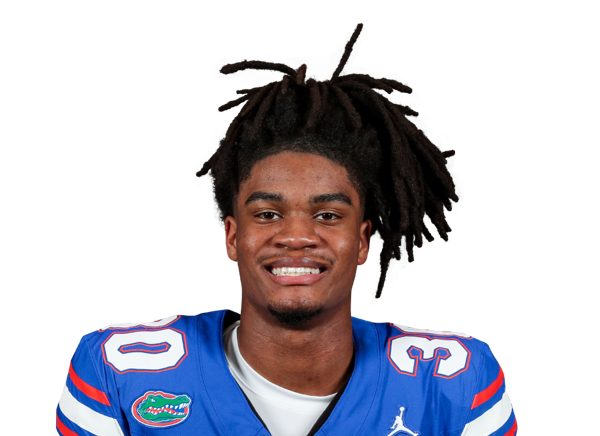
Dylan Purter
 Florida
Freshman
Florida
Freshman
Bio
Recruiting
Scouting Report
Dylan Purter is a 4-star Safety from Tuskegee, AL (Booker T. Washington) in the 2026 class. Ranked No. 256 nationally, No. 20 at S, No. 10 in AL. Composite rating: 0.9131. Committed to University of Florida since December 3, 2025.
Physical Profile
Listed at 6-0, 184 lbs. Taller than 27% and heavier than 41% of 2026 Safety prospects in the SEC Scouts database (200 with a listed size).
Play Style
He plays downhill and physically despite the thin frame. He fits his gap on the run instead of waiting and wraps up rather than launching at the ball carrier. In coverage he's at his best playing from depth: he reads the quarterback, uses his long stride to get over the top of vertical routes, and uses his length to break up high throws. His blitz production (3 sacks as a junior) shows good timing on pressures from the second level. Playing running back gives him a feel for the ball in space, and he's dangerous after takeaways. His film looks more like a rangy strong/field safety than a pure man-to-man corner.
Strengths
- He tackles well for his size. Ivins calls him 'a plus tackler' in gap assignments, and he made 60 total tackles in 10 games as a senior while also playing a big role on offense.
- He can play safety or corner. He can carry receivers into the deep third, and schools recruited him at both spots (ESPN and On3 listed him at CB when he committed to LSU), so a defensive coordinator can move him between post safety, field safety and nickel/boundary corner.
- He makes plays on the ball and gets into the backfield: 3 sacks and 2 interceptions as a junior in 2024 and another interception in 2025. That points to good timing as a blitzer and good instincts when the ball is in the air.
- He's a real athlete with the ball in his hands. As a senior running back he ran for 518 yards and 6 touchdowns, and that open-field vision should help on returns and after interceptions.
- SEC programs wanted him: LSU, Florida, Auburn, South Carolina and Kentucky all offered, along with North Carolina, Mississippi State and Tulane. He held his LSU commitment through the summer, then Florida flipped him during the early signing period.
Areas to Improve
- Add strength and mass. He needs to get from about 165–184 to 195–200 pounds so he can hold up in the box, get off blocks against 240-pound tight ends and stay healthy over a full SEC season.
- Clean up his transitions and backpedal. The 'leggy' high-hip turns Ivins flagged would get exposed by SEC slot receivers in man coverage, so he needs a lower pedal and quicker hip flips to stay at nickel or corner.
- Learn more of the defense. Splitting time with offense in high school cut into his defensive reps, so pre-snap disguises, rotating from two-high to single-high, and communicating in a pattern-matching scheme will take time to learn.
College Projection
Expect him to start at Florida on special teams and in dime and third-safety packages while he spends a year in the strength program. A redshirt, or a season limited under the four-game rule, is realistic unless injuries in the secondary force him onto the field. With 15+ pounds added, he could compete for a starting safety job as a redshirt freshman or sophomore (2027–28). He knows Sumrall's staff, which should help him learn the defense, and his ability to play both safety and corner raises the odds he sees the field somewhere in the secondary. Best case, he's a two- to three-year starter at field safety or nickel.
NFL Outlook
He projects as a Day 3 prospect, with a chance to rise to Day 2 if his body develops. NFL teams value safeties who are 6-1 with long arms and can play the deep middle or cover in the slot, and that versatility is his clearest route to the league. His draft stock depends on reaching about 200 pounds without losing range and on smoothing out his transitions. If both happen, and his college production confirms the ball skills, his path looks like a special-teams contributor who can grow into a rotational safety. If his frame doesn't fill out, he's more of a priority free agent or special-teams specialist.
Best Fit
A multiple, split-safety defense that rotates coverages and asks its safeties to disguise, trigger downhill against the run, and roll into the deep third. That uses his range, tackling and length without leaving him in man coverage on an island. Florida under Jon Sumrall is a strong fit: Sumrall recruited him first at Tulane, the defense values secondary players who can line up in more than one spot, and his high school teammate, WR Marquez Daniel, signed with Florida too. A staff with a strong strength program matters more for him than scheme, because his frame is what decides how high his ceiling goes.
Player Comparison
Both prospects share similar physical dimensions at 6'0" 165 lbs with elite athleticism that translated to versatile weapons in college. Harvin was also a highly-rated recruit who committed to Florida and became a dynamic playmaker who could line up at multiple positions, leveraging his speed and athleticism to create mismatches regardless of where he was deployed on the field.
Current Team
University of Florida