
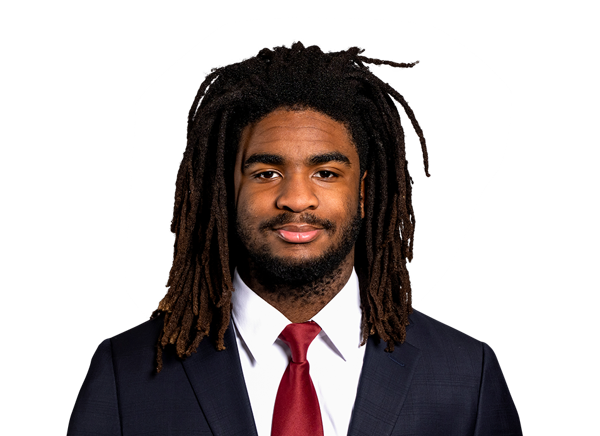
Jayden Petit
 Oklahoma
Freshman
Oklahoma
Freshman
Bio
Recruiting
Scouting Report
Jayden Petit is a 4-star Wide Receiver from Naples, FL (St. John Neumann) in the 2026 class. Ranked No. 185 nationally, No. 55 at WR, No. 52 in FL. Composite rating: 0.9262. Committed to University of Oklahoma since November 26, 2025.
Physical Profile
Listed at 6-4, 218 lbs. Taller than 91% and heavier than 97% of 2026 Wide Receiver prospects in the SEC Scouts database (329 with a listed size).
Play Style
On film Petit is a boundary 'X' receiver who plays bigger than defensive backs and wins through positioning and hands rather than raw speed. He is at his best on vertical fades, back-shoulder throws, deep comebacks and red-zone jump balls, where he uses his frame to box out and attacks the ball at its highest point. He shows unusual fluidity for his size when turning to track deep balls. His tape includes body-control catches along the sideline, which Ivins ties to his basketball background. High school offenses also used him on screens and quick hitches to get the ball in space, where his long stride and size make him hard to bring down for smaller DBs. Coaches and teammates describe a quiet, 'head-down,' work-first approach: redshirt freshman Manny Choice said, 'he's going to be that guy.'
Strengths
- Production that improved every year and peaked against better competition. At Naples First Baptist Academy in 2023 he caught 66 passes for 1,141 yards and 16 TDs, including 18-233-3 during the Class 1S state title run. In 2024 he posted 50-777-12. After transferring to St. John Neumann for his senior year in 2025, he went off for 69-1,544-23 in nine regular-season games (171.6 yards per game).
- Catch radius and contested-ball skills. At 6-4 with a hoops background, he high-points 50/50 balls, adjusts to back-shoulder and underthrown throws in the air, and gives quarterbacks a large target in the red zone. His 23 senior TDs reflect a true scoring threat, not just a volume target.
- Physical, violent route breaks unusual for a high schooler. Brent Venables singled out his 'strain at the top of the route' as 'a little bit different' and called him a 'freakazoid' who could 'jump in right away.' He uses his size to stack and shield defensive backs instead of relying on quickness alone.
- Big-play ability after the catch for his size. A 22.4 yards-per-catch average and Ivins' note that he is effective in the screen game point to real run-after-catch value: long strides, a hard-to-tackle frame, and enough fluidity to turn upfield quickly.
Areas to Improve
- Top-end speed and explosiveness. Evaluators flag possibly underwhelming testing, so he must prove he can threaten Power Four and SEC corners vertically. Against press-man corners with 4.4 speed, stacking and separating deep will depend on route craft and leverage rather than burst off the line.
- Release package and route tree against press coverage. Small-school Florida competition rarely challenged him with physical press at the line. He needs a varied release package (hand usage, footwork, stem control) and sharper, more efficient breaks on short-to-intermediate routes to become a full-route-tree X receiver instead of a fade/slant/screen specialist.
- Adjusting to SEC speed. His spring game debut (one catch for 5 yards on 4/18/2026) and a deep OU receiver room (Isaiah Sategna, Trell Harris, Parker Livingstone) mean his early reps depend on learning the playbook and earning the quarterbacks' trust. Continuing to add functional strength while keeping his fluidity at 220 is also key.
College Projection
An early-enrollee rotational boundary receiver in 2026, most likely red-zone and situational snaps plus special teams, with redshirt-rule flexibility behind established veterans. A realistic path puts him in a starting-caliber X role in 2027 as his route tree and release package develop. He projects as a multi-year starter who can be a primary red-zone and third-down target by his third season in the SEC. Upside: a 50-60 catch, 8-10 TD boundary starter in Oklahoma's spread passing offense. Floor: a reliable big-bodied rotation receiver and red-zone specialist.
NFL Outlook
247Sports projects him as a Day 3 pick (Rounds 4-7) and compares him to Malachi Fields (Notre Dame, formerly Virginia), a big, productive possession-plus receiver. His NFL value rests on his size-adjusted athleticism: if his combine speed (40, vertical, broad jump) lands at or above average for a 6-4, 215-220 receiver and his route running matures, his frame, catch radius and red-zone production could push him into Day 2. If his testing stays mediocre, he projects as a Day 3 X/red-zone receiver whose NFL roster spot depends on special teams and contested-catch reliability.
Best Fit
A spread passing offense with a defined boundary X role that throws vertical and back-shoulder shots and uses big receivers in the red zone, which is exactly what Oklahoma's pass-heavy system under Brent Venables provides. His ideal setting pairs him with an accurate quarterback willing to throw into tight coverage, plus a receivers coach who can build out his press-release and short-to-intermediate route work. He is less suited to a slot-heavy, horizontal quick-game scheme that relies on burst and quickness, and to run-first schemes where boundary targets are limited.
Current Team
University of Oklahoma