
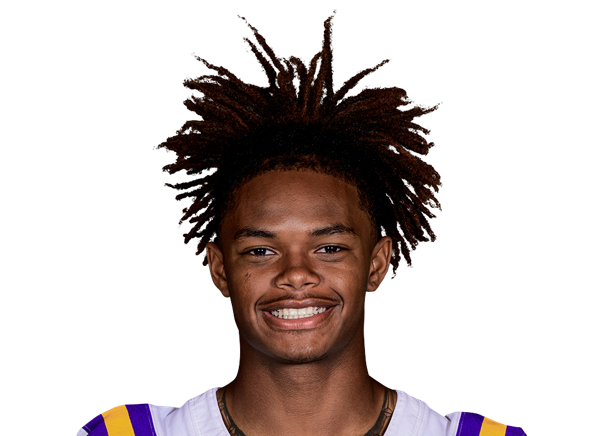
Jabari Mack
 LSU
Freshman
LSU
Freshman
Bio
Recruiting
Scouting Report
Jabari Mack is a 4-star Wide Receiver from Kenner, LA (Destrehan) in the 2026 class. Ranked No. 171 nationally, No. 39 at WR, No. 8 in LA. Composite rating: 0.9320. Committed to Louisiana State University since March 21, 2025.
Physical Profile
Listed at 6-0, 195 lbs. Taller than 26% and heavier than 79% of 2026 Wide Receiver prospects in the SEC Scouts database (329 with a listed size).
Play Style
He is a vertical-first outside receiver who uses long speed to stretch coverage and then attacks the ball in the air. At Destrehan he produced in chunks: go routes, posts, and catch-and-run plays after he eats up a corner's cushion. He tracks the deep ball well and shows natural hands away from his body, including one-handed catches. His run after the catch comes from straight-line acceleration more than elusiveness. He is at his best when the defense has to account for him on every snap as a deep threat.
Strengths
- Verified vertical speed: 22.2 mph GPS as an early enrollee, No. 2 among LSU receivers. He threatens the deep third and forces safeties to respect him
- Big-play production at a high level of Louisiana football: 58 catches, 1,275 yards and 14 TDs as a junior at Destrehan, about 22 yards per catch, a sign of real explosiveness rather than volume from short passes
- Hands and body control on the ball: his acrobatic one-handed grab in LSU spring camp went viral, which fits the ball skills on his high school film
- Tested against elite competition: 2026 Under Armour All-American, early enrollee, and a steady commitment from March 2025 through signing despite visits to SEC rivals, which points to maturity and commitment to his development
Areas to Improve
- Route detail against SEC press coverage: much of his high school production came from winning vertically with speed. He needs sharper releases, better stem manipulation and cleaner breaks on intermediate routes (digs, comebacks, deep outs) to be a full-route-tree X
- Play strength and blocking: at about 198 he has to keep adding functional strength to beat physical corners at the line, hold up in contested situations and meet the perimeter-blocking standard of a run-capable SEC offense
College Projection
As an early enrollee who stood out in spring, he is well positioned to rotate in as a true freshman in 2026, mainly as a vertical outside option and on special teams. He probably won't be a featured starter right away in a deep LSU receiver room. A realistic timeline is rotation and situational deep shots in Year 1, a larger outside role in Year 2 as his route tree develops, and a projected starter or primary outside target by Year 2–3 if he adds strength and refines his breaks.
NFL Outlook
He has a legitimate NFL draft profile. Six-one, about 200 pounds with 22+ mph speed is a sought-after combination for outside receivers. If he develops into a complete route runner and produces over two seasons in the SEC, his projection is a Day 2 pick with Day 1 upside. If he stays mostly a vertical specialist, the likelier range is Day 3 as a field-stretching WR3 or WR4.
Best Fit
An up-tempo, vertical passing offense that isolates outside receivers and uses play-action shots, like the spread system LSU now runs under Lane Kiffin. That scheme regularly creates one-on-one outside matchups that suit Mack's speed and ball skills while he develops the rest of his route tree. A pro-style system focused on precise intermediate route running would limit his early impact.
Player Comparison
Both are elite Louisiana recruits with similar size (6'0", 190-200 lbs) who committed to LSU as highly-rated prospects. Mathieu was also a dynamic playmaker who could impact games in multiple ways, whether at safety, cornerback, or return specialist, demonstrating the versatility that top-rated Louisiana prospects often possess in the state's competitive high school environment.
Current Team
Louisiana State University