
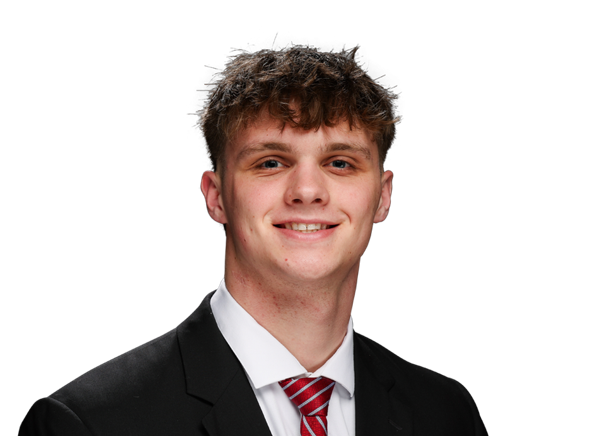
Mack Sutter
 Alabama
Freshman
Alabama
Freshman
Bio
Recruiting
Scouting Report
Mack Sutter is a 4-star Tight End from Dunlap, IL (Dunlap) in the 2026 class. Ranked No. 123 nationally, No. 11 at TE, No. 6 in IL. Composite rating: 0.9488. Committed to University of Alabama since June 25, 2025.
Physical Profile
Listed at 6-5, 248 lbs. Taller than 53% and heavier than 91% of 2026 Tight End prospects in the SEC Scouts database (116 with a listed size).
Play Style
Sutter is a big wide receiver who plays tight end. His best tape shows him working the seam and the boundary as a hands catcher, going up over defensive backs, and turning short catches into long runs when he finds open field. Dunlap used him everywhere, including splitting him out, lining him up in the slot, putting him at quarterback (he threw a TD as a senior) and playing him off the edge on defense. That shows in his competitiveness and physical play as a ball carrier. As a blocker he's aggressive and gets low, but he relies more on effort than technique. He helped lead Dunlap to a 9-3 record and a 6A quarterfinal as the 2025 Journal Star Player of the Year.
Strengths
- Wins at the catch point: he uses his hoops background and length to climb over defenders and win contested balls, making him a real red-zone and seam threat (16 receiving TDs over his junior and senior seasons: 35-505-7, then 31-596-9)
- Separates easily for a 6-5+ target: he started at receiver before moving to tight end, so he shows smooth releases, quickness in and out of breaks, and the ability to stretch the seam against linebackers and safeties
- Tough runner after the catch with a physical edge: he picked that up playing EDGE and linebacker (36 tackles, 8 TFL, 6 sacks as a junior; 55.5 tackles and an INT as a senior), which shows up in his contact balance and effort after the catch
- Can line up anywhere: he took snaps at QB, WR, TE, EDGE and LB at the IHSA 6A level, so he can move around the formation in 11 and 12 personnel as an in-line, wing, slot or split-out target
- Willing and explosive when he gets his pads down as a blocker, which gives him a base to build on rather than being a receiver-only prospect
Areas to Improve
- Technique as an in-line blocker: his hand placement, keeping his feet moving through contact, and holding blocks against SEC defensive ends need a lot of work, and 247 grades his pass protection as still developing
- Learning one position: he spent high school spread across five spots, so he has to learn the route tree, blocking assignments and pre-snap reads that a college tight end needs. He has said himself that 'really learning one position' is the goal
- Adding functional strength, so he can play attached to the line on early downs without becoming a predictable passing-down-only player
College Projection
He is the lone freshman in a veteran Alabama tight end room in 2026, so a redshirt is expected, with work on special teams and in two-tight-end packages if injuries hit. A realistic path is a rotational receiving role in 2027 once he reaches about 255 and has a year of strength training behind him. He should be a starting-caliber move tight end by 2028, used as a detached mismatch in the red zone and on third down, with the in-line role growing as his blocking matures.
NFL Outlook
247Sports analyst Hudson Standish projects him as a Day 2 (Rounds 2-3) NFL prospect and compares him to Jared Wiley (Kansas City Chiefs). His length, ability at the catch point and movement skills fit how the NFL now values detached 'Y/F' tight ends. Whether he goes higher or lower depends mostly on his blocking. If he becomes a competent in-line blocker at about 255, a top-75 selection is realistic. If he stays a receiver who is a liability as a blocker, he is more likely a mid-round specialist.
Best Fit
He fits best in a pro-style or multiple-personnel offense that uses 12 personnel and moves the tight end around the formation, lining him up in the slot, split out, as an H-back or on the wing to create mismatches with linebackers. It should also have a patient development plan for his blocking. Alabama's system and strength program fit that well: he can redshirt behind veterans, add mass, and then be used mainly as a seam and red-zone target while his in-line work develops.
Player Comparison
Both prospects share the 6'5" frame with similar weight profiles and earned Alabama commitments despite relatively low national rankings, suggesting elite physical tools that translate well to Alabama's system. Ridley was also underranked nationally but possessed the precise combination of size, athleticism, and football IQ that Alabama's staff identified early, leading to immediate impact and NFL success.
Current Team
University of Alabama