
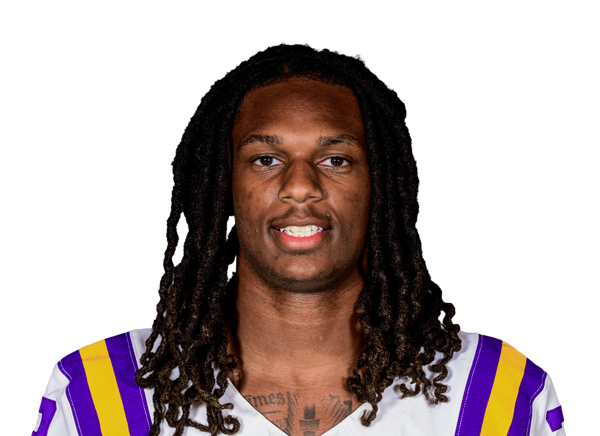
Havon Finney
 LSU
Freshman
LSU
Freshman
Bio
Recruiting
Scouting Report
Havon Finney is a 4-star Cornerback from Carson, CA (Sierra Canyon) in the 2026 class. Ranked No. 149 nationally, No. 24 at CB, No. 18 in CA. Composite rating: 0.9391. Committed to Louisiana State University since April 27, 2025.
Physical Profile
Listed at 6-1, 173 lbs. Taller than 57% and heavier than 34% of 2026 Cornerback prospects in the SEC Scouts database (204 with a listed size).
Play Style
A long boundary corner who wants to challenge receivers. He is comfortable in press and trail technique, uses his length to crowd the receiver's hands, and relies on his speed to recover on deep routes. His ball production (16 breakups and 4 interceptions in one season) shows he plays the ball rather than the receiver, turning to find it late and playing through the catch point. His receiver and punt-return background shows up after the catch: he runs with the ball like an offensive player once he gets it. The running game is where he is not yet a factor. He plays tough, but he doesn't have the mass yet to shed blocks or finish tackles consistently.
Strengths
- Ball production: 16 pass breakups and 4 interceptions as a sophomore (2024), after 27 tackles and an interception as a freshman. Twenty breakups-plus-picks in one season shows he finds the ball in the air and finishes plays, not just that he runs well.
- Speed and length together: a 10.81 100m and 4x100 anchor on a 6-1/6-2 frame. He can carry routes vertically and still close in-breaking windows with his reach, the key trait for a boundary corner in man-heavy coverage.
- Return value and all-around athleticism: two punt-return touchdowns as a sophomore, and he has also played receiver. That points to open-field vision and ball skills, and it gives LSU a special-teams role for him early.
- Physical style in coverage: 247Sports describes him as physical at the catch point despite his light build. The competitive toughness is there before the strength catches up.
- Maturity and pedigree: he reclassified up a year, played against elite Southern California competition at Sierra Canyon (10-0 regular season and No. 1 in the state as a senior), made the 2026 Navy All-American Bowl, and reportedly looked ahead of schedule in LSU's 2026 fall camp.
Areas to Improve
- Weight and play strength: he needs to get to about 185-190 pounds to hold up in press against big SEC receivers, beat blocks on the perimeter, and tackle reliably in run support. Evaluators consistently named adding good weight as his main need.
- Technical refinement that comes with age: skipping a year of high school means fewer reps in press footwork, patience at the line, and reading routes in zone. Expect some early grabbing downfield and late eye discipline against double moves while he adjusts to SEC route runners.
- Consistency as a tackler: his tackle totals (27 and 37) are modest for a player on the field that much. Taking good angles and wrapping up in space are areas to grow.
College Projection
He is on LSU's 2026 roster as a true freshman (No. 22) under Lane Kiffin. Reports have him ahead of schedule in fall camp. Year 1 (2026): special teams and returns, rotating into dime and sub-packages, with a real chance to play in four games and keep his redshirt, or more if injuries hit the corners. Year 2 (2027): after a full offseason in the weight room at about 185 pounds, he projects as a starting boundary corner. Since he is a year young, he will be 19 or 20 years old during his first starting season. Years 3-4: an All-SEC-level lockdown corner if the strength gains come.
NFL Outlook
Legitimate Day 1-2 potential. The traits NFL scouts screen for are already there: 6-1+ height, verified sub-10.9 100m speed, long arms, and consistent ball production. Being a year young also means he will be draft-eligible at an age when most prospects are still developing. His stock will depend on getting to about 185-195 pounds while keeping his speed, and on becoming a dependable tackler. If both happen, he fits the profile of a first-round press corner. If he stays light, he is more likely a Day 2 zone or nickel corner.
Best Fit
A defense with a lot of press-man and Cover 1/Cover 3 on the boundary side, where his length and long speed can take away the X receiver one-on-one. That needs to come with a strong strength-and-conditioning program to add mass for a young player. LSU, with its long tradition of producing corners and its SEC schedule, is a good fit, provided the staff lets him develop on special teams and in sub-packages in 2026 instead of throwing him into a full-time starting role while he is still under 180 pounds.
Player Comparison
Both are 6'1" prospects from elite California high school programs who developed technical fundamentals and high football IQ. McCaffrey also came from Valor Christian, a premier prep program, and showed the same combination of strong academics, character, and versatility that Sierra Canyon develops in its players.
Current Team
Louisiana State University