
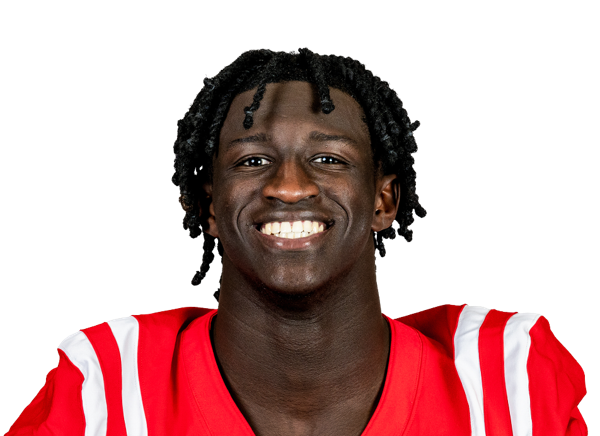
Landon Barnes
 Ole Miss
Freshman
Ole Miss
Freshman
Bio
Recruiting
Scouting Report
Landon Barnes is a 4-star Edge Rusher from Baton Rouge, LA (Duncanville) in the 2026 class. Ranked No. 101 nationally, No. 13 at EDGE, No. 8 in TX. Composite rating: 0.9574. Committed to University of Mississippi since June 29, 2025.
Physical Profile
Listed at 6-3, 250 lbs. Taller than 21% and heavier than 81% of 2026 Edge Rusher prospects in the SEC Scouts database (169 with a listed size).
Play Style
He is a high-motor, attacking edge who plays best standing up in space. He times the snap well, attacks the tackle's outside shoulder, and has the ankle flexibility to flatten toward the quarterback instead of drifting wide. His TFL total (23.5 as a senior) is more than double his sack total, which shows he is not only a pass rusher: he knifes into the backfield against runs and screens and plays through to the whistle, as the 25 QB hits show. The weakness on film is when he gets engaged by bigger blockers. If he doesn't win with his first move, bigger bodies can take him out of the play, which is typical for a young speed-based edge.
Strengths
- Backfield disruption: as a senior he had 44 tackles, 23.5 TFL, 10.5 sacks and 25 QB hits. Career totals were 82 tackles, 33.5 TFL, 13 sacks, 31 hurries and 3 forced fumbles, against Texas 6A-DI competition deep into a state semifinal run.
- Explosive get-off and ability to turn the corner from a two-point stance, which lets him win outside before an offensive tackle can set his anchor. That is why evaluators project him best as a stand-up edge or rush end.
- Early readiness: he enrolled in spring 2026, and DC Bryan Brown said he would be 'a household name... write that down.' He was praised by a veteran at SEC Media Days and got defensive-line snaps as a true freshman (including the 41-9 win over Charlotte on 9/13/2026). The staff is clearly treating him as a contributor now, not a redshirt project.
- Heavily recruited: he had 32+ offers, and Ohio State and Washington were his other finalists. The national interest confirms the evaluation was not a regional one.
Areas to Improve
- Run defense at the point of attack: he needs to add lower-body strength and hand placement so he can set the edge and shed blocks instead of getting 'washed out' by bigger tackles and down-blocking tight ends. Until then, expect the staff to limit his early snaps to passing downs.
- A deeper set of pass-rush moves: high school production that leans on speed has to become a planned counter plan, such as a long-arm or bull rush to punish tackles who over-set, and an inside counter. Without those, SEC tackles will simply widen their sets and run him past the pocket.
College Projection
He is already in the rotation as a true freshman under HC Pete Golding and DC Bryan Brown. The realistic 2026 role is situational pass rusher / rotational edge, 10-25 snaps a game, weighted toward third downs. He retains a redshirt option only if his appearances stay within the four-game limit, which the staff's comments suggest is unlikely. With a full strength-program offseason, 2027 projects as a co-starter or primary rusher, and years 3-4 bring potential All-SEC production if he gets to about 255-260 without losing his get-off.
NFL Outlook
He has a legitimate draft ceiling as a 3-4 outside linebacker or wide-9 rush end. His size (6-3/250), burst and production profile fit the NFL model for edge rushers, and he is draft-eligible after the 2028 season. His draft range will depend almost entirely on strength gains and a proven counter move. If he adds anchor and stays productive, a Day 2 profile is reasonable, with Day 1 upside if he posts double-digit sacks in the SEC. If he stays a speed-only rusher, the projection drops to a Day 3 situational rusher.
Best Fit
A multiple or 3-4 front that uses a stand-up rush linebacker or 'Jack' role and lets him rush from a wide alignment on obvious passing downs while developing as a run defender. That describes Ole Miss's current defense under Golding/Brown, which runs a deep defensive-line rotation, so the fit is strong: he can contribute right away in a pass-rush package without being asked to play every down against the run before he is physically ready.
Player Comparison
Jack was a versatile 6'1" 245 lb athlete who played both linebacker and running back at UCLA, demonstrating the multi-positional flexibility that Barnes' profile suggests. Like Barnes, Jack was a highly-ranked recruit (#47 nationally) from a powerhouse high school program who committed early based on his exceptional athleticism and projection rather than a defined position. Both prospects share the rare combination of size, athleticism, and versatility that allows elite programs to move them around to maximize their impact.
Current Team
University of Mississippi