
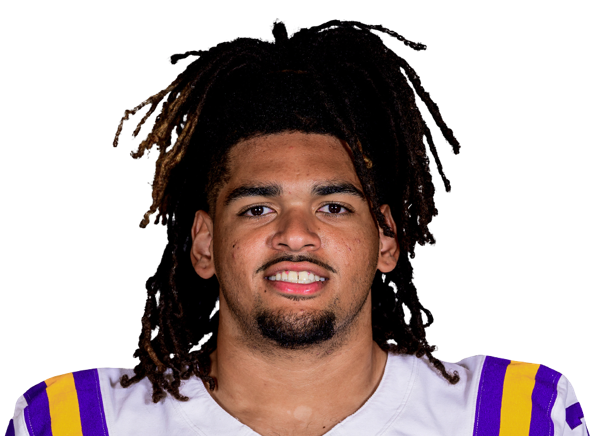
Brysten Martinez
 LSU
Freshman
LSU
Freshman
Bio
Recruiting
Scouting Report
Brysten Martinez is a 4-star Offensive Tackle from Gonzales, LA (East Ascension) in the 2026 class. Ranked No. 93 nationally, No. 17 at OT, No. 4 in LA. Composite rating: 0.9602. Committed to Louisiana State University since February 12, 2025.
Physical Profile
Listed at 6-5, 318 lbs. Taller than 12% and heavier than 85% of 2026 Offensive Tackle prospects in the SEC Scouts database (182 with a listed size).
Play Style
An athletic, long tackle who plays like a bigger tight end. He wins with his feet and reach more than raw power. He gets out of his stance quickly, takes good angles to the second level and looks comfortable in space. That fits outside zone, pin-and-pull and screen concepts. In pass protection he uses his length to push rushers wide. His coaches trusted him to move all over the formation at tight end, which reflects his football IQ and adaptability. On film he looks like a prospect whose physical tools are ahead of his technique at tackle, which is normal for a player with his size and athletic background.
Strengths
- Rare movement for his size. East Ascension used him at tight end as a senior, lining him up in-line, at H-back and even split out wide. Very few 300-pound linemen are trusted to do that, and it points to the foot speed and change-of-direction you want at left tackle.
- Length and frame for the blindside. At 6-6 he can win with his reach, set wide against edge rushers and recover when beaten early. That profile is why ESPN ranks him the No. 4 OT nationally (No. 32 in its Junior 300) and On3's Industry Ranking puts him No. 59 overall and No. 8 OT.
- Proven development. He grew from a 280-pound all-district tackle (first-team All-District 5-5A in 2024) into a 308-pound four-star. That suggests the weight room work and coachability that turn a high floor into early playing time.
- Blocking in space. His snaps at tight end and H-back meant blocking on the move, climbing to linebackers and adjusting to moving targets. That work carries over directly to zone runs, screens and pulling assignments.
Areas to Improve
- Play strength and anchor. Much of his added weight is recent, and SEC power rushers will test whether he can hold his ground against bull rushes. He needs to fill out his lower half and learn to sink his hips and absorb contact before he's ready for a full season in the SEC.
- Technical consistency at tackle. His senior-year tight end role meant fewer true pass-protection snaps from a two-point stance. He needs to sharpen his set depth, hand placement and timing against counter moves and stunts, and to stop playing high, a common habit for tall linemen.
- Finishing blocks. Like many athletic, long tackles, he can win by positioning instead of driving defenders off the ball. Adding a more physical finish in the run game would raise his floor.
College Projection
He is expected to redshirt or play a reserve role at LSU in 2026 while he strengthens his lower body and learns the finer points of tackle play. A realistic plan is to compete for a starting tackle job as a redshirt freshman or sophomore in 2027-28. His best long-term fit is left tackle, with right tackle as the likely entry point if his feet develop faster than his anchor. If the weight gain holds and he gets stronger, he projects as a multi-year SEC starter.
NFL Outlook
He has NFL-level tools: height, length and footwork that played at tight end are exactly what scouts look for in a blindside tackle. If he reaches 315-plus pounds with his movement intact and gets two or more years of starting experience in the SEC, a Day 2 selection is realistic, with Day 1 possible if his anchor and pass-protection technique develop fully. The main risk is play strength. Athletic tackles who never develop power tend to slide to swing-tackle or later-round grades.
Best Fit
A pro-style or wide-zone offense that uses athletic tackles in space and has a strong strength staff with patience to develop young linemen. LSU fits well: an in-state program with an SEC schedule that will speed up his development, plus enough offensive line depth to let him redshirt rather than force him into early playing time. Schemes built on outside zone, RPOs and screens make the most of his movement. A heavy gap-and-power offense would expose his current anchor limitations sooner.
Player Comparison
Both are elite Louisiana prospects who committed early to LSU with exceptional in-state recognition. Fournette was also a top-5 Louisiana recruit with a similar physical profile at 6'1" 230 lbs as a high school player, though he eventually grew larger. The combination of premier SEC program commitment, top Louisiana ranking, and high composite rating creates a strong parallel in recruiting pedigree and evaluation.
Current Team
Louisiana State University