
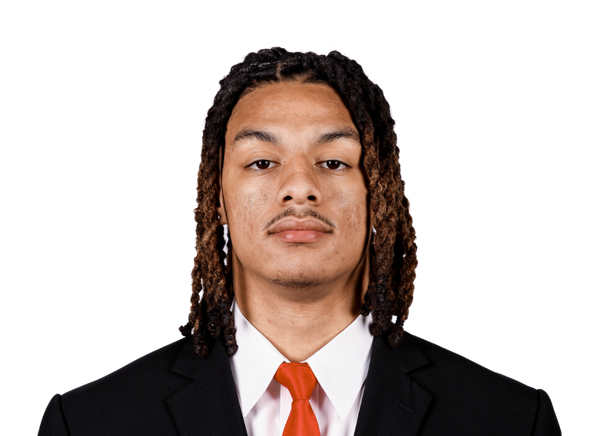

Jordan Smith
Georgia
Freshman
Bio
Recruiting
Scouting Report
Jordan Smith is a 6-foot-2, 200-pound safety out of Houston County (Warner Robins, GA) who signed with Georgia in the December 2025 early period after committing on May 11, 2025 over Florida State, Tennessee and Georgia Tech. He finished as a consensus four-star and top-140 national prospect (247Sports: No. 137 overall, No. 12 safety, No. 14 in Georgia; Rivals Industry: No. 89 overall, No. 10 safety, No. 9 in Georgia), with verified track speed — 10.67 in the 100m and 22.68 in the 200m — that is genuinely rare at his size. He is the archetype modern defenses are hunting: a long, sub-10.7 athlete who can play the post, walk down over the slot, and finish tackles in the alley.
Physical Profile
Smith grew from a listed 185 pounds at commitment to a legitimate 200 by signing day without losing timed speed, which is the single most encouraging data point in his profile. 247Sports' Andrew Ivins describes a 'high-hipped frame' over 6-2 — long-levered, with room to carry 210-215 without becoming a liability in space. The 10.67/22.68 track marks matter more than a shuttle time here: they confirm the top-end range to play single-high and the burst to close from depth on flat-breaking routes. The high-hipped build is a double-edged trait — it produces the stride length that lets him erase ground, but it also means his transitions out of a backpedal will never be as compact as a 5-11 corner's, which is precisely why safety and not boundary corner is his position. Frame, timed speed and length all fit a split-safety or single-high role at the SEC level with no projection required.
Play Style
Smith plays fast and downhill with a clear trigger — he trusts what he sees and accelerates, which is why he is 'almost always where he needs to be' in Ivins' evaluation. In the post he uses width and depth well and closes on the throw rather than sitting flat-footed. Rolled into the box he attacks blocks with leverage instead of running around them and is a willing, physical run-force player who will take on pulling linemen. In man coverage on slots he mirrors reasonably in the first five yards and then leans on recovery speed if beaten, a habit that works in Class 5A Georgia and will need refining. He is a decisive, physical, range-first safety, not a passive read-and-react center fielder — his best plays are the ones where he is moving forward.
Strengths
- Elite verified straight-line speed for the position and weight class — 10.67 in the 100m at 200 pounds gives him true center-field range and the recovery gear to survive when he guesses wrong on a route stem. This is not projected speed off film; it is timed on a track.
- Genuine positional versatility with real reps to back it. Houston County played him over the top as a free safety, dropped him into the box as a run-force defender, and lined him up at corner in man coverage. Ivins specifically credits him as 'athletic enough to handle slot coverage responsibilities' with 'the awareness to find success in a split-field role' — meaning he can be left on the field on all three downs rather than substituted by personnel grouping.
- Reliable, high-volume tackler with special-teams value. He posted 173 tackles across his sophomore and junior seasons and added roughly 86-94 more as a senior (62 solo), with multiple kickoff return touchdowns in his career including one as a senior. The tackling is technique-based and finishes, not just arrival — a real differentiator at safety, where missed tackles convert 8-yard gains into 50-yard gains.
Areas to Improve
- Ball production regressed sharply as a senior. He recorded five interceptions and seven passes defended over his first two varsity seasons, then just one interception and one-to-two passes broken up as a senior on 10-2 team. Some of that is opponents throwing away from him and some is a heavier box-safety workload, but the tape needs to show he can play the ball at its highest point and finish the catch, not just contest it. At Georgia he will not manufacture snaps on volume tackling alone — safeties there earn playing time by taking the ball away.
- Change-of-direction efficiency and pad level in his transitions. The high-hipped frame that produces his range costs him in short-area quickness; against SEC slot receivers he will get tested on option routes and double moves where he has to sink his hips and drive rather than run. Adding functional lower-body strength without adding stiffness is the developmental priority, along with route-concept recognition — high school offenses let him play reactively, and SEC pass concepts will punish a safety who diagnoses late even with his recovery speed.
College Projection
Smith signed in the December 2025 early period and is already on campus at Georgia wearing No. 28 as a true freshman for the 2026 season, so his projection is immediate and concrete rather than hypothetical. The complication is the room: Georgia's safety group includes fellow 2026 four-stars Blake Stewart and Zech Fort plus portal additions Khalil Barnes (Clemson) and Ja'Marley Riddle (ECU), which makes meaningful defensive snaps as a freshman unlikely. The realistic 2026 path is special teams — his kickoff-return background and closing speed make him an immediate coverage-unit contributor — with a redshirt or limited-package role on defense. Project a rotational nickel/dime safety in year two, a starter by year three, with the timeline accelerating if the ball skills catch up to the range. Kirby Smart's staff has a long track record of developing exactly this body type, and Smith is not a project — he is a depth-chart queue problem, which is a much better problem to have.
NFL Outlook
247Sports formally projects Smith as a fourth-to-seventh-round draft selection with a player comparison to Jordan Battle (Cincinnati Bengals), a fair and well-calibrated comp — Battle was a similarly-sized, tackle-productive Alabama safety who profiled as a versatile Day 3 pick. The floor is real: length, timed speed and reliable tackling are traits that survive the pre-draft process even if production is modest, and his special-teams value gives him a roster-making path. The ceiling above Day 3 is entirely a function of ball production. If Smith develops into a takeaway safety at Georgia rather than a volume tackler, the frame-plus-10.67-speed combination is a Day 2 athletic profile. Absent that, he projects as a backup safety and core special-teamer at the NFL level.
Best Fit
A split-safety, quarters-heavy defense that lets him play both the post and the slot rather than pinning him to one alignment — which is essentially what Georgia runs, making this a genuinely good schematic match rather than a pure blue-blood-recruiting outcome. He is best deployed as the field safety in a two-high shell with the freedom to rotate down into the run fit, where his speed covers the grass and his tackling shows up. A pure single-high Cover 3 scheme that asks him to play the deep middle on every snap would underuse his box value; a heavy man-coverage scheme that isolates him on tight ends and slots on early downs would over-expose his transitional quickness before he adds strength. He needs a defensive backs coach who will drill hip sink and ball-tracking specifically — the range and the willingness are already there.
Player Comparison
Similar elite recruiting pedigree as a top-100 national prospect from Georgia who committed early to an SEC powerhouse. The 6'2" 180 lb frame matches Waddle's lean but athletic build coming out of high school, and both showed the advanced fundamentals and football IQ that translate to multiple skill positions at the next level.