
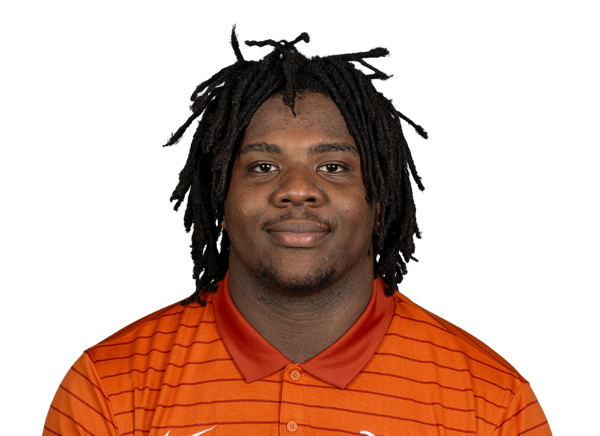
James Johnson
 Texas
Freshman
Texas
Freshman
Bio
Recruiting
Scouting Report
James Johnson is a 4-star Defensive Line from Fort Myers, FL (Miami Northwestern) in the 2026 class. Ranked No. 105 nationally, No. 6 at DL, No. 7 in FL. Composite rating: 0.9551. Committed to University of Texas since July 14, 2025.
Physical Profile
Listed at 6-3, 279 lbs. Taller than 37% and heavier than 50% of 2026 Defensive Line prospects in the SEC Scouts database (227 with a listed size).
Play Style
An upfield, penetrating interior lineman. His best reps come from a quick first step into the gap, extending his long arms to control the blocker, then finishing in the backfield. His tackle-for-loss rate points to a player who disrupts run plays at the mesh point rather than one who waits and reads. He plays with an aggressive, finishing temperament. On losing reps, his pads rise and he gets washed down the line by angle blocks or double teams. In pass rush he currently relies on get-off and effort more than a refined plan.
Strengths
- Get-off and lower-body explosion. 247Sports calls out his twitch off the snap, and his 29 tackles for loss in nine junior games (more than three per game) show a player who lives in the backfield rather than one who only eats blocks.
- Length. A nearly 82-inch wingspan on a 6-2.5 frame gives him a reach edge against interior linemen, so he can lock out, keep his chest clean and shed toward the ball.
- Schematic flexibility. Evaluators project him as able to play one-gap or two-gap, so he fits either an attacking 3-technique role or a heavier two-gap role once he grows into a 300-pound frame.
- Production over time. Across his sophomore and junior seasons he totaled 111 tackles, 42 tackles for loss and 12 sacks. The disruption was consistent, not a single breakout year.
Areas to Improve
- Pad level. 247Sports specifically flags that he plays high at times. Against college guards and double teams, a tall-playing 285-pounder gets moved off the ball, so staying low through contact is his main technical need.
- Pass-rush finishing and counter moves. He had 29 tackles for loss but only 5 sacks as a junior, so he wins penetration against the run more often than he converts it into sacks. He needs a developed counter (swim or arm-over off his length, or a push-pull) to become a three-down rusher.
- Senior-year film. He was credited with only 5 tackles and 1 QB hurry in a small number of games for Miami Northwestern in 2025. Most of his current evidence is junior tape against North Fort Myers-level competition, so his first year of college strength and conditioning and practice reps matter more than usual.
College Projection
Projects as a 3-technique or rotating interior tackle at Texas. The likely path is a situational role as a true freshman in 2026, mostly early-down run defense and interior pass-rush packages, while he adds weight toward 295–305. A realistic timeline to become a full-time starter is his second or third year, depending on how quickly his pad-level issue is fixed and how deep the Longhorns' interior rotation is.
NFL Outlook
Legitimate Day 2 draft upside if his traits develop. The combination of first-step explosion, rare length for his height and a frame that can add weight is what NFL teams look for in penetrating 3-techniques. Shorter tackles with long arms and real twitch regularly go in the first three rounds. If he consistently plays with low pads and turns backfield penetration into sacks, he could climb into the Day 1 conversation. The main risks are his thin senior-year résumé and whether he can anchor against double teams at 300+ pounds.
Best Fit
An attacking, one-gap front that lines him up as a 3-technique and lets him shoot gaps instead of absorbing blocks, with a strength staff that can add 15–20 pounds without costing him his burst. A Texas staff that rotates heavily along the defensive line and uses multiple fronts suits him well, since his two-gap potential gives the coordinators flexibility as his body matures.
Player Comparison
Similar physical profile at 6'0" 175 lbs with elite recruiting credentials as a top-50 national prospect. Both demonstrate exceptional football IQ and technical skills that translate to immediate impact despite not having prototypical size for their position, with strong relationship-building abilities evidenced by high-profile program commitments.
Transfer Portal History
Current Team
University of Texas