
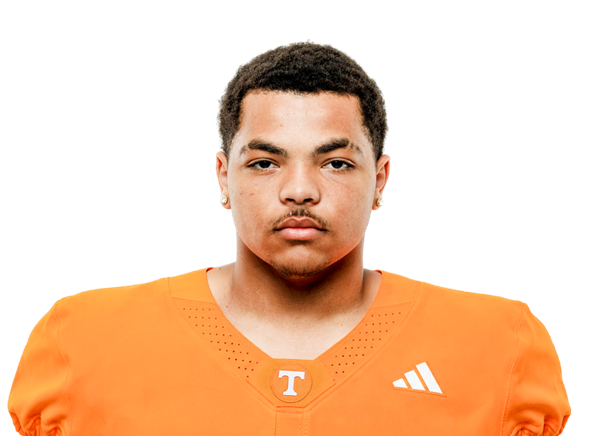
Gabriel Osenda
 Tennessee
Freshman
Tennessee
Freshman
Bio
Recruiting
Scouting Report
Gabriel Osenda is a 4-star Offensive Tackle from Airdrie, AB (Baylor School) in the 2026 class. Ranked No. 102 nationally, No. 19 at OT, No. 7 in FL. Composite rating: 0.9566. Committed to University of Tennessee since January 10, 2025.
Physical Profile
Listed at 6-8, 330 lbs. Taller than 97% and heavier than 96% of 2026 Offensive Tackle prospects in the SEC Scouts database (182 with a listed size).
Play Style
Osenda plays like a mauler. In the run game he fires off the ball, gets his hands inside, drives defenders off the ball with his upper body and angles them away from the play, and he's at his best on down blocks and double teams. In pass protection he relies on his length and anchor: once he gets his hands on a rusher, the rep usually ends there. His film shows the most dominance against high school competition that couldn't match his size. The open question is how his set and recovery hold up against long, quick edge rushers, which Baylor's schedule rarely put in front of him.
Strengths
- Run-game power: 247Sports cites 'devastating power in the run game' and says he 'clears traffic with his initial surge,' moving defensive linemen off the ball rather than just sealing them
- Blocking angles and finishing: he 'angles off defenders and generates plenty of movement,' using good leverage on down and double-team blocks, which suits a gap or duo run game
- Anchor in pass protection: his size and upper-body strength let him 'clamp down in pass protection' once his hands land, so bull rushers don't collapse the pocket
- Experience against top competition: he played in the 2025 Navy All-American Bowl as a junior and was picked for the 2026 Polynesian Bowl, and he has already played both left and right tackle in Tennessee's spring practices
- Early enrollment: he joined Tennessee in January 2026 and went through spring practice and the April 11 Orange & White Game, giving him a head start on strength work and learning the offense
Areas to Improve
- Handling speed rushes on an island: at 330+ pounds his kick-slide and ability to recover against quick edge rushers, especially in Tennessee's spread offense with wide splits, is the main thing to prove against SEC edge rushers
- Technique and consistency: he's a Canadian who arrived in U.S. high school football through Clearwater Academy in 2023, so he has fewer reps than a typical five-star. Hand timing, placement and pad level will need to improve as he learns against college-level speed
- Body management and flexibility: keeping his weight steady while improving hip and ankle bend will decide whether he stays at tackle or moves to guard
College Projection
As an early enrollee who repped at both tackle spots in the spring, Osenda is ahead of most 2026 linemen. The most likely path is swing-tackle or backup work plus special teams in 2026, with a redshirt possible depending on depth, then a real shot to compete for a starting tackle job in 2027 under offensive line coach Glen Elarbee. If his pass-protection technique comes along, he can be a three-year starter at tackle. If it doesn't, his power makes him a natural fit at guard.
NFL Outlook
His five-star ranking, size and the Ersery comparison point to a day-two draft ceiling (rounds 2-3), with first-round upside if he proves he can hold up against speed rushers at tackle. His floor is an NFL guard or right tackle, given how well his run-blocking power translates. The key years for his draft stock will be his redshirt sophomore and junior seasons (2028-29).
Best Fit
A program that runs gap, duo or inside-zone concepts and wants its tackles to move defenders off the ball, with patient development through a redshirt year and strong strength coaching. Tennessee fits: Elarbee's line room has turned big, less polished tackles into starters, and although Heupel's tempo offense uses wide splits, its run game is built on downhill power. He would do best at right tackle early, where there's slightly less pressure from elite speed rushers, before any move to left tackle.
Player Comparison
Smith was a similarly elite-rated recruit (5-star) who chose Tennessee and had the rare combination of elite size at 6'6" 321 lbs with surprising athleticism for his frame. Like this prospect, Smith was highly versatile early in his career and developed into a dominant interior lineman, suggesting this 6'7" 345 lb prospect could follow a similar developmental path from raw athletic talent to polished starter.
Current Team
University of Tennessee