
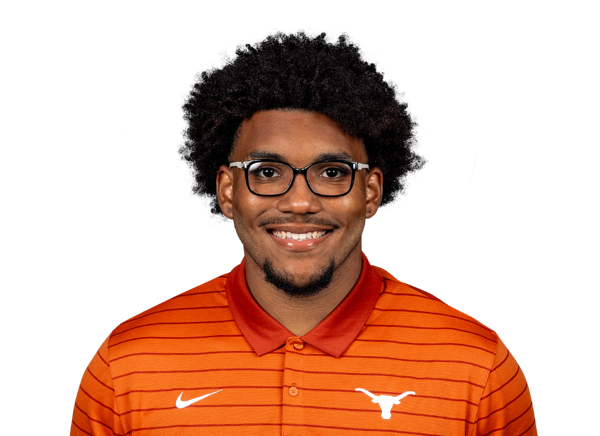
John Turntine
 Texas
Freshman
Texas
Freshman
Bio
Recruiting
Scouting Report
John Turntine is a 4-star Offensive Tackle from Fort Worth, TX (North Crowley) in the 2026 class. Ranked No. 83 nationally, No. 3 at OT, No. 6 in TX. Composite rating: 0.9635. Committed to University of Texas since July 3, 2025.
Physical Profile
Listed at 6-4, 295 lbs. Taller than 1% and heavier than 51% of 2026 Offensive Tackle prospects in the SEC Scouts database (182 with a listed size).
Play Style
Turntine plays with a power base. He is best driving defenders off the ball on inside zone and down or double-team blocks, where his lower-body strength does the most work. He gets out of his stance quickly and has good hip roll into contact, and his hands are strong enough to take control of a defender once he locks on. In pass protection he is more solid than flashy. He wins by keeping his weight low and anchoring, not by mirroring rushers in space. That is a big reason evaluators see him fitting best at guard or center. The staff has moved him between both tackle spots as a freshman, which suggests they value his football IQ and his ability to handle different assignments.
Strengths
- Pedigree against top competition: he was a starter on North Crowley's 16-0 Class 6A Division I state title team, which is the highest level of Texas high school football, and he was named a MaxPreps first-team junior All-American
- Explosive power: his throwing numbers (48-11 shot put, 158-1 discus) show up on film as a strong first punch and the ability to move defenders off the ball in the run game
- Versatility: he played tackle in high school and has already practiced at both LT and RT at Texas (second-team RT in camp, third-team LT on the season-opening depth chart), while scouts project him inside. That gives Texas at least three positions where he can help
- Physically ready early: he gained weight quickly after enrolling early and made the two-deep as a true freshman. Both are unusual for an 18-year-old lineman and point to strong work habits and fast adaptation to a college strength program
Areas to Improve
- Pass protection on the edge against length: at 6-4, he needs very efficient set points, strong hand placement and an exact kick-step to handle long SEC edge rushers. If his arms measure short, a move to guard is the likely answer
- Hand technique and leverage against college-level interior defenders: high school opponents rarely tested his hand replacement and counters against stunts and twists. He will need to be more disciplined with inside hands and keep his pad level low through the whole rep
- Adding strength without losing movement: he needs to reach 305-315 lb to play guard in the SEC, and he has to get there without losing the quickness he needs for pulls and reach blocks in Texas's run game
College Projection
He is a true freshman early enrollee who is already on the two-deep (third-team LT, has worked as second-team RT). A redshirt in 2026 is still realistic. He can play up to four games and keep the year, and he can serve as swing depth if injuries hit. The likeliest path is to compete for a starting guard spot in 2027 as a redshirt freshman and become a full-time starter in 2027-28. If he shows the length and balance to stay outside, he could become the starting right tackle instead. Either way, he projects as a multi-year starter under offensive line coach Kyle Flood.
NFL Outlook
Turntine has a mid-round NFL draft profile with room to climb, most likely as an interior lineman. NFL teams generally like guards around 6-4 with a powerful base and good athleticism, and if he stays around 310 lb without losing movement, he fits that profile. If he starts two or three years at guard in the SEC and plays well, a Day 2 pick (rounds 2-3) is a realistic ceiling. The most likely range is Day 2 to early Day 3, depending on arm length and how consistent he is in pass protection. Being able to play guard and tackle, and possibly center, would help his value.
Best Fit
A pro-style or gap/zone hybrid offense that asks guards to pull, move defenders off the ball on double-teams and play downhill. That describes Texas's current offense under Steve Sarkisian and Kyle Flood. He also fits a program that develops linemen patiently, because his long-term value is as a powerful interior blocker who can also fill in at tackle, not as a quick fix at left tackle.
Player Comparison
At 6'3" 260 lbs with elite recruiting metrics, this prospect mirrors Garrett's physical profile and blue-chip pedigree coming out of Texas. Both were top-100 national recruits with exceptional composite ratings who committed early to premier programs, suggesting similar elite athleticism and technique that translates across multiple defensive positions.
Current Team
University of Texas