
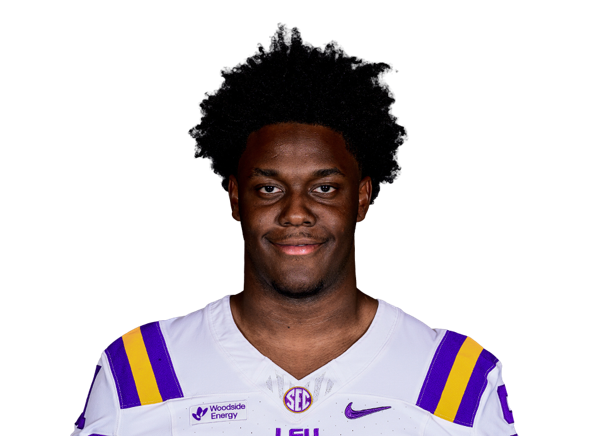
Trenton Henderson
 LSU
Freshman
LSU
Freshman
Bio
Recruiting
Scouting Report
Trenton Henderson is a 4-star Edge Rusher from Pensacola, FL (Pine Forest) in the 2026 class. Ranked No. 86 nationally, No. 20 at EDGE, No. 15 in FL. Composite rating: 0.9629. Committed to Louisiana State University since July 1, 2025.
Physical Profile
Listed at 6-4, 243 lbs. Taller than 54% and heavier than 70% of 2026 Edge Rusher prospects in the SEC Scouts database (169 with a listed size).
Play Style
He usually lines up in a wide alignment, often standing up, and plays like a speed-to-bend rusher. He gets up the field, dips his shoulder under the tackle's reach and flattens toward the quarterback. His 20 hurries in 10 junior games show he was around the quarterback a lot even when he didn't finish the sack. Against the run he is more of a pursuer who chases from the backside than a player who sets the edge at the point of attack. He takes good angles and runs down plays across the field. In coverage he looks comfortable backpedaling and reading the quarterback, which is uncommon for an edge prospect this size. Right now he wins mostly with athleticism rather than a planned sequence of rush moves.
Strengths
- Wins the edge with speed and bend. 247Sports' Andrew Ivins says he uses fluidity to get around the edge. That showed in his junior year at Pensacola Catholic: 50 tackles, 18 TFL, 10 sacks and 20 QB hurries in 10 games, so his rush turns into pressure consistently, not just now and then.
- Can drop into coverage. He can play the flats and hook zones, which makes him a real fit at a hybrid outside linebacker spot. It also lets a defense show pressure and bring it from somewhere else, and gives him a way onto the field before his pass rush is fully developed.
- Makes plays in space and has good length. Six pass breakups as a junior, plus a blocked punt and a blocked field goal as a senior, show that he uses his length and gets his hands up and into passing lanes. That translates to special teams right away.
- Well regarded around the country: about 34 offers from programs like Alabama, Georgia, Michigan, Notre Dame, Texas, USC and Oklahoma. He stuck with LSU through a coaching change (the Tigers are now under Lane Kiffin) and was ranked the No. 1 EDGE in Florida at signing by some outlets.
Areas to Improve
- Power and hand technique. Ivins notes he needs to add power and develop his hands. He doesn't yet have a reliable bull-rush or long-arm move to use when a tackle over-sets against his speed, and he needs a counter move (like an inside spin or a cross-chop) so SEC tackles can't simply run him past the quarterback.
- Setting the edge against the run. At his high school weight he could lose ground against down blocks and tight end–tackle double teams. He needs to hold his spot with his outside arm free before he can be an every-down player. His senior dip (35 tackles, 8 TFL, 4.5 sacks after transferring to Pine Forest) also suggests he produced less when offenses built their game plans around him.
College Projection
In 2026 he projects as a rotational pass rusher on third downs and a special-teams player, with a redshirt still an option depending on LSU's depth. By 2027, at about 250 lbs, he should compete for a larger rotational role at the hybrid outside linebacker spot. He becomes a starting candidate by his third year if the strength work pays off. His ceiling is a double-digit-sack SEC edge rusher, but he'll most likely become a quality contributor at that level in his second or third season rather than dominating right away.
NFL Outlook
247Sports projects him as a Day 2 NFL pick (rounds 2-3) who will need development, and compares him to Kyle Kennard (Los Angeles Chargers), another lean, bendy edge who got stronger and produced more over time in college. His draft value depends on reaching 250+ lbs without losing his burst, adding a reliable power move and a counter, and proving he can hold up against the run. If he does that, his length, bend and ability to drop into coverage fit what NFL teams look for in a 3-4 outside linebacker. If his strength doesn't develop, he likely stays a situational pass-rush specialist and a mid-round pick.
Best Fit
An aggressive multiple or 3-4 front that uses a stand-up hybrid edge, puts him in wide alignments, stunts and games to free him in space, and uses simulated pressures where he sometimes drops into coverage. He also needs a strong strength-and-conditioning program to put mass on his frame. LSU's defensive system and SEC-level strength staff fit this well, as long as the staff brings him along as a rotational rusher first instead of asking him to play every down before he's ready physically.
Player Comparison
Jones had similar size at 6'1" 222 lbs with elite athleticism that allowed positional flexibility during recruitment. Like this prospect, he was a highly-rated recruit who committed to LSU and possessed the rare combination of size and speed that made him projectable at multiple positions before settling at linebacker in college and becoming an NFL starter.
Current Team
Louisiana State University