
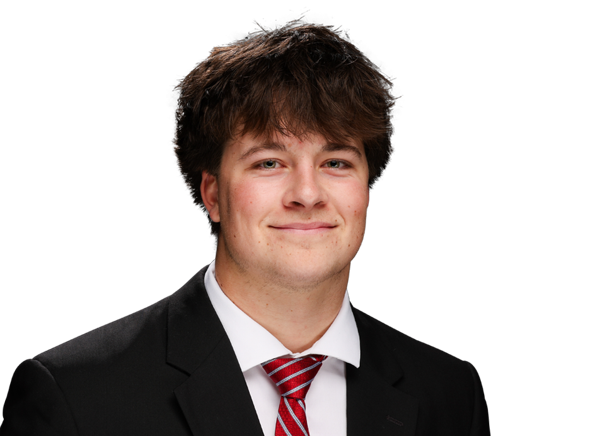
Jett Thomalla
 Alabama
Freshman
Alabama
Freshman
Bio
Recruiting
Scouting Report
Jett Thomalla is a 4-star Quarterback from Omaha, NE (Millard South) in the 2026 class. Ranked No. 48 nationally, No. 8 at QB, No. 1 in NE. Composite rating: 0.9794. Committed to University of Alabama since June 16, 2025.
Physical Profile
Listed at 6-4, 229 lbs. Taller than 80% and heavier than 97% of 2026 Quarterback prospects in the SEC Scouts database (128 with a listed size).
Play Style
Thomalla is a timing-and-rhythm pocket passer who ran a high-volume, high-efficiency passing offense at Millard South. He is at his best taking the quick game and intermediate concepts on schedule: drop, hitch and fire with a quick release. He adds enough arm to threaten vertically and drive the ball outside the numbers. When the play breaks down, the point-guard feet let him slide, reset and throw from different platforms rather than tuck and run. His low interception rate reflects a conservative risk profile: he takes the completion the defense gives him more often than he forces the shot.
Strengths
- Production and efficiency with ball security: as a senior he completed 193 of 266 passes (72.6%) for 3,484 yards, 58 TDs and 5 INTs, after a junior year of 3,663 yards, 47 TDs and 3 INTs. That's 105 TDs to 8 INTs over two seasons, which points to sound decisions, not just a big arm.
- Arm talent and release: NextGen Logic grades his arm strength as elite with a snap release. He can make the whole field of throws, including the deep out and outside-the-numbers throws from the far hash that SEC coaches look for.
- Pocket presence and footwork: evaluators call his pocket presence and footwork very good. His feet stay tied to his reads, and he climbs the pocket and slides away from pressure instead of bailing out.
- Rhythm passer who can also improvise: scouting notes say he 'can win in rhythm and within the system as well as off script when the play breaks down', so he gives you both on-schedule execution and playmaking when a play breaks down.
- Big-game results: he won back-to-back Nebraska Class A titles and went 11-1 as a senior. He tied the state single-game record with seven TD passes in both the semifinal and the final, and he was Gatorade and MaxPreps Nebraska Player of the Year and an Elite 11 finalist.
Areas to Improve
- Level-of-competition jump: Nebraska Class A defenses rarely showed him the disguised coverages, simulated pressures or NFL-caliber pass rush he'll see in the SEC. Expect a learning curve on post-snap reads and on identifying pressure pre-snap.
- Processing speed under pressure: prep defenders were often late to close his throwing windows. He'll need to speed up his progression reads and learn to throw with anticipation into windows that close a half-count sooner in college.
- Designed run value: he is a mobile pocket passer, not a dual-threat. He can extend plays, but he won't give an offense the QB-run element, so his value depends almost entirely on passing efficiency.
College Projection
He is already on campus and sits third on Alabama's 2026 depth chart behind starter Keelon Russell and Austin Mack. As of the Sept. 5 opener against ECU, no 2026 game snaps for him had turned up. The realistic path is a development year in 2026, most likely preserved as a redshirt under the four-game rule, and then a real competition for QB2 in 2027. Russell's timeline sets the ceiling: if Russell stays through 2027, Thomalla's likely starting window is 2028 as a redshirt sophomore. An injury or transfer-portal movement could move that up.
NFL Outlook
247Sports (Andrew Ivins) compared him to Daniel Jones and projected a Day 2 NFL pick. The traits that NFL teams draft are already there: height, arm talent, release and pocket movement. Whether he goes as a first-round quarterback or a Day 2 developmental one will depend on how quickly he processes SEC defenses and how many starts he gets. A multi-year starter at Alabama with his efficiency profile would fit the league's pocket-passer mold well.
Best Fit
A pro-style or spread offense built on a pocket passer, with quick-game and RPO rhythm throws plus vertical play-action shots. That describes Alabama's current system, which uses a QB-friendly, timing-based passing structure and has elite perimeter receivers to maximize his accuracy and release. He fits best where he gets a development year before starting. He is not suited to a QB-run-heavy option scheme.
Player Comparison
Similar elite recruiting profile as a 4-star prospect who committed early to Alabama, with the versatile 6'3" 200lb frame that Saban values for multiple positions. Both prospects showed the high football IQ and fundamental skills that translate to immediate impact at the college level, with Ridley demonstrating how Alabama develops top-tier talent into NFL-ready players.
Current Team
University of Alabama