
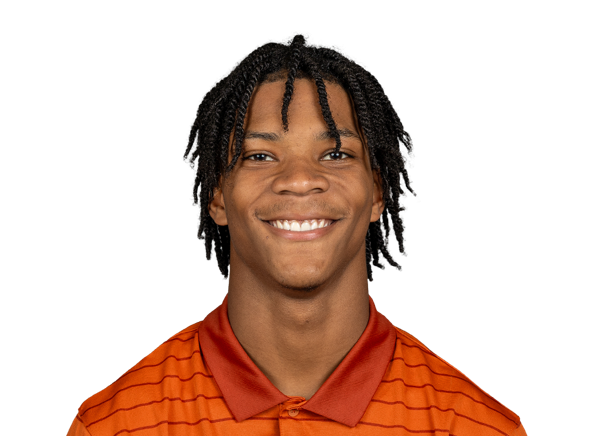
Jermaine Bishop Jr.
 Texas
Freshman
Texas
Freshman
Bio
Recruiting
Scouting Report
Jermaine Bishop Jr. is a 4-star Athlete from Willis, TX (Willis) in the 2026 class. Ranked No. 58 nationally, No. 2 at ATH, No. 18 in TX. Composite rating: 0.9738. Committed to University of Texas since May 13, 2025.
Physical Profile
Listed at 6-0, 166 lbs. Taller than 33% and heavier than 16% of 2026 Athlete prospects in the SEC Scouts database (150 with a listed size).
Play Style
On film he plays like a quick-twitch vertical separator who can also win underneath. He sells routes, stacks defenders on posts and go routes, and turns short catches into chunk plays with his burst and ability to set up defenders in space. Willis moved him around the formation, got him the ball on jet sweeps and screens, and used him as a runner, so he is comfortable with the ball in his hands in the open field. On defense he shows ball skills and closing speed that project to nickel or corner. He is instinctive and aggressive rather than physical, which lines up with his frame.
Strengths
- Big-play production against high-volume competition: as a senior at Willis he had 120 catches for 1,940 yards and 20 TDs, plus 424 rushing yards and 8 rushing TDs. He is the Houston area's all-time career receiving-yards leader (3,601 yards through his junior year alone), which shows sustained production, not one hot season.
- Two-way ability: he also had 86 tackles and 4 interceptions as a senior. Texas has worked him at defensive back in summer workouts, and Steve Sarkisian has said he 'can play all three positions' at receiver (X, Z and slot). That flexibility gives the staff more ways to get him on the field and protects his value.
- Separation and yards after the catch: he is sudden out of his breaks and hits top speed quickly after the catch. 247's Gabe Brooks compared him to Jordan Addison, a route-savvy separator more than a big-bodied target. He is also useful in the return game.
- Ready early: he got on the field in the opener as a true freshman. Against No. 1 Ohio State his speed on a post route drew a pass-interference penalty on CB Devin Sanchez, and he contributed on kickoff coverage and punt returns.
Areas to Improve
- Strength and play strength: at 165 lbs he has to add mass to beat press coverage, finish contested catches and block on the perimeter in Texas's run-heavy RPO looks. That is the difference between a rotational slot and an every-down starter.
- Catch consistency and detail: he dropped 1 of 3 targets in his debut against Texas State. Refining his route stems and releases against SEC-level corners, and sticking at one primary position instead of splitting reps between WR and DB, will speed up his development.
College Projection
He is already contributing. Through three games of 2026 he is Texas's co-backup in the slot with Daylan McCutcheon, behind Ryan Wingo and DeAndre Moore Jr.-era veterans such as Coleman, with a steady role on special teams: 2 catches for 25 yards vs Texas State, 1 solo tackle vs Ohio State, 2 catches for 22 yards vs UTSA. Realistic timeline: a rotational slot and return role in 2026, a starting-caliber receiver job in 2027 once he adds 10-15 lbs, and a potential primary target by 2028. A full-time move to nickel or corner remains a real option if Texas's receiver depth chart stays crowded.
NFL Outlook
He has first-round tools and was projected as a first-rounder in 247's evaluation. The comparison to Jordan Addison, a first-round slot/Z separator, fits his profile. His draft stock will depend on getting to about 175-180 lbs and producing at the level his tools suggest by his third year. If he does, he projects as a Day 1-2 slot/Z receiver whose return and possible defensive back value add to his stock. If he stays under 170 lbs, he looks more like a Day 2-3 slot and return specialist.
Best Fit
A spread or RPO offense that moves receivers around pre-snap and creates isolation and space throws. Texas under Sarkisian is close to ideal: the staff is already using him at X, Z and slot, can use his return and defensive back ability, and has the strength program his frame needs. He is best in a scheme that lets him play the slot/Z and get manufactured touches rather than line up as a pure boundary X against press coverage every snap.
Player Comparison
Austin shared a nearly identical physical profile at 5'8" 174 lbs with elite speed and agility that made him dangerous in multiple roles. Like Bishop, he was a highly-rated 4-star recruit who could impact games as a receiver, returner, or gadget player, maximizing his athleticism despite smaller stature. Both prospects represent that rare combination of elite ratings with compact frames, suggesting exceptional football instincts and versatility that compensate for size limitations.
Current Team
University of Texas