
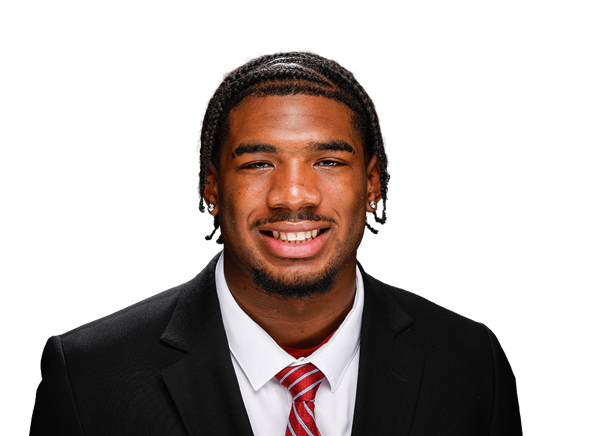
Jamarion Matthews
 Alabama
Freshman
Alabama
Freshman
Bio
Recruiting
Scouting Report
Jamarion Matthews is a 4-star Defensive Line from Huntsville, AL (Gainesville) in the 2026 class. Ranked No. 62 nationally, No. 12 at DL, No. 6 in GA. Composite rating: 0.9718. Committed to University of Alabama since February 20, 2025.
Physical Profile
Listed at 6-2, 254 lbs. Taller than 14% and heavier than 16% of 2026 Defensive Line prospects in the SEC Scouts database (227 with a listed size).
Play Style
A downhill, power-based rusher who plays with urgency. He knocks tackles back with the bull rush, collapses the pocket and shows good closing speed once the quarterback is in reach. Against the run he sets a firm edge and chases plays from the backside. Most of his tackles for loss are penetration plays, not cleaning up behind the line. He is more of a heavy-handed end than a speed rusher.
Strengths
- Proven production: as a junior at Sparkman he had 57 tackles, 29 TFL, 17 sacks and 15 QB hurries in 10 games and led the state of Alabama in sacks. Against tougher Georgia 7A-level competition as a senior he added about 8-10 sacks and 18-21 TFL.
- Power and pad level: he wins with leverage and a strong bull rush from a low pad level, which suits a player built lower than the typical edge.
- Motor and effort: evaluators note a relentless motor, and many of his sacks and TFLs come from pursuit and second effort, not just his first move.
- Versatility: in high school he played 3-tech, 4i, 5-tech and stand-up edge. At Alabama that lets him play Wolf, base end and interior pass rusher.
- Physically ready: he enrolled early (January 2026), added weight and made the Wolf depth chart as a true freshman.
Areas to Improve
- Linebacker-specific skills at Wolf: dropping into coverage, spot drops and matching running backs in the flat were never part of his high school role, and those are the biggest adjustments to the position.
- Countering bigger tackles: with average length he needs a deeper set of hand moves (long-arm, cross-chop, inside counter) to keep offensive tackles from locking him up.
- Bend around the edge: his rush path is power-first, and he needs to improve ankle flexibility and his ability to turn the corner to finish outside rushes against SEC tackles.
- Body composition: at 256 pounds he needs to keep his first-step burst as he adds mass. If the extra weight costs him speed, his long-term position may move toward end or 3-tech.
College Projection
He is already on Alabama's 2026 Wolf depth chart, roughly fourth or fifth. Veterans such as Jah-Marien Latham are ahead of him, and no 2026 game stats were found through Week 3. Expect special teams and occasional pass-rush snaps in 2026 (with a redshirt possible under the four-game rule), a role as a rotational pass rusher in 2027, and a starting case in 2028. Two paths are open: (1) he develops coverage skills and sticks at Wolf, or (2) he keeps adding weight and becomes a base end or interior pass rusher. 247's evaluator had already projected him best as a 3-tech or 4i.
NFL Outlook
He projects as a Day 2 prospect (rounds 2-3) if his production grows, fitting the power-rusher mold. 247 compared him to Brandon Dorlus, an inside/outside player. His draft ceiling depends on the position he settles into. As an undersized edge he needs strong sack numbers to offset his lack of length. As a 4-3 end or sub-package interior rusher, his power and motor are the kind of traits NFL teams draft on.
Best Fit
A multiple front that uses a hybrid Wolf / big end who can rush from wide alignments and move inside on passing downs, which is what Alabama runs now. He is less suited to a scheme that needs a long, speed-first 3-4 outside linebacker who drops into coverage often. His best use is a stand-up or hand-down rusher who attacks straight upfield.
Player Comparison
Smith had a similar physical profile at 6'1" 235 lbs with elite athleticism and was Georgia's top-rated linebacker recruit. Like this prospect, Smith was an early commit to an elite program (Georgia) with a composite rating in the mid-90s, suggesting similar recruiting pedigree and the type of instinctive, athletic linebacker that championship programs prioritize.
Current Team
University of Alabama