
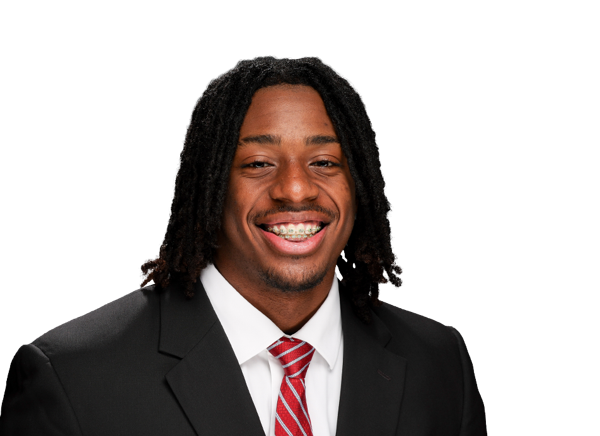
Cederian Morgan
 Alabama
Freshman
Alabama
Freshman
Bio
Recruiting
Scouting Report
Cederian Morgan is a 4-star Wide Receiver from Alexander City, AL (Benjamin Russell) in the 2026 class. Ranked No. 44 nationally, No. 14 at WR, No. 3 in AL. Composite rating: 0.9807. Committed to University of Alabama since July 1, 2025.
Physical Profile
Listed at 6-4, 222 lbs. Taller than 91% and heavier than 98% of 2026 Wide Receiver prospects in the SEC Scouts database (329 with a listed size).
Play Style
Morgan plays as a size-and-speed outside receiver who wins at the catch point. On film he is a vertical threat on go routes, back-shoulder throws and fades, where he gets position with his frame and high-points the ball over defenders. What stands out is how smoothly he moves for a 6-4 player. He builds speed well on the stem, tracks the ball in the air without breaking stride, and adjusts to off-target throws with an 'enormous catch radius', as 247 put it. He is used as a primary option on quick game, slants and screens, where he runs through arm tackles. His basketball background shows in how he uses his body to shield defenders, times his jumps, and finishes through contact.
Strengths
- Contested catches: he consistently high-points the ball and uses his 6-8 high-jump vertical and rebounding instincts to beat smaller corners. 247Sports calls him 'dominant in contested scenarios', which makes him a real 50-50 and red-zone weapon.
- Long speed for his size: 21.74 in the 200 lets him win vertically, not just jump over people. That showed up in 17.3 yards per catch as a senior and 16.6 as a junior against defenses built to stop him.
- Fluid movement for a big receiver: evaluators point to 'physical refinement and nuance in regards to fluidity and locomotion.' He can open his hips and run the full route tree instead of living only on go routes and fades.
- Steady production growth: 36-622-4 as a sophomore, 70-1,162-14 as a junior and 82-1,419-16 as a senior, with his volume and efficiency rising every year as the clear focus of opposing game plans.
- Run after the catch: his size and strength make him hard to bring down on quick screens and slants, and the 247 comparison to Savion Williams points to a big body who can be a ball-carrier after the catch.
Areas to Improve
- Getting off press coverage: in high school he usually just beat smaller defenders physically. Against SEC corners who can match his length, he needs a real release plan, with hand fighting, footwork and a counter move, so he isn't slowed down at the line.
- Short-area burst and route precision: his 11.19 in the 100 and his long-strider build mean his breaks can get rounded. Sinking his hips on comebacks, digs and out-breaking routes will decide whether he is a complete X or mostly a vertical and red-zone option.
- Blocking and consistency: like most receivers who are also multi-sport and track athletes, he needs to build the strength and effort to be a dependable perimeter blocker in Alabama's run game. That is also often the first thing that earns early snaps.
College Projection
In 2026 he projects as a rotational outside receiver who could win red-zone and third-down packages early, since contested catching carries over immediately even before his route running is polished. Reaching 223 pounds by spring shows his body is developing on schedule. A realistic path is limited but meaningful snaps as a freshman, a starting boundary X job by his second year, and WR1 production in years 2-3 once his release package and route precision catch up to his physical tools. Alabama's track record with outside receivers and its pass-oriented approach, both of which he cited when he committed, fit how he develops.
NFL Outlook
His NFL projection is based on traits. 247Sports calls him a player with 'traits that suggest long-term NFL Draft high-round potential' and projects him as a possible Day 2 pick. A 6-4, 220-plus receiver with sub-22-second 200 speed and elite leaping ability will test well at the combine and fits the big-X mold NFL teams value. Moving into the Day 1 conversation will depend on showing he can beat press coverage and run sharp intermediate routes in the SEC, not just win jump balls. If his route running develops, he is a likely early-entry candidate after his third season.
Best Fit
A pro-style or spread offense with a quarterback who throws vertically and trusts receivers on back-shoulder and 50-50 balls, and that lines him up mostly at the boundary X spot. He is most valuable where he gets isolated one-on-one looks, can be moved to the slot to create size mismatches, and is fed in the red zone. Alabama fits that profile. It would get the most from him by pairing his contested-catch value with a quick-game package that uses his run-after-catch ability, while its receiver coaching speeds up his work against press.
Player Comparison
Both share the ideal 6'4" 220 lb frame that suggests versatility between safety and linebacker roles, along with elite recruiting pedigree as top-80 national prospects who chose Alabama early. Fitzpatrick's combination of size, athleticism, and football IQ that made him a Day 1 NFL pick mirrors the profile traits that would earn a similar rating and early Alabama commitment.
Current Team
University of Alabama