
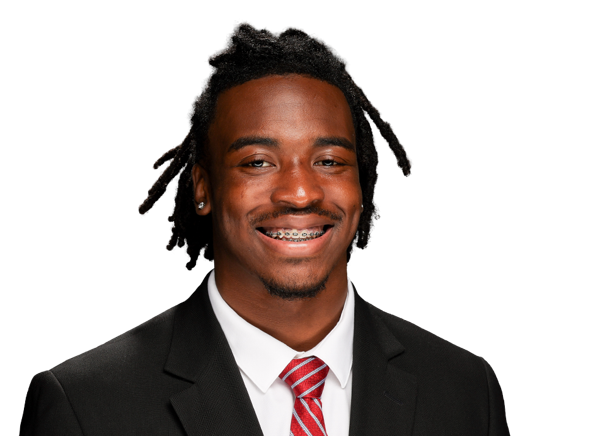
Jireh Edwards
 Alabama
Freshman
Alabama
Freshman
Bio
Recruiting
Scouting Report
Jireh Edwards is a 5-star Safety from Largo, MD (St. Frances Academy) in the 2026 class. Ranked No. 33 nationally, No. 5 at S, No. 4 in MD. Composite rating: 0.9850. Committed to University of Alabama since July 4, 2025.
Physical Profile
Listed at 6-2, 218 lbs. Taller than 75% and heavier than 100% of 2026 Safety prospects in the SEC Scouts database (200 with a listed size).
Play Style
An aggressive, instinctive safety who plays downhill and 'plays angry' before, during and after the whistle. His film is best when he starts at 8-10 yards and attacks: filling the run, reading run versus pass quickly, and knocking the ball carrier backward. He blitzes with good timing and doesn't tip the pressure early. In coverage he is most comfortable matching up in man on tight ends and slot receivers, and he is physical at the catch point. St. Frances moved him around the defense (deep half, robber, box/star), so he has already handled the multiple roles a college safety is asked to play. He tracks the ball well; Wommack described his 'phenomenal tracking of the ball.' His next step is doing that just as well from deep alignments.
Strengths
- Run defense that makes plays in the backfield: 92 tackles, 17 tackles for loss and 3 forced fumbles as a junior in 2024, when he was a MaxPreps Junior All-American. Seventeen TFLs is a lot for a safety and comes from reacting fast and hitting through contact. 247's evaluation says he 'explodes through contact' and has 'elite reaction times.'
- Man coverage on tight ends and slot receivers: 247's camp evaluation (Hudson Standish) noted he 'consistently mirrored receivers,' with an interception and several pass breakups in one session. He had 6 PBUs as a junior. This lets a defense leave him one-on-one with a tight end or big slot instead of adding help.
- Pre-snap smarts and blitzing: Alabama defensive coordinator Kane Wommack called him 'one of the most instinctive playmakers' he has seen out of high school and said his 'blitz IQ and awareness is really high.' 247 says he has 'green dot potential,' meaning he could one day wear the helmet radio and call the defense.
- Toughness and quick grasp of the playbook: he was in team meetings two days after arm surgery and made a tackle for loss on 2nd-and-1 at Kentucky 19 days after the operation, while also playing special teams. Nick Saban's successor Kalen DeBoer publicly praised his toughness.
Areas to Improve
- Deep-coverage technique: 247's main criticism is body positioning and angle discipline against vertical routes. When he plays deep in a single-high look, he tends to get pulled downhill, which opens seams and post routes behind him. He needs to get more consistent with his backpedal-to-turn transition and with keeping his angles on deep balls.
- Controlled tackling in space: his aggressive style is a strength near the line, but in the open field he needs to break down and fit under control more often instead of going for the big hit. SEC ball carriers will punish overruns more than high school opponents did. He also needs to show he can play a full workload after the arm injury.
College Projection
He is already contributing as a true freshman after enrolling early. Before the injury Alabama projected him as a rotation player rather than a Day 1 starter, and the plan is to use him in specific packages (sub-package safety/star, pressure looks) plus special teams while he recovers. A realistic path: a package and special-teams role in 2026, a push for a starting job at strong safety or star in 2027, and a multi-year starter and possible defensive signal-caller by 2028. How fast he gets there depends mostly on cleaning up his deep-coverage technique so coaches trust him in two-high and single-high looks, not just as a box player.
NFL Outlook
He has Day 2 talent with a chance at Round 1 if he develops his deep coverage. 247 comps him to Lewis Cine (a first-round safety), and its evaluation compared him to Malaki Starks with a Day 2 projection. His size (about 6-2/218), speed (4.48), run-defense production and ability to cover tight ends are exactly what NFL teams want in a modern strong safety or big nickel who can match tight ends. The most likely outcome is a starting strong safety with special-teams value early in his career. The earliest he could enter the draft is 2029.
Best Fit
A multiple, pressure-heavy defense that rotates its safeties and uses a star/nickel spot, like Wommack's Alabama scheme. It should let him play down in the box, blitz from depth, and match up with tight ends in man coverage, while mostly using two-high shells that protect him from long stretches as the lone deep safety. He is less suited to a strict single-high, Cover-1/Cover-3 system that asks one free safety to guard the whole deep middle.
Player Comparison
Similar physical profile at 6'1" 207 lbs with elite versatility and football IQ. Both prospects share the pedigree of elite high school programs and early Alabama commitments, suggesting similar character profiles and developmental potential that Saban's program values in multi-dimensional defensive backs.
Current Team
University of Alabama