
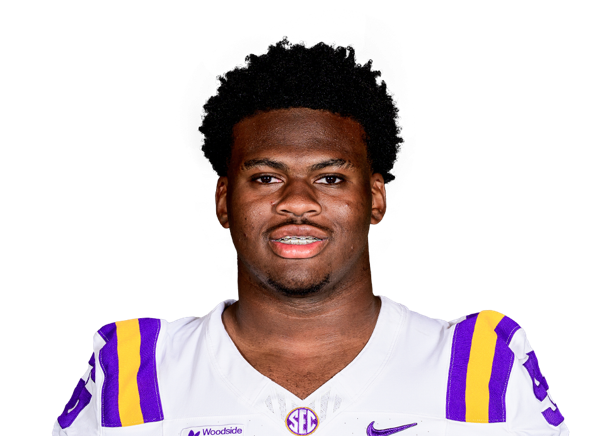
Lamar Brown
 LSU
Freshman
LSU
Freshman
Bio
Recruiting
Scouting Report
Lamar Brown is a 5-star Athlete from Erwinville, LA (University Lab) in the 2026 class. Ranked No. 3 nationally, No. 1 at ATH, No. 1 in LA. Composite rating: 0.9986. Committed to Louisiana State University since July 9, 2025.
Physical Profile
Listed at 6-4, 295 lbs. Taller than 87% and heavier than 99% of 2026 Athlete prospects in the SEC Scouts database (150 with a listed size).
Play Style
Brown plays like a power-first lineman who attacks blockers. He gets his hands on the blocker quickly, stays low and uses his long arms to lock out and control the gap before shedding to the ball. Against the run he sets a hard edge and pushes tight ends backward into the backfield, and he penetrates well enough to blow up zone runs at the mesh point. As a pass rusher he currently wins with bull rushes and quick-twitch speed-to-power more than pure bend. His offensive-line background shows in how he reacts to down blocks and double-teams. His motor and range let him chase plays down the line to the sideline, which is uncommon at his weight.
Strengths
- Can play almost anywhere on the line. Recruiting services graded him a five-star as an interior offensive lineman and as a defensive lineman, which is very rare. At LSU he has lined up on the edge and can move inside to 3-technique on passing downs, so coordinators can use him in odd, even and sub-package fronts.
- He had 29 tackles, 9 TFL, 3 sacks and 2 forced fumbles as a senior in 2025. The TFL-to-sack ratio fits the scouting view that he wins by getting into the backfield against the run and blowing up plays early, not by piling up sacks against weak blockers.
- He is ready for college football right away. He did not enroll early and missed spring practice, but he still competed for first-team reps in his first fall camp. Lane Kiffin publicly praised him, and Kiffin and defensive coordinator Blake Baker both said he will play at least a rotational role in 2026.
- His years as an offensive lineman help him on defense. He understands blocking angles, pad level and how offensive linemen set their hands, so he reads down blocks and pulling guards better than a typical freshman defensive lineman.
Areas to Improve
- Pass-rush moves. His 3 senior sacks against Louisiana high school competition suggest he beat blockers mostly with size and power. To stay on the edge in the SEC he needs a planned rush plan: a reliable first move (long-arm or cross-chop), a counter inside, and better bend around the corner against 6-6 offensive tackles who have long arms.
- Settling on one position. He split his development between offense and defense in high school, so his defensive technique is behind his talent. Getting consistent reps at one spot, whether edge or 3-technique, will matter more than raw athleticism in Year 1. He also had a brief injury scare in fall camp, so how well he holds up over a full SEC season is still unknown.
College Projection
He is already on LSU's 2026 depth chart as a true freshman. The staff has said he will play at least a rotational role, and in camp he was pushing for first-team snaps. He should start in a 20–30 snap rotation that expands into a starting role by midseason or Year 2. His long-term home is probably a big defensive end or 4i/5-technique in base defense who moves inside to 3-technique on passing downs. If his pass-rush moves develop, he could be a multi-year starter and All-SEC candidate by his second or third season.
NFL Outlook
He has first-round tools. Players his size who move this well and can play multiple spots on the line are among the NFL's most valued defensive prospects, like the 5-technique/3-technique hybrid role that Chris Jones and Jalen Carter redefined. He will be eligible for the 2029 draft. How high he goes will depend on whether he turns into a productive pass rusher (roughly 8+ sacks a season) rather than just a strong run defender. If he does not, his size and offensive-line background still make him a Day 2 floor prospect with a possible move back to guard.
Best Fit
He fits best in a multiple front that moves players around, one that asks its down linemen to attack upfield instead of just holding blocks. That lets him play edge on early downs and move inside to 3-technique on passing downs. LSU under Kiffin and Baker fits this well, especially with Brown coming in alongside fellow freshman defensive linemen Anderson and Geralds. He is less suited to a pure 3-4 two-gap system that would pin him at 5-technique and use him mainly to hold up blockers.
Player Comparison
Gary entered Michigan as the No. 1 overall recruit at a near-identical 6'4"/287 with elite combine-caliber testing for a lineman — the same 'jumbo athlete' profile Brown carries. Both win with an explosive first step, heavy hands, and rare closing burst for their weight class, and ESPN has already drawn the Gary parallel on Brown's defensive tape. The recruiting pedigree (top-2 nationally, five-star with positional versatility) and the disruptive, gap-shooting interior playing style make this the cleanest fit.
Current Team
Louisiana State University