
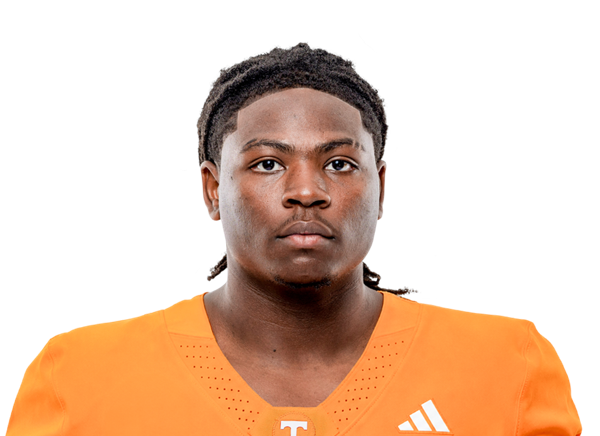

Nuk Simmons
Tennessee
Freshman
Bio
Recruiting
Scouting Report
Nic'Quayvion 'Big Nuk' Simmons is a 6-3, 305-pound interior defensive lineman who signed with Tennessee in the December 2025 Early Signing Period after a late-rising senior season at Columbus (Ga.) Carver. His 0.8722 composite and #1030 national ranking badly understate him — he played 8-man football as a freshman and sophomore, moved to the defensive line only afterward, and then posted 54 tackles with 30 tackles for loss and 7 sacks while transferring up from Class A Division II to a 13-0 Carver program. He was recruited specifically by Rodney Garner to play nose tackle and 2i, and he is a developmental body-and-technique project with a genuinely uncommon disruption baseline.
Physical Profile
At 6-3 and 305-310 pounds he is built exactly to the specification for a modern nose tackle rather than being a leftover from the tackle spot. The height is the asset most services undervalue: 6-3 lets him win the leverage battle against 6-4/6-5 SEC centers and guards without having to sink into an unnatural stance, and pad level is the single largest predictor of whether a nose holds up on double teams. The mass is currently carried in a thick, natural-strength distribution rather than a redistributed one — he has never been through a college strength program, so the 305 is raw farm weight, not built weight. That is a positive: there is real room for Tennessee to recompose him into 315-320 of functional mass without a conditioning penalty. Explosiveness off the snap is his standout physical trait, and he knows it — Tennessee's staff told him directly that what they liked was 'how I get off the ball.' For a nose prospect, first-step quickness is the trait that cannot be coached, and the two that can — hand technique and anchor strength — are the two he is missing.
Play Style
He plays as a penetrator first, not a two-gap space-eater, which is slightly at odds with the classic nose profile and is exactly what makes him interesting. On film he beats centers with timing off the snap and lateral quickness into the gap rather than with hand placement, then converts his first-step advantage into backfield contact before the blocker can recover. That approach is what generates 30 TFLs and it is also why he is a 3-star: it is a high-variance style that works overwhelmingly against high school interior blockers and needs technical support to work against SEC ones. He is disruptive rather than stout — the tape shows him making plays in the neighboring gap far more often than it shows him holding a double team and stacking. His forced fumbles suggest he plays through the ball-carrier rather than to him. The 8-man football background shows up as an athlete who moves better in space than a 305-pounder should and as a player whose stance, get-off, and hand usage are all still being installed.
Strengths
- Extraordinary disruption rate from an interior alignment: 30 tackles for loss and 7 sacks as a senior, with 26 of those TFLs coming in just the 10-game regular season. TFL production at that volume from a 305-pound nose is not a scheme artifact — interior linemen have to defeat a blocker and redirect to produce it, and it points to a get-off that beats the center's first punch consistently.
- Proven against a competition jump. He put up those numbers after transferring from Chattahoochee County in Class A Division II — where he was a Region 6 first-team selection as a junior — to Carver, a far larger and historically stronger Columbus program that went 13-0. Production that survives a two-classification jump is the most reliable signal on a late-rising prospect's profile.
- Motor and pursuit beyond the box score: 10 quarterback hurries plus 2 forced fumbles and a fumble recovery. The hurry total matters because it shows he is still working the pocket on plays where the initial rush is stalemated, which is the exact habit that separates rotational SEC noses from two-down bodies.
- Leverage-friendly frame at 6-3 with untrained mass, giving a college strength staff an unusually clean canvas — he has never had access to year-round college-level development, which means his current tape is close to a floor rather than a ceiling.
Areas to Improve
- Hand technique and pass-rush counters are the primary gap. With roughly two seasons of 11-man defensive line experience, the interior wins on his film are overwhelmingly first-step and raw-power wins rather than plan-based — no established swipe/rip sequencing, no consistent counter when the initial move is absorbed. Against SEC guards who can mirror and anchor, an athlete who only has a Plan A gets neutralized by the second quarter.
- Anchor and double-team discipline. His high school TFL volume came largely against single blocks from lesser interior linemen, and he was rarely asked to two-gap and hold a point on early downs. Nose tackle in a Rodney Garner front demands the ability to absorb a center-guard combination without giving ground and keep linebackers clean — that is a strength-program and film-room outcome, not a talent one, but it is the specific thing standing between him and a rotation.
- Snap-count conditioning and pad-level consistency across a full series. Carrying 305-310 of untrained mass through SEC tempo practices is a different physiological demand than a 10-game Georgia high school schedule, and his pad level tends to rise on his third and fourth consecutive snaps.
College Projection
A near-certain redshirt in 2026. He signed in December but did not early-enroll — he reported after May graduation, meaning he is going through his first college fall camp right now with no spring practice bank behind him, on top of only about two years of 11-man defensive line experience. The realistic path is a 2026 developmental year focused on body recomposition toward 315-320 and installing an actual hand-technique base under Rodney Garner, a 2027 push for rotational early-down nose and 2i snaps, and a legitimate starting-caliber ceiling by 2028-29 if the anchor develops. He should be evaluated on the 2027 and 2028 tape, not the 2026 depth chart. The bust risk is real and sits almost entirely in whether the technical development takes; the athletic and production baseline is not the concern.
Best Fit
He is already in close to the ideal situation, which is worth stating plainly rather than hedging. He needs (1) an elite interior defensive line developer, and Rodney Garner has been the most consistent producer of SEC interior linemen for two decades, and (2) a front that lets a penetrating nose slant and attack a gap on early downs rather than demanding pure two-gap read-and-react from day one, which is what Tennessee's 'nose and 2i' plan for him describes. A program that needed immediate snaps from him would waste him; a program with an established interior that can afford to redshirt and recompose him is the requirement, and Tennessee's 2026 class — 24-plus commits, top-10 nationally by Rivals — has the depth to allow exactly that. The wrong fit would be a G5 program needing him to start as a true freshman at 305 with no technical base, which would set his pad level and hand habits badly and permanently.