
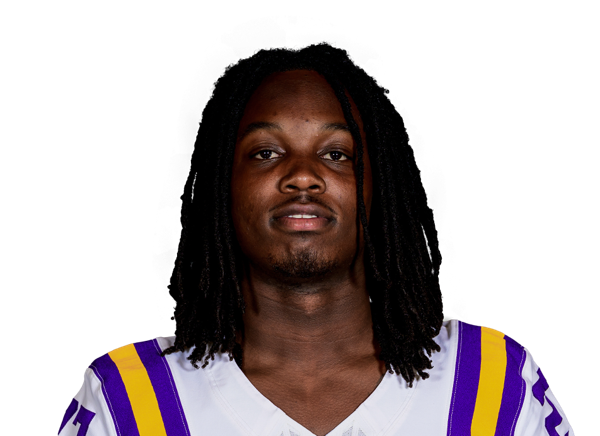
Dez Ellis
 LSU
Freshman
LSU
Freshman
Bio
Recruiting
Scouting Report
Dez Ellis is a 4-star Cornerback from Wisner, LA (Franklin Parish) in the 2026 class. Ranked No. 410 nationally. Composite rating: 0.8965. Committed to Louisiana State University since August 5, 2026.
Physical Profile
Listed at 6-2, 180 lbs. Taller than 78% and heavier than 61% of 2026 Cornerback prospects in the SEC Scouts database (204 with a listed size).
Play Style
On film he wins with athleticism rather than refinement. He is a loose-hipped, rangy mover who plays fast in space and shows natural hands and ball-tracking. In the secondary, he projects best facing the play in off-man or Cover 3/Cover 4 on the boundary, where his read of the quarterback and his closing burst can create interceptions. His length gives him a natural fit in press-bail, but his press-jam technique and physical play at the catch point are unproven given his high school role.
Strengths
- Length plus speed: a 6-2+ frame with reported 4.5 speed is the prototype LSU's Corey Raymond recruits for press-man on the boundary, and it gives him a high ceiling for contesting catches.
- Quarterback background: 2,184 passing yards, 31 TD and 7 INT as a junior, plus 827 rushing yards and 10 TD. Reading coverages from the pocket gives him an advanced feel for route concepts, QB eyes and throw timing that most converted athletes lack.
- Body control and ball skills: his gymnastic athleticism and a passer's feel for trajectory project well to tracking the deep ball and finishing at the catch point.
- Competitive make-up and production: first-team 4A All-State as the offensive centerpiece, and a program-first LSU commit. Power Five staffs valued his play at two positions, since West Virginia offered him as a QB.
Areas to Improve
- Technique at the position: he has limited full-time defensive reps, so press footwork, patience at the line, pedal-to-drive transitions and phase maintenance down the field all need to be built from the base up.
- Strength and physicality: at about 180 lbs, he must add mass to hold up against SEC receivers in press and to tackle on the perimeter. LSU's fall 2026 camp reports flagged physicality as his main development point.
- Discipline in zone: former QBs can over-read and jump routes. He will need to learn leverage rules and when to trust his eyes versus his technique.
College Projection
He is a developmental outside corner. The stored ranking (4★, #410, 0.8965) doesn't match any source we checked. At commit, 247 had him at Composite #547 / #12 in Louisiana, and Rivals had him at 4★ / #45 CB / #15 in Louisiana. Expect a 2026 role of special teams (coverage units, and possibly returns given his open-field skills) and depth snaps behind the established corners, alongside fellow freshmen such as Havon Finney. A redshirt-style year under the four-game rule is realistic. With a normal strength-program gain, he could enter the rotation in 2027 and compete for a starting boundary job in 2028. His rise depends almost entirely on how fast the technique arrives.
NFL Outlook
The traits (height, length, reported 4.5 speed, fluidity) match what NFL teams screen for at outside corner, so the ceiling is real. His draft stock depends entirely on college development. If he adds 15+ lbs and becomes a multi-year SEC starter with ball production, he fits the Day 2 long-corner mold. If the conversion stalls, he projects as a Day 3 or priority free agent special-teams and depth corner. It is too early for anything more specific than a developmental grade.
Best Fit
A program with an elite DB coach and patience for conversion projects. LSU with Corey Raymond, the coach who recruited him, is close to ideal. Schematically he fits best in a press-bail / quarters system on the boundary, where his length and QB feel for reading the passer turn into interceptions. A strong strength-and-conditioning pipeline to build his frame is also essential.
Player Comparison
Similar physical profile at 5'9" 190 lbs with elite athleticism and high football IQ that allowed positional versatility. Both were highly-rated Louisiana prospects who committed early to LSU based on raw talent and development potential rather than extensive film study, with coaching staffs projecting their athletic ability to translate across multiple defensive positions.
Current Team
Louisiana State University