
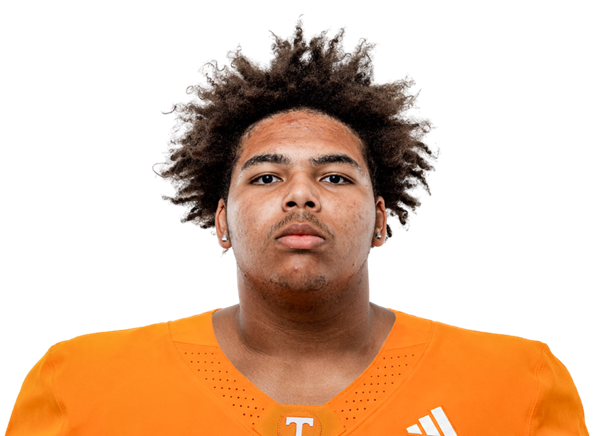

#63

Jeremy George-El

OL Tennessee Tennessee Freshman

Bio

Height 6'4"
Weight 325 lbs
Hometown Knoxville, TN
High School Knoxville Catholic
Rating ⭐⭐⭐

Recruiting

⭐⭐⭐ Class of 2026
#1336 National
0.8650 Rating

Scouting Report

B+
87 / 100 Ceiling 87 • Floor 75
project

Jeremy George-El is a 6-foot-4, 325-pound interior offensive lineman from Knoxville Catholic who signed with hometown Tennessee in the February 2026 late period after the Vols converted a fall preferred-walk-on offer into a scholarship on January 17. A Quebec native who did not play American football until relocating to Tennessee before his junior year, he carries a 0.865 composite (three stars, No. 75 IOL nationally, No. 31 in Tennessee) that reflects a low-rep, high-frame developmental profile rather than a finished product. He is a mass-and-movement bet by Glen Elarbee on a player whose ceiling is largely untested because his football odometer reads roughly three seasons.

Physical Profile

The frame is legitimately SEC-caliber and is the entire basis of the evaluation: 6-4, 325 with the width through the hips and chest that interior play demands, and he arrived at Tennessee already trimmed to a listed 310 — meaningful, because it signals the weight is redistributable rather than fixed. Height is a genuine asset at guard, where 6-4 keeps him under 3-techniques' hands instead of fighting the leverage battle 6-6 tackle converts lose inside. The track numbers (40-11 shot put, 105-8 discus as a junior) are the most useful athletic data available on him and they read as functional, not elite: the shot put mark indicates real hip-and-torso rotational power and lower-body drive, while the modest discus number suggests his explosiveness is more grinding than whippy. Nothing in his profile points to the lateral range needed to survive on an island, which is precisely why every service projects him inside.

Play Style

A phone-booth, drive-block interior player whose value shows up on the first two steps and in the double-team. He wins with mass and hip torque on down blocks and gap-scheme pulls of short distance, and he is a natural fit as the post man on a combination block, where he can occupy a nose and let the tackle climb. The all-state nod against Division II-AAA competition indicates he was consistently the more physical player rather than a boom-or-bust one. In protection he is a stationary anchor more than a mirror-and-slide pass protector at this stage — he sets, absorbs, and holds, which works against high school edge pressure but leaves him vulnerable to interior counters and inside moves until his hands and feet get coached up. Bluntly, the film is a size-and-strength film, not a technique film, and the honest read is that his floor and his ceiling are separated by how fast Elarbee can install the details.

Strengths

  • Play-strength at the point of attack, corroborated by a 40-11 shot put — he generates displacement through the hips rather than falling on defenders, and at 325 he simply cannot be bull-rushed backward by high school interior linemen.
  • Legitimate on-field production against real competition: TFCA Division II-AAA all-state selection as a 2025 senior and team lead in pancakes (eight), earned in Tennessee's toughest private-school classification — the honor validates that the size translated to finishing, not just occupying space.
  • Steep, still-climbing development curve. He went from Dalbé-Viau in Quebec as a sophomore to The Webb School as a junior to an all-state senior season at Knoxville Catholic in roughly 24 months. Three years of American football producing an SEC scholarship is a slope, not a plateau.
  • Proven adaptability off the field — two program changes and a country change in three years, with performance improving at each stop. That is a real, if unglamorous, indicator for a player who will need to absorb a complex protection install.

Areas to Improve

  • Technical refinement across the board — hand placement, timing of the punch, and the pass-set footwork that only comes from rep volume. He has had fewer coached snaps than nearly anyone in this signing class, and the gap between his physical readiness and his technical readiness is the single largest variable in his projection.
  • Pad level and knee bend at his listed height and mass. Large-framed linemen with limited reps default to catching and waist-bending against SEC interior pressure; sustaining a 310-320 playing weight without losing ankle flexion is the conditioning priority.
  • Recognition and communication in protection — line calls, twist and stunt passing, identifying the Mike. This is the phase where a late-start lineman is most exposed, and it cannot be accelerated by weight-room work.
  • Finishing volume. Eight pancakes led his team, but that is a modest raw number for a 325-pounder against high school defensive fronts, and it hints at a player who wins the initial collision but does not consistently carry blocks through the whistle.

College Projection

A redshirt in 2026 is close to a certainty, and it is the correct outcome rather than a disappointment — he entered fall camp buried on the interior depth chart behind established scholarship bodies and transfer additions, in a reserve role. Realistic timeline: year one is body composition and technique remediation, year two is a special-teams and scout-team-standout role with spot interior snaps, and the meaningful competition window opens in years three and four at guard, with center a plausible cross-train if his snap consistency and line-call processing come along. He is best evaluated as a 2028-2029 contributor. The comparison point is not the four-star who plays as a true freshman — it is the developmental interior signee who becomes a dependable multi-year starter in his fourth year, which is a very real and very valuable outcome for a program. The main risk is not bust potential but stagnation: if the technique does not catch the frame by the end of year two, he settles in as a depth piece.

Best Fit

He is already in close to an ideal situation. A gap- and duo-heavy run scheme that asks its interior linemen to double-team, displace, and short-pull suits him far better than a wide-zone outfit that demands lateral range and reach blocks — and Tennessee's offense gives him enough downhill and gap concepts to play to the strength. Just as important is the coaching infrastructure: a late-start prospect with this much raw material needs a program with a track record of interior-line development and a staff patient enough to redshirt and build, not one that needs snaps from him in year one. Playing 15 minutes from home, alongside prep teammate Tyreek King, removes the transition friction that has historically hurt international and late-conversion linemen. If he had signed somewhere with immediate depth-chart need, the pressure to play him early would likely have capped his development.