
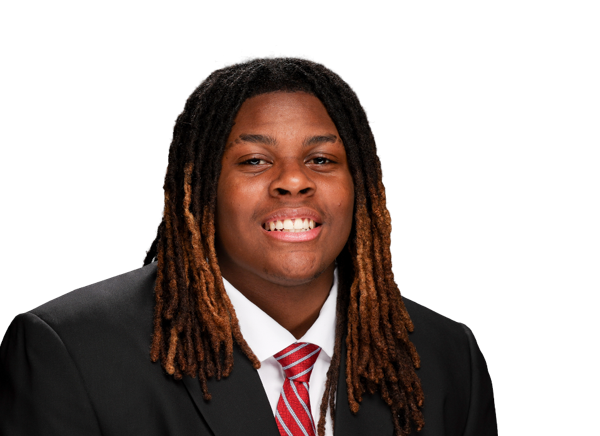
Mhari Johnson
 Alabama
Freshman
Alabama
Freshman
Bio
Recruiting
Scouting Report
Mhari Johnson is a 4-star Edge Rusher from Muscle Shoals, AL (Muscle Shoals) in the 2026 class. Ranked No. 278 nationally. Composite rating: 0.9089. Committed to University of Alabama since July 26, 2026.
Physical Profile
Listed at 6-3, 290 lbs. Taller than 21% and heavier than 100% of 2026 Edge Rusher prospects in the SEC Scouts database (169 with a listed size).
Play Style
Johnson plays downhill and physically, as a first-contact defender. He's at his best attacking a gap, getting under the blocker's pads and pushing him back into the backfield rather than trying to run around him. Against the run he squeezes blocks and holds his gap well, and his tackle totals show he chases plays down the line. As a rusher he wins mostly with effort and power, closing on the quarterback after the first move, and he's alert to getting his hands into passing lanes when the rush stalls. BamaHammer called him 'unstoppable at the line of scrimmage' during his senior season. That's fair against 6A competition, but the film shows more power than bend.
Strengths
- Inside-out versatility: he's played both on the edge and inside at Muscle Shoals, which lets a college staff move him around by down and distance and gives him more ways to get on the field early.
- He makes plays beyond sacks. As a sophomore in 2023 he had 54 solo tackles, 9 TFL and 3 PBU, and in October 2025 he had 2 sacks, 1 FF, 2 PBU and 3 hurries over back-to-back games against Athens and Jasper. That shows he gets into the backfield and gets his hands up when he can't get home.
- He's produced against good competition over time: 2024 ASWA Class 6A all-state, then a key piece of a Muscle Shoals team that reached the state semifinals in 2025.
- Low center of gravity and a heavy lower body let him hold the point against double teams and set a hard edge in the run game. That's the trait most likely to get him snaps early at Alabama.
Areas to Improve
- His pass rush is still developing. He had only 2 sacks in 2023, and his rush relies on power more than a planned set of moves. He needs a go-to counter, like a long-arm to swipe or a push-pull, to win consistently as a rusher at the SEC level.
- The weight gain has to be good weight. Going from about 265 to 290 has to keep his first-step quickness and change of direction. If it costs him his get-off, he becomes a pure interior run-stopper and loses the versatility that drives his value.
- His length is only average, so he'll need precise hand placement and a strong first strike to keep longer SEC tackles from locking him up. Using his leverage and hand fighting will matter more for him than for a 6-5 prototype.
College Projection
Year 1 (2026): rotational depth and probably a redshirt-type season, working at the big end/4i spot while he adapts to college strength training and learns Freddie Roach's defensive line techniques. Years 2–3: if the 290-pound frame holds his quickness, he projects as a rotational run-down end who shifts inside on passing downs, a 20–30 snap-per-game player in a deep Alabama DL room. Years 3–4: a realistic ceiling is a starting strong-side end or 3-technique who produces steady TFLs rather than double-digit sacks.
NFL Outlook
He's a 4-star in the #275–#360 national range with inside-out flexibility, so his NFL path is as a versatile, run-first defensive lineman, not a premium edge rusher. If he settles in the 290–300 range and develops a reliable pass-rush plan, he fits the day-3 profile of a 4-3 base end or 3-4 5-technique who can slide inside on passing downs. His lack of elite length limits how high he could be drafted as an edge. How well he develops an interior pass rush will decide whether he becomes a draftable prospect or a strong college starter.
Best Fit
A multiple or odd-front scheme that values two-gap strength and versatility along the line, which is exactly what Alabama runs. He's most valuable to a program that uses him as a heavy strong-side end on early downs and moves him to a 3-technique in pass-rush packages. That lets his leverage and motor show while hiding his average length on the edge.
Current Team
University of Alabama