
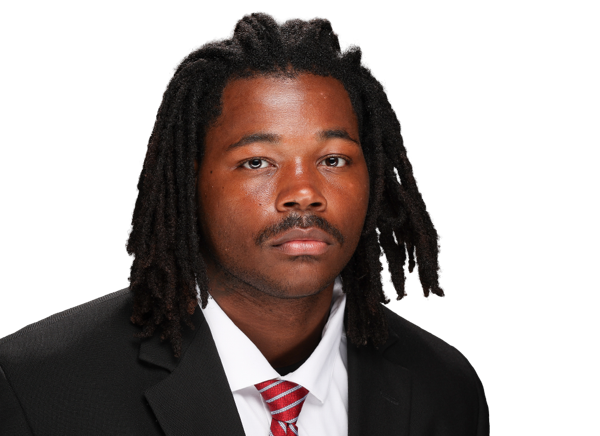

Jared Graham
Alabama
Freshman
Bio
Recruiting
Scouting Report
Jared Graham — who recruited as Jared Doughty before a legal name change — is a 6-foot-5½, 300-pound offensive tackle from Atlanta's Banneker High School who committed to Alabama on Oct. 5, 2025 and shut his recruitment down immediately, choosing the Crimson Tide over Georgia, Ohio State, Auburn, Missouri and Florida State. He is a late-blooming riser: a three-star (Rivals' No. 35 OT) on commitment day who climbed to a composite four-star (0.9296, roughly No. 28 among tackles and No. 24 in Georgia) on the strength of his senior tape. He arrived in Tuscaloosa as a summer enrollee rather than an early enrollee, which is the single biggest factor shaping his 2026 outlook.
Physical Profile
The frame is the headline trait and it is a genuine left-tackle body: 6-5½ to 6-6 with legitimate length, listed at 300 pounds with no bad weight on him and clear room to carry 315-320 without losing movement. Evaluators consistently flag him as unusually agile for the size — he has looked the part of a college tackle for several years, which for a Georgia public-school prospect usually means multiple seasons of being the biggest, most athletic body on the field. He self-scouts as scheme-flexible ('athletic enough to play all five positions') and took snaps at center as a senior, which is a real data point about his body control and football IQ, not just recruiting bravado. The caveat is that 300 pounds on a 6-6 frame at 18 is a developmental number, not a finished one; he needs SEC mass through the hips and lower half before he can anchor against Power Four interior length.
Play Style
He plays like an oversized athlete who has not yet been asked to be a technician. On tape he's a length-and-reach blocker in the run game — quick off the ball, comfortable working in space, effective on reach and combo blocks where his agility lets him get a hip across the defender's face rather than having to root him out with power. In pass protection he's a catcher more than a striker: he uses his arm length to keep rushers off his frame and relies on recovery athleticism when his initial set is late. That works against high school edges and will not against SEC ones until his sets shorten and his hands arrive first. He is not a mauler or a finisher yet — the nasty streak and the ability to displace bodies at the point of attack are still developing, which is typical for a player this recently added to his frame. The center experience shows up as clean footwork on the move and above-average processing of stunts and games for a high schooler.
Strengths
- Elite positional frame with length to spare — 6-5½/6-6, 300 pounds with clean weight distribution and the skeleton to add 15-20 pounds of functional mass without compromising the foot quickness that got him ranked
- Rare movement skill for the size, corroborated by his senior year at center: the ability to snap and immediately fit a moving target is a body-control test most 300-pound high school tackles would fail, and it projects to reach blocks, second-level climbs and pulls in a zone or gap-mixed run scheme
- Legitimate positional versatility with a pure-tackle floor — evaluators grade him as a 'pure tackle prospect with good film' rather than a guard-in-waiting, which means his best position is also the most valuable one on the line; the center reps are bonus emergency depth, not a projection
- Recruiting-market validation from the toughest evaluators in the country: Georgia, Ohio State, Auburn, Missouri and Florida State all offered, and he rose a full star tier from commitment (October 2025) to signing — an arrow-up trajectory tied to on-field improvement, not camp-circuit hype
Areas to Improve
- Footwork and pass-set mechanics are the explicit development item in every evaluation — his kick-slide depth and hand timing were built against Georgia Class 5A edge rushers and will need full rebuilding to hold up against SEC speed off the edge; expect a pronounced tempo gap early
- Play strength and anchor: he wins high school reps on length and athleticism before contact, which masks whether he can absorb and reset a bull rush. At his current 300 pounds he needs a full offseason of lower-body strength work before he can be trusted one-on-one on obvious passing downs
- Developmental calendar — this is the real limiter, not a physical trait. He skipped spring practice as a summer enrollee, meaning he lost roughly 15 practices, a spring game and a full strength cycle relative to early-enrolling classmates. Alabama's own beat evaluation is blunt: he 'will find getting reps to be difficult' this fall
- Coaching continuity risk: his lead recruiter and position coach, Chris Kapilovic, was fired and replaced by Adrian Klemm. Graham has to re-earn evaluation from a coach with no investment in his recruitment and a different technical system
College Projection
Redshirt in 2026 is the overwhelmingly likely and correct outcome. Alabama's projected line — Lloyd at left tackle, Sanders at left guard, Delgatty at center, Carroll at right guard, James at right tackle — is set, with Waldrep, Brooks, Strayhorn and a deep reserve group ahead of him, and he's currently taking developmental reps rather than competing for a two-deep spot. Realistic timeline: burn the redshirt year on a strength cycle to 315-plus and a technical rebuild under Klemm; compete for swing-tackle/two-deep status in 2027; first legitimate starting window in 2028 as a redshirt sophomore, most plausibly at right tackle, where evaluators have projected him from the start. If the mass comes on faster than the footwork, an interior kick to guard is the fallback path to the field — but his tackle traits are good enough that Alabama should resist that move for at least two years. Nothing about this projection is a knock; it's the standard arc for a summer-enrollee tackle at a program with an established line.
NFL Outlook
Draftable traits, undraftable resume so far — the profile is a Day 2/Day 3 developmental tackle if the arc holds. The things NFL teams cannot coach he already owns: 6-6, near-33-inch-type length, 300 pounds of clean weight and better-than-expected feet, plus the positional flex to fall back to guard or emergency center. The things that determine whether he's drafted at all — anchor strength, pass-set consistency, hand placement, and 25-plus career starts against SEC edges — are entirely unwritten. His star-rise from three to four during his senior year is the encouraging signal, because late risers who improve on tape rather than at camps tend to keep improving in college strength programs. The bear case is that he tops out as a good SEC swing tackle and a priority free agent. Best-case, if he adds mass without losing the agility, he's a fourth- or fifth-year right tackle prospect in the Day 2 conversation. Too early to project higher, and he needs to hold the tackle spot to hold that value.
Best Fit
Alabama is a defensible fit, though not a frictionless one. Ideal scheme is a wide-zone or zone-heavy run system with movement responsibilities — reach blocks, backside cutoffs and climbs to linebackers — where his agility is the featured trait and his not-yet-developed point-of-attack power isn't the whole job. He is a poor early fit for a downhill gap/duo scheme that asks the tackle to displace a 300-pound five-technique on every snap. The bigger fit variable is developmental: he needs a program with an offensive line room deep enough to let him redshirt without pressure, a strength staff that can add 15-20 pounds without costing him foot speed, and a position coach willing to rebuild his pass set from the ground up. Alabama supplies the first two comfortably; the third now runs through Adrian Klemm rather than the coach who recruited him, which is the one genuine variable in an otherwise sound landing spot.