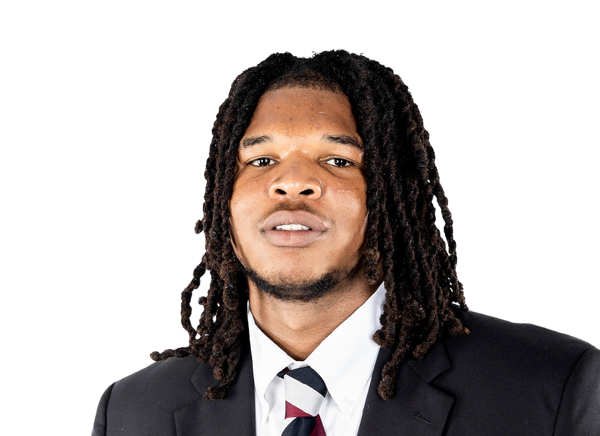
Caleb Williams
South Carolina
Freshman
Bio
Recruiting
Scouting Report
Caleb Williams is a high-three-star interior defensive lineman from Matoaca High School (Chesterfield, VA) who committed to South Carolina on April 21, 2024 and signed with the 2025 class — not, as the record states, a prospect from Specially Fit Academy, which belongs to an unrelated 2026 basketball recruit of the same name. At 6-5, 290 with a legitimate 15-plus-offer recruitment (Penn State, Virginia Tech, Maryland, Virginia, Syracuse, JMU), he graded out as a developmental power-position defensive tackle with a plus first-step punch and rare length for the interior. His 0.8822 composite (#601 national, DL #38, VA #14, No. 58 DT in the On3 industry) understates the frame; his senior tape and a broken left tibia in October 2025 are the two reasons his stock and his college clock both stalled.
Physical Profile
6-5 to 6-6 and 250-290 across his recruitment, now 287 at South Carolina — a frame that grew roughly 40 pounds between his junior evaluation and college arrival without visible loss of change-of-direction. That growth curve is the whole evaluation: he was recruited as a long, light interior player who could be built into a 3-technique, not as a finished nose tackle. The height is a double-edged trait inside — it gives him the arm length to shed and to bat balls, but it means his natural pad level starts above the offensive lineman's, so his leverage has to be manufactured with knee bend rather than inherited from his build. He is a four-year varsity player and a basketball player, and the hips and footwork show it; the medical file now includes a surgically repaired left tibia (October 2025) that must be treated as a live variable in any projection.
Play Style
A gap-penetrating interior defender who plays through the offensive lineman rather than around him. He fires off with a strong initial punch, extends to lock out and create separation, and reads the play from a stacked position before shedding to the ball — a high-effort, high-motor two-gap style that produced elite tackle-for-loss volume at the high school level. He is not yet a bender or a hand-fighter; his wins come from the first strike, from run-down pursuit, and from getting his hands into throwing lanes when the rush stalls. Against Class 5 competition he was frequently unblockable one-on-one, which is exactly why the senior-year sack drop reads as scheme attention rather than regression.
Strengths
- Initial punch and get-off. Evaluators consistently flagged a good initial punch at the snap that walks offensive linemen backward while he keeps his eyes in the backfield — a two-gap trait, not just a bull rush, and the reason he was a run-defense projection first.
- Length converted into pass deflections. He has a documented knack for knocking passes down at the line of scrimmage, a direct transfer from his basketball background. For an interior player who was not going to win as a bender early, the ability to affect throwing lanes is real snap-count value.
- Junior-year production at volume. As a 2023 junior he posted 95 tackles, 25.0 TFL and 15.0 sacks and earned All-State and All-Metro Defensive Player of the Year honors — that is not a projection-only recruit; he was the disruptive centerpiece of a Class 5 defense.
- Sustained four-year growth arc. 20 tackles / 5 sacks as a freshman, 50 / 12 TFL / 8 sacks as a sophomore, then the junior explosion. The trajectory shows a player who improved every offseason rather than one who peaked on an early camp circuit.
Areas to Improve
- Pad level and hand refinement. At 6-5-plus he loses the leverage battle against low, wide interior blockers when the punch does not land clean; he needs a counter-move inventory (swim, long-arm to rip) so the rush does not stall into a push when his first move is matched.
- Pass-rush conversion. Length and athleticism were graded as pass-rush *potential*, not production. Fifteen high school sacks came largely from disruption and effort; against SEC guards he has to develop a plan to win in under two seconds.
- The senior-year drop and the medical. His 2024 senior line was 58 tackles, 11.0 TFL and 3.0 sacks in eight games — a sharp fall from 15 sacks, in fewer games, that is not fully explained in public reporting (attention/double-teams and missed time are the likely causes, but this is unresolved). Layer on the October 2025 broken tibia and season-ending surgery, and the honest read is that he has not played a full, healthy, evaluable season since 2023.
- Anchor at SEC weight. He arrived light for a true interior player and has been adding mass since. Holding the point against 320-pound doubles is the specific strength-program milestone that gates his first meaningful snaps.
College Projection
This is now partially observable rather than projected. He enrolled at South Carolina in January 2025, missed spring drills injured, spent the fall on the scout team, broke his left tibia in October and redshirted with zero game action. He enters 2026 as a redshirt freshman at 6-5, 287 with four years of eligibility, an SEC Fall Academic Honor Roll citation and a sports media major. The original projection — a two-to-three-year developmental interior lineman who competes for rotational snaps behind veterans like Monkell Goodwine and Nick Barrett — is intact but pushed back a full year by the injury. Realistic path: rotational run-down 3-technique in 2026-27 if the leg holds, with starter-caliber upside by his redshirt-sophomore or junior year contingent on pass-rush development.
Best Fit
A four-down, gap-and-a-half front that lets a long defensive tackle two-gap on early downs and slide to a 3-technique on passing downs — precisely the multiple front South Carolina runs, so the fit was correct at commitment. He needs a program with a mature strength-and-conditioning operation (he was a 40-pound-projection body at signing) and, critically, a defensive line coach who teaches hand technique and pad level as curriculum rather than assuming it. He is the wrong fit for a system asking a defensive tackle to two-gap a nose full-time at 300-plus pounds, and the wrong fit for a program that needs immediate freshman production. Given the surgical repair, a place with patience and a deep interior rotation is the single biggest determinant of whether the junior-year tape ever shows up again.