
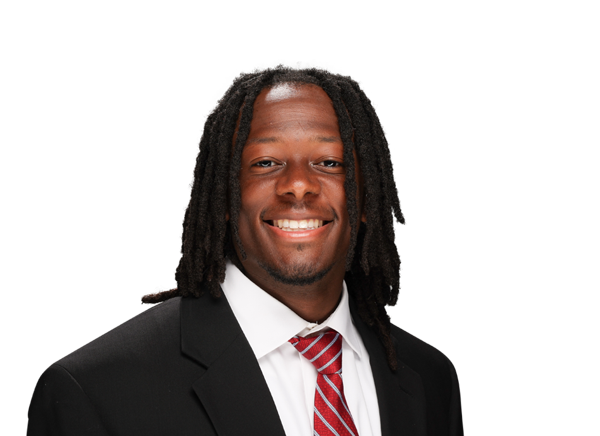

Amari Sabb
Alabama
Freshman
Bio
Recruiting
Scouting Report
Amari Sabb is a 5-foot-9, 155-pound slot receiver/athlete from Glassboro (N.J.) who signed with Alabama on February National Signing Day 2026 as the 26th and final commitment in the Tide's No. 2-ranked class. A two-time Group 1 state champion and Army All-American selection, he finished his career with 5,135 all-purpose yards, 61 touchdowns, 96 tackles and 14 interceptions as a genuine two-way weapon. The composite grade (.8578, mid-three-star, roughly top-65 among athletes nationally and top-20 in New Jersey) reflects a legitimate high-major skill player whose frame — not his production or his football character — is the thing holding the ranking down.
Physical Profile
Sabb is listed at 5-9, 155 on Alabama's July 2026 summer-enrollee measurements, down from the 165-180 range circulated during his recruitment; that is the smallest frame in the signing class and the single defining variable in his projection. What the frame gives him is rare short-area burst and change of direction — he wins with a low center of gravity, immediate acceleration out of breaks, and the balance to run through arm tackles that a bigger back absorbs standing up. The athletic testing supports real explosiveness rather than just quickness: a 6-foot-4 indoor high jump as a junior (verified, and consistent with the reported 39-inch vertical) is elite lower-body pop for his size, and he ran 6.93 in the indoor 55 and 23.28 in the outdoor 200. Note the reported 4.4 forty is program/recruiting-service sourced, not verified — his 11.25 100-meter PR is good speed for a two-sport athlete but not track-star long speed, so evaluate him as a sudden, twitchy sub-4.5-to-the-first-15-yards athlete rather than a pure vertical burner. The playing weight is the priority: at 155 he cannot yet survive interior alignment against SEC nickels and safeties, and adding 15-20 pounds without losing the burst is the entire developmental question.
Play Style
A gadget-forward slot and designed-touch weapon. Glassboro used him as the offense's engine rather than as a route runner: jet motion, sweeps, tunnel and bubble screens, and the occasional shot down the seam or on a fade, and the film reflects that — quick burst, exceptional weave through traffic, comfort making the first man miss in a phone booth, but a thin catalogue of true receiver reps. He is more comfortable as a ball carrier than as a hands-catcher working a full field read at this stage. On defense he played nickel with genuine ball skills and was a willing tackler despite the size. The overall picture is a high-motor, high-touch playmaker who was too good for his classification and got the ball however his staff could deliver it.
Strengths
- Elite yards-after-catch and ball-in-hands creativity — 916 receiving yards on 53 catches (17.3 per reception) as a senior plus 823 rushing yards on just 65 carries (12.7 per carry) is a manufactured-touch profile that produced explosive plays on both jet/sweep action and quick game; he weaves through congested space and rarely takes a clean first hit.
- Verified explosive-athlete traits: 6-4 high jump and reported 39-inch vertical at 5-9, with the short-area burst to threaten leverage immediately off the snap. That combination shows up as separation in the first three steps and as a bigger catch radius than his height suggests.
- Proven high-leverage production and football IQ from two-way duty — 14 career interceptions and 96 tackles at nickel, plus a Group 1 title-game line of 78 rushing yards, 86 receiving yards, two touchdowns, an interception and a forced fumble. Defensive reps show he understands route spacing and coverage rotations from the other side, and he tracks the deep ball naturally (also a kick-return touchdown as a junior).
- Winning pedigree and program fit — two state championships, an Army All-American selection from a pool of 85, and an offer sheet that included Georgia, Ohio State, Michigan, Penn State, Oklahoma, Oregon and Rutgers before he chose Alabama, where his brother Keon starts at safety.
Areas to Improve
- Route-tree development is the gating item. His high school usage was overwhelmingly screens, jet sweeps, and vertical/fade releases; he has limited film running option routes, whip/pivot concepts, or the leverage-based stem work a college slot lives on. He has to learn to threaten a defender's leverage before breaking rather than relying on pure athleticism to win late.
- Playing weight and contact durability. At 155 pounds he will not hold up to SEC press coverage, physical nickel jams, or the collision volume of inside alignment. He needs a full offseason of strength and mass work — realistically 170-175 as a functional target — before he can be trusted on early downs.
- Release package against press. He beat off-coverage and soft cushions at the Group 1 level; against defenders who can legally reroute a 155-pound receiver at the line, he currently lacks the hand technique and the strength to defeat contact and stay on schedule.
- He arrived as a summer enrollee after graduating in the summer rather than enrolling in January, so he missed spring practice and installation — a real developmental cost for a player whose primary need is technique refinement.
College Projection
Redshirt candidate in 2026. Alabama's receiver room has a strong established top five with thin depth behind it, which is precisely why the staff wanted bodies in before fall camp — but that depth need argues for scout-team and special-teams development, not early snaps at 155 pounds. Realistic path: a redshirt year devoted to mass and route technique, a 2027 season as a situational slot with 8-15 manufactured touches (jet sweep, tunnel screen, motion) and a look at punt/kick return, then a chance to compete for real slot volume as a redshirt sophomore or junior if he gets to the 170-plus range with a functional route tree. Return duty is the most likely early path to the field; the traits — burst, vision, balance, a high school kick-return touchdown — fit. The floor is a rotational gadget/special-teams contributor; the ceiling is a 60-catch SEC slot if the body and the technique both come along.
Best Fit
A spread offense that manufactures touches and is willing to scheme space rather than ask him to win contested reps outside — heavy pre-snap motion, jet and orbit action, tunnel and slip screens, RPO flat routes, and mesh/option concepts that let him work in the middle of the field against zone. He needs a staff with a genuine strength-and-conditioning plan for undersized receivers and a receivers coach who will rebuild his route tree from the ground up, because the athletic ingredients are real and the technical base is not. Alabama fits the developmental infrastructure and the family situation; whether it fits the depth-chart timeline is the open question, since a Group of Five or lower-tier Power Four program would have handed him 40 touches as a true freshman.